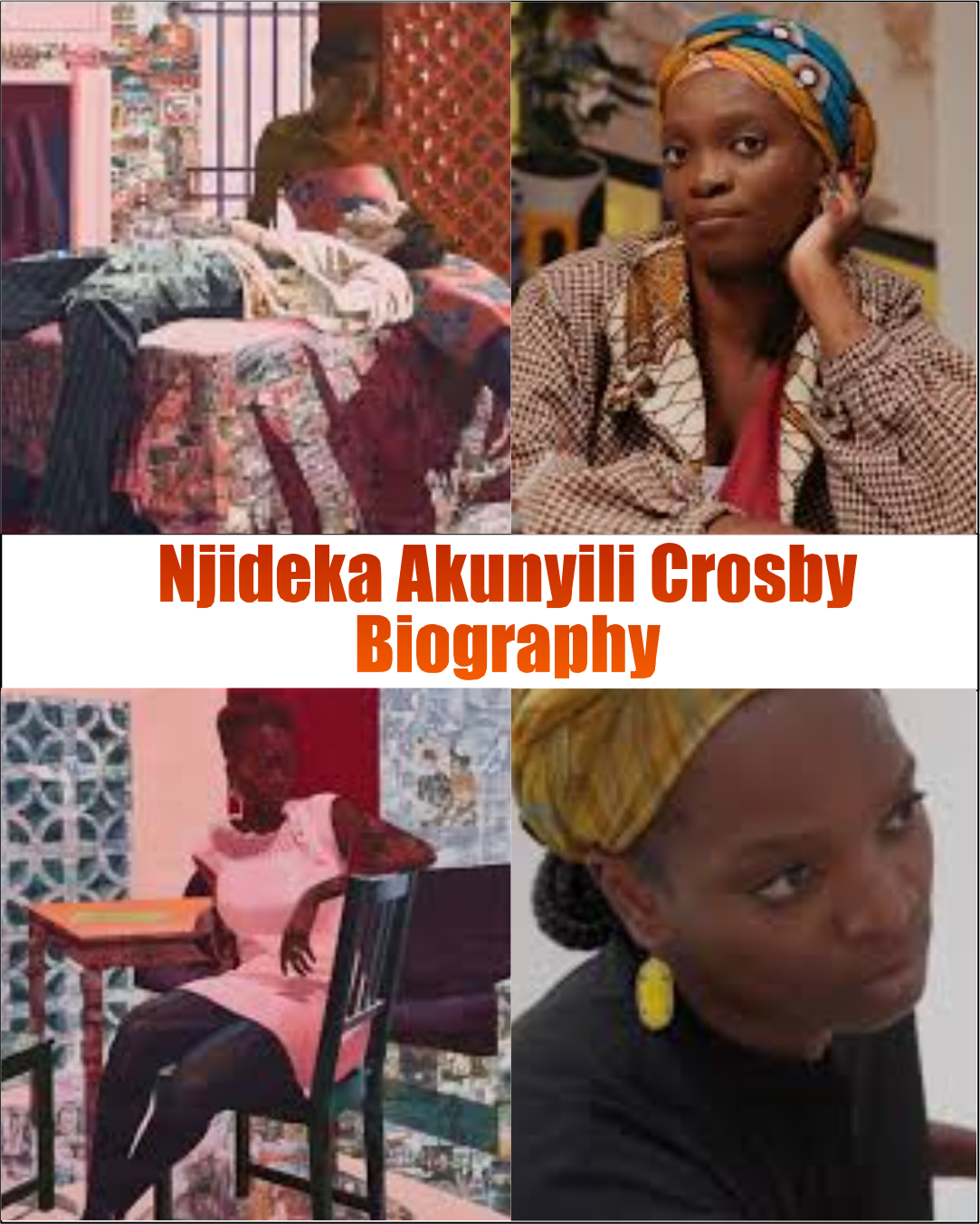
Njideka Akunyili Crosby Biography
The Njideka Akunyili Crosby Biography: Painting Identity Between Two Worlds
Discover the life of Njideka Akunyili Crosby, the Nigerian artist whose deeply layered paintings explore identity, migration, and memory across cultures.
The Artist Who Painted What It Feels Like to Belong—and Not Belong
There are artists who paint what they see.
Others paint what they remember.
Njideka Akunyili Crosby paints something more complex—what it feels like to exist between worlds.
Not fully here.
Not entirely there.
Her work does not shout.
It sits quietly, layered with fragments of memory, culture, and identity—inviting the viewer to look closer, to notice what is hidden beneath the surface.
Because nothing in her paintings exists in a single dimension.
Njideka Akunyili Crosby Biography
| Information | Details |
|---|---|
| Full Name | Njideka Akunyili Crosby |
| Date of Birth | 1983 |
| Age | ~43 years (as of 2026) |
| Place of Birth | Enugu, Nigeria |
| Nationality | Nigerian-American |
| Occupation | Painter, Visual Artist |
| Education | Yale School of Art (MFA) |
| Known For | Mixed-media paintings blending Nigerian and Western cultures |
| Family Background | Daughter of Dora Akunyili |
A Life That Crossed Continents
Njideka Akunyili Crosby was born in 1983 in Enugu, Nigeria, into a family where education and public service were deeply valued. Her mother, Dora Akunyili, was a prominent figure in Nigeria’s public health sector.
Her early life was rooted in Nigerian culture—language, environment, daily rhythm.
Then, at the age of sixteen, she moved to the United States.
The shift was immediate.
And permanent.
She was no longer fully Nigerian in the same way.
But she was not yet American either.
This in-between space would later define her work.
From Science to Art
Interestingly, Crosby did not begin with art.
She initially studied biology, following a path that seemed structured and predictable.
But something was missing.
The precision of science did not allow for the kind of expression she was searching for.
So she changed direction.
She moved into art, eventually studying at the Pennsylvania Academy of the Fine Arts and later at Yale School of Art.
This transition was not just academic.
It was personal.
A Signature Technique Built on Layers
What sets Crosby’s work apart is her technique.
At first glance, her paintings appear realistic—intimate domestic scenes, often featuring figures in quiet, everyday moments.
But look closer.
The surfaces are not painted alone.
They are built.
She combines:
- Acrylic and oil painting
- Photo transfers
- Collaged imagery from Nigerian magazines and family archives
These photographic fragments are embedded into the canvas, forming backgrounds that are dense with cultural references.
This layering becomes her signature.
Most Famous Works That Redefined Contemporary Portraiture
Some of Crosby’s most recognized works include:
- Drown
- The Beautyful Ones
- I Still Face You
These paintings often depict interiors—rooms, furniture, personal spaces.
But within those spaces, there are multiple narratives unfolding.
The figures are present.
The past is present.
The culture is present.
All at once.
Inspiration Drawn from Memory and Migration
Crosby’s inspiration is deeply personal.
Her work draws from:
- Her Nigerian upbringing
- Her experience in the United States
- Family photographs
- Cultural artifacts
She often references everyday life—conversations, relationships, domestic routines.
But within these moments lies something deeper.
A negotiation of identity.
Hidden Meanings Beneath Familiar Scenes
At first glance, her paintings feel calm.
Almost still.
But beneath that calm is complexity.
The collaged backgrounds often include:
- Nigerian pop culture imagery
- Political references
- Historical fragments
These details are not always immediately visible.
They require attention.
And when noticed, they shift the meaning of the entire piece.
A simple room becomes a layered narrative.
A quiet moment becomes a cultural intersection.
See also: Mulatu Astatke Biography: The Visionary Who Invented Ethio-Jazz and Waited Decades to Be Heard
The Struggle of In-Between Identity
Crosby’s journey has not been defined by rejection in the traditional sense.
But it has been shaped by something equally challenging.
Displacement.
Living between cultures means constantly negotiating identity—deciding what to hold onto, what to adapt, what to question.
Her work reflects this tension.
It does not resolve it.
It sits within it.
Redefining Contemporary African Art
Crosby is part of a generation of African artists redefining how African identity is represented globally.
Her work challenges expectations.
It is not overtly political.
Not overtly traditional.
Not easily categorized.
And that is precisely its strength.
She expands the narrative—showing that African identity is not singular, but layered and evolving.
Controversy and Conversation
As Crosby’s work gained attention, it also entered broader conversations about representation.
Some critics question how African artists in the diaspora are framed—whether their work is interpreted through Western lenses rather than on its own terms.
Others debate the commercialization of identity-based art.
These discussions are complex.
And Crosby’s work sits at the center of them.
Recognition on a Global Scale
Crosby’s rise in the art world has been significant.
Her works have been exhibited in major institutions and galleries worldwide.
She has received prestigious awards, including the MacArthur Fellowship—often referred to as the “Genius Grant.”
Collectors quickly recognized her value.
Her paintings began appearing in major collections, both public and private.
The Value of Her Artworks
Crosby’s works are among the most sought-after in contemporary art.
Paintings that once sold for modest amounts now fetch millions at auction.
This rapid increase reflects both demand and recognition.
But it also raises questions about access—who gets to own these narratives once they enter the global market.
A Legacy Still Being Written
Unlike many artists whose legacies are viewed in retrospect, Crosby is still in the middle of hers.
Her work continues to evolve.
Her themes continue to deepen.
She remains active, present, and engaged with the questions that define her art.
The Quiet Power of Her Work
There is no spectacle in Crosby’s paintings.
No dramatic gestures.
Instead, there is stillness.
And within that stillness, there is complexity.
Her work does not demand attention.
It holds it.
Closing Reflection
Some artists paint what is visible.
Njideka Akunyili Crosby paints what is felt.
The tension of belonging.
The weight of memory.
The quiet negotiation of identity.
She does not offer answers.
She offers perspective.
And in doing so, she creates something deeply resonant.
Not just images.
But experiences.
Frequently Asked Questions
1. Who is Njideka Akunyili Crosby?
Njideka Akunyili Crosby is a Nigerian-American visual artist known for her richly layered paintings that explore identity, migration, and cultural hybridity.
2. Why is Njideka Akunyili Crosby famous?
She gained international recognition for her mixed-media technique, combining painting, collage, and photo transfers to tell deeply personal and cultural stories.
3. What themes does her art explore?
Her work focuses on diaspora experiences, family life, cultural identity, and the blending of Nigerian and Western influences.
4. Has Njideka Akunyili Crosby won any major awards?
Yes — she received global acclaim and prestigious recognitions, including the MacArthur “Genius” Grant (2017).
5. What is Njideka Akunyili Crosby’s legacy?
Her legacy lies in redefining contemporary African art through storytelling that bridges cultures and highlights the modern African experience.