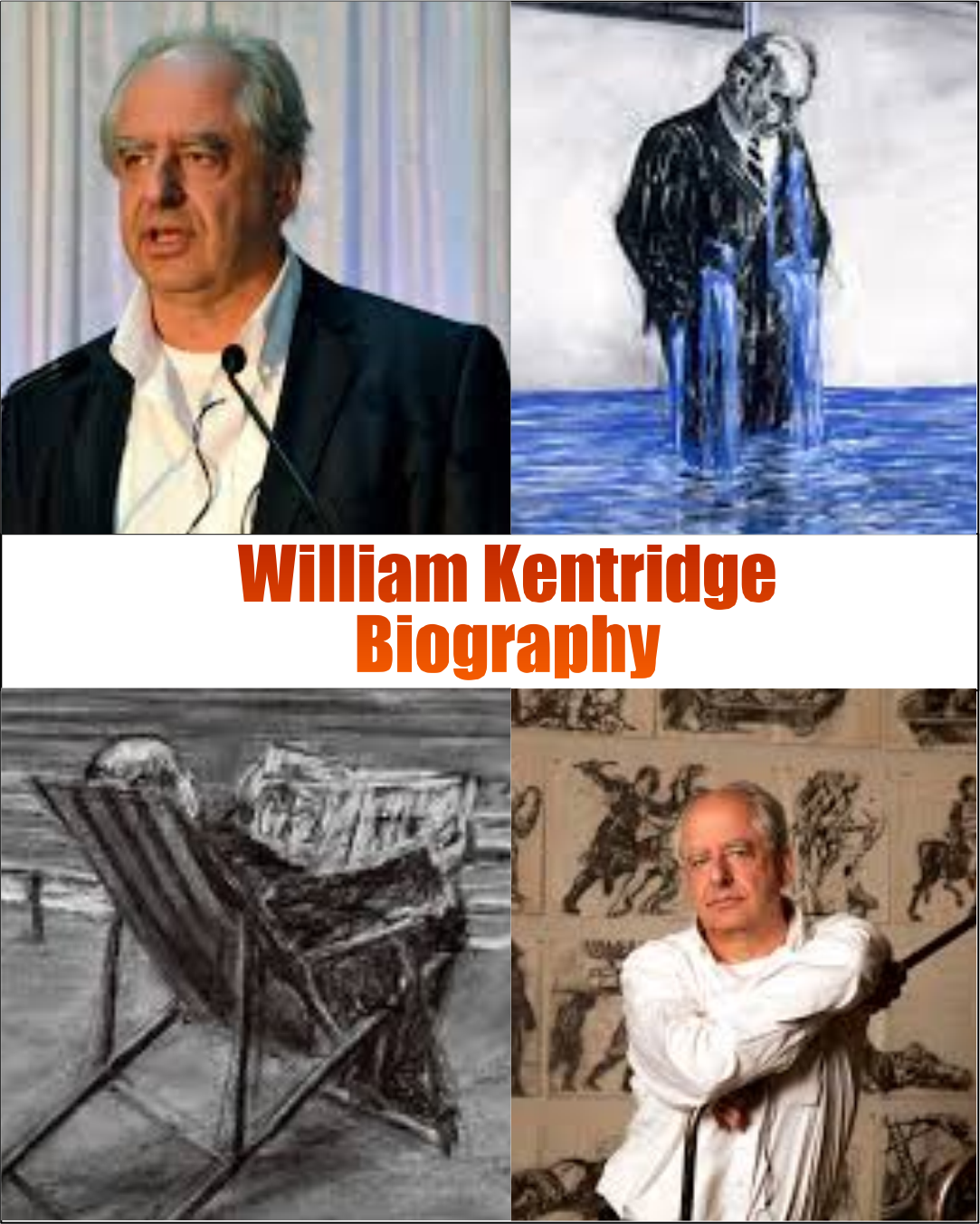
William Kentridge Biography
The William Kentridge Biography: Drawing Memory, Erasing History, and Rewriting South Africa
Explore the life of William Kentridge, the South African artist whose charcoal animations confront apartheid, memory, and political injustice.
The Artist Who Drew What History Tried to Erase
Some artists paint clarity.
Others embrace uncertainty.
William Kentridge built an entire body of work around what is incomplete—what is erased, altered, and remembered differently depending on who is telling the story.
His drawings are not static.
They change.
They are erased.
They are redrawn.
And in that process, they mirror something deeper.
History itself.
William Kentridge Biography
| Information | Details |
|---|---|
| Full Name | William Kentridge |
| Date of Birth | April 28, 1955 |
| Age | 71 years (as of 2026) |
| Place of Birth | Johannesburg, South Africa |
| Nationality | South African |
| Occupation | Artist, Filmmaker, Director |
| Known For | Charcoal animation films and political art |
| Art Style | Drawings, stop-motion animation, multimedia installations |
| Themes | Apartheid, memory, history, social injustice |
A Childhood Inside a Divided Country
William Kentridge was born in 1955 in Johannesburg, South Africa, into a family deeply involved in the legal fight against apartheid.
His parents were prominent lawyers who defended victims of racial injustice. From an early age, Kentridge was exposed to the realities of a country divided by law and inequality.
But his response was not direct activism.
It was observation.
He watched.
He absorbed.
He remembered.
And later, he would draw.
A Path That Almost Wasn’t Art
Kentridge’s early journey was not straightforward.
He initially studied politics and African studies, before turning to fine art. He even explored theater and filmmaking, experimenting with different forms of expression.
These experiences would later shape his work in unexpected ways.
Because Kentridge does not simply draw.
He stages.
He performs.
He animates.
See also: Ben Enwonwu Biography: The Nigerian Master Behind Tutu and the Rise of Modern African Art
A Signature Technique Built on Erasure
Kentridge’s most distinctive method is deceptively simple.
He creates charcoal drawings on paper.
Then he alters them.
Erases parts.
Redraws others.
Photographs each stage.
These images are then sequenced into animations.
The result is something unique.
A drawing that moves—not smoothly, but visibly, with traces of its own making and unmaking.
The erasure marks remain.
Nothing is fully removed.
Most Famous Works That Redefined Animation
Among Kentridge’s most influential works are:
- Felix in Exile
- History of the Main Complaint
- Johannesburg, 2nd Greatest City After Paris
These films are not traditional animations.
They are fragmented, layered, and often ambiguous.
They tell stories—but not in a linear way.
They reflect memory, not certainty.
Inspiration Rooted in History and Memory
Kentridge’s work is deeply tied to South Africa’s history—particularly apartheid.
But he does not present it in straightforward narratives.
Instead, he explores:
- Memory
- Guilt
- Power
- Forgetting
His characters often appear disoriented, moving through landscapes that shift and dissolve.
This reflects a central idea.
That history is not fixed.
It is constantly being rewritten.
Hidden Meanings in Every Line
At first glance, Kentridge’s drawings can appear rough, almost unfinished.
But this is intentional.
The smudges, the erasures, the visible corrections—all of these elements carry meaning.
They suggest:
- The instability of truth
- The persistence of memory
- The impossibility of complete erasure
Nothing in his work is accidental.
Even absence has presence.
Struggles in Representing the Unrepresentable
Kentridge’s challenge was not lack of recognition.
It was something more complex.
How do you represent injustice without simplifying it?
How do you depict trauma without reducing it?
His work avoids clear answers.
Instead, it sits in ambiguity—acknowledging that some experiences cannot be fully captured.
This approach was not always easily accepted.
Some viewers found his work difficult, even inaccessible.
But that difficulty is part of its purpose.
Influence on Contemporary Art and Film
Kentridge’s approach has had a significant impact on contemporary art.
He blurred the boundaries between:
- Drawing and film
- Visual art and performance
- Fine art and theater
His work influenced artists who now explore interdisciplinary forms—combining mediums to create more complex narratives.
He showed that art does not have to fit into a single category.
Controversy and Interpretation
Kentridge’s work has sparked ongoing discussion.
Some critics question whether his indirect approach to political themes avoids taking a clear stance.
Others argue that his work is deeply political precisely because it resists simplification.
There are also broader conversations about representation—who tells certain stories, and how they are framed.
Kentridge does not resolve these debates.
He contributes to them.
Recognition Across the World
Over the years, Kentridge has gained international recognition.
His work has been exhibited in major institutions, including:
- The Museum of Modern Art (MoMA)
- The Tate Modern
- The Venice Biennale
He has also worked in opera and theater, bringing his visual language into new spaces.
Awards and honors followed—but his work never shifted toward ease or accessibility.
He remained committed to complexity.
The Value of His Artworks
Kentridge’s works are highly valued in the global art market.
His drawings, prints, and installations are collected by major institutions and private collectors.
Their value reflects both artistic significance and historical relevance.
They are not just objects.
They are documents of a particular way of seeing.
A Legacy Built on Questioning
Kentridge’s legacy is not about providing answers.
It is about asking questions.
What is remembered?
What is forgotten?
What is erased—and what remains?
His work invites viewers into this process, requiring engagement rather than passive observation.
Still Creating, Still Reflecting
Kentridge continues to work, producing new pieces that expand his approach.
His themes remain consistent, but his methods continue to evolve—incorporating performance, installation, and large-scale projections.
He remains active in the same space he has always occupied.
Between certainty and doubt.
The Power of Imperfection
In a world that often values precision and polish, Kentridge embraces imperfection.
His drawings are not clean.
His animations are not seamless.
And that is exactly why they work.
They feel human.
Closing Reflection
Some artists aim for clarity.
William Kentridge works in uncertainty.
He draws, erases, redraws—leaving traces of each decision behind.
And in that process, he reveals something essential.
That history is not fixed.
That memory is fragile.
That what we see is often only part of the story.
His work does not resolve these tensions.
It keeps them alive.
Frequently Asked Questions
1. Who is William Kentridge?
William Kentridge is a South African artist and filmmaker known for his powerful visual storytelling through drawings and animated films.
2. Why is William Kentridge famous?
He is famous for his charcoal animation technique, where drawings are erased and redrawn to create motion, often addressing political and historical themes.
3. What themes does William Kentridge explore?
His work explores apartheid, colonial history, memory, identity, and social justice.
4. What makes William Kentridge’s art unique?
His distinctive method of combining drawing, erasure, and animation gives his work a raw, evolving, and deeply expressive quality.
5. What is William Kentridge’s legacy?
His legacy lies in using art as a tool for political reflection and storytelling, influencing contemporary artists globally.