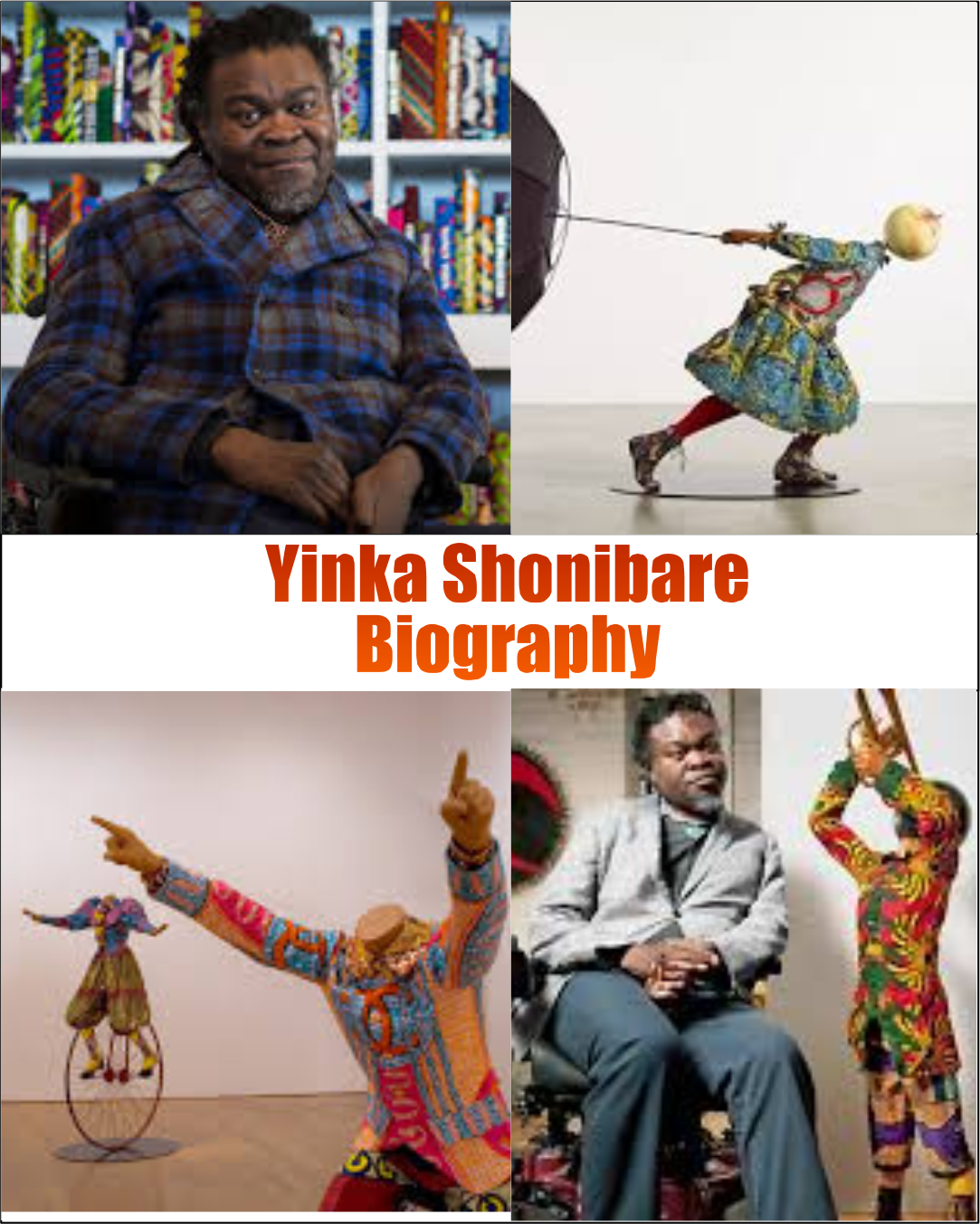
Yinka Shonibare Biography
The Yinka Shonibare Biography: The Artist Who Rewrote Colonial History in Fabric
Discover the life of Yinka Shonibare, the British-Nigerian artist who uses Dutch wax fabric and headless figures to challenge colonial history and identity.
The Artist Who Dressed History Differently
History is often presented as fixed.
Documented. Recorded. Settled.
But Yinka Shonibare saw something else.
Gaps.
Contradictions.
Stories told from one perspective, while others remained hidden.
And instead of writing about them, he reconstructed them—through fabric, form, and carefully staged scenes that feel familiar, yet strangely unsettling.
Because in his world, history does not stay as it was told.
It is re-dressed.
Yinka Shonibare Biography
| Information | Details |
|---|---|
| Full Name | Yinka Shonibare CBE |
| Date of Birth | August 9, 1962 |
| Age | 64 years (as of 2026) |
| Place of Birth | London, United Kingdom |
| Nationality | British-Nigerian |
| Occupation | Artist, Sculptor, Curator |
| Known For | Use of Dutch wax fabric in sculptures and installations |
| Art Style | Conceptual art, installation, photography |
| Themes | Colonialism, identity, globalization, race |
A Life Between Cultures
Yinka Shonibare was born in 1962 in London and raised in Lagos, Nigeria.
From an early age, he existed between two cultural realities—British and Nigerian. This duality would later become central to his work.
At seventeen, he returned to London for his education.
Not long after, his life changed dramatically.
He contracted transverse myelitis, a condition that left him partially paralyzed.
This physical limitation shaped how he worked—but it did not define what he created.
Instead, it led him to collaborate more, directing teams to bring his ideas to life.
A Signature Style That Challenges Assumptions
Shonibare’s work is immediately recognizable.
Mannequins dressed in elaborate, historical European costumes—Victorian gowns, aristocratic suits, scenes that resemble paintings from another era.
But there is a disruption.
The fabrics are not European.
They are Dutch wax prints—often associated with African identity.
And the figures?
They are headless.
See also: Mahmoud Ahmed Biography: The Voice Rediscovered That Redefined Ethiopian Music
The Meaning Behind the Technique
This combination is not decorative.
It is deliberate.
Dutch wax fabric, commonly seen as “African,” actually has a complex history tied to colonial trade routes between Europe, Indonesia, and West Africa.
By placing these fabrics on European figures, Shonibare exposes the layered realities of identity and globalization.
The headless mannequins add another layer.
They remove individual identity.
They question power.
They suggest that history is not about singular figures—but systems.
Most Famous Works That Reframed History
Some of Shonibare’s most recognized works include:
- The Swing (after Fragonard)
- Scramble for Africa
- Nelson’s Ship in a Bottle
The Swing recreates a famous 18th-century painting, but replaces the original subject with a headless figure dressed in vibrant fabric.
Scramble for Africa presents European leaders as headless mannequins, seated around a table dividing the continent.
These works are visually striking.
But their impact lies in what they reveal.
Inspiration Rooted in Colonial History
Shonibare’s work draws heavily from history—particularly the period of European colonial expansion.
But he does not present it as a distant past.
He brings it into the present.
By recreating historical scenes with altered elements, he invites viewers to reconsider what they think they know.
His work asks questions:
- Who controls the narrative?
- Whose stories are told?
- What is left out?
Hidden Meanings in Every Detail
Nothing in Shonibare’s work is accidental.
The fabrics carry history.
The costumes reference power.
The absence of heads removes hierarchy.
Even the poses—often drawn from classical art—are recontextualized.
At first glance, the works can appear playful, even theatrical.
But beneath that surface is critique.
Struggles Beyond the Canvas
Shonibare’s journey was shaped not only by cultural complexity but also by physical limitation.
His condition required him to rethink how art is made.
He could not always execute work physically.
So he adapted.
He became a conceptual artist—focusing on ideas, directing their execution, and maintaining control over vision rather than process.
This shift was not easy.
But it became a defining strength.
Influence on Contemporary Art
Shonibare’s work has had a significant impact on how contemporary art engages with history and identity.
He demonstrated that:
- Historical narratives can be reinterpreted
- Identity is not fixed
- Materials carry meaning beyond aesthetics
His influence can be seen in artists who now explore postcolonial themes with similar complexity.
Controversy and Interpretation
Shonibare’s work has sparked ongoing debate.
Some critics question whether his use of Dutch wax fabric reinforces stereotypes about African identity.
Others argue that his work successfully exposes the complexity behind those very assumptions.
There are also discussions about accessibility—whether the layered meanings in his work are fully understood by all audiences.
These tensions are part of the conversation his art creates.
Recognition on a Global Scale
Shonibare’s work has been widely recognized.
He has exhibited in major institutions worldwide, including:
- The Tate Modern
- The Museum of Modern Art
- The Venice Biennale
One of his most public works, Nelson’s Ship in a Bottle, was displayed in London’s Trafalgar Square—a prominent cultural space.
He has received numerous honors, including being appointed a Commander of the Order of the British Empire (CBE).
The Value of His Artworks
Shonibare’s works are highly valued in the global art market.
Collectors and institutions recognize their conceptual depth and historical significance.
His installations, sculptures, and limited editions command substantial prices, reflecting both demand and influence.
But their value extends beyond the market.
They hold cultural weight.
A Legacy of Reinterpretation
Shonibare’s legacy lies in how he reshapes perception.
He does not discard history.
He reexamines it.
He shows that what we consider fixed can be questioned, reframed, and understood differently.
Still Creating, Still Challenging
Shonibare remains active, continuing to produce work that engages with new contexts and conversations.
His themes remain consistent, but his approach evolves—expanding into new forms and spaces.
He continues to challenge.
Quietly. Precisely.
The Power of Recontextualization
What makes Shonibare’s work powerful is not just what it shows.
It is how it shows it.
By placing familiar elements in unfamiliar contexts, he creates tension.
And in that tension, meaning emerges.
Closing Reflection
Some artists create new images.
Yinka Shonibare reshapes old ones.
He takes history, dresses it differently, removes its faces, and presents it again—forcing us to look more closely.
To question.
To reconsider.
And in doing so, he reminds us of something essential.
That history is not just what happened.
It is how we choose to see it.
Frequently Asked Questions
1. Who is Yinka Shonibare?
Yinka Shonibare is a British-Nigerian contemporary artist known for exploring identity, history, and colonialism through visually striking works.
2. Why is Yinka Shonibare famous?
He is famous for using Dutch wax fabrics—often associated with African identity—to challenge ideas about culture, authenticity, and globalization.
3. What themes does Yinka Shonibare explore?
His work addresses colonial history, race, identity, class, and power dynamics in society.
4. What is unique about Yinka Shonibare’s art?
His sculptures often feature headless figures dressed in vibrant fabrics, symbolizing the loss of identity and the complexities of colonial history.
5. What is Yinka Shonibare’s legacy?
His legacy lies in reshaping conversations around African identity in global art, influencing contemporary art discourse worldwide.