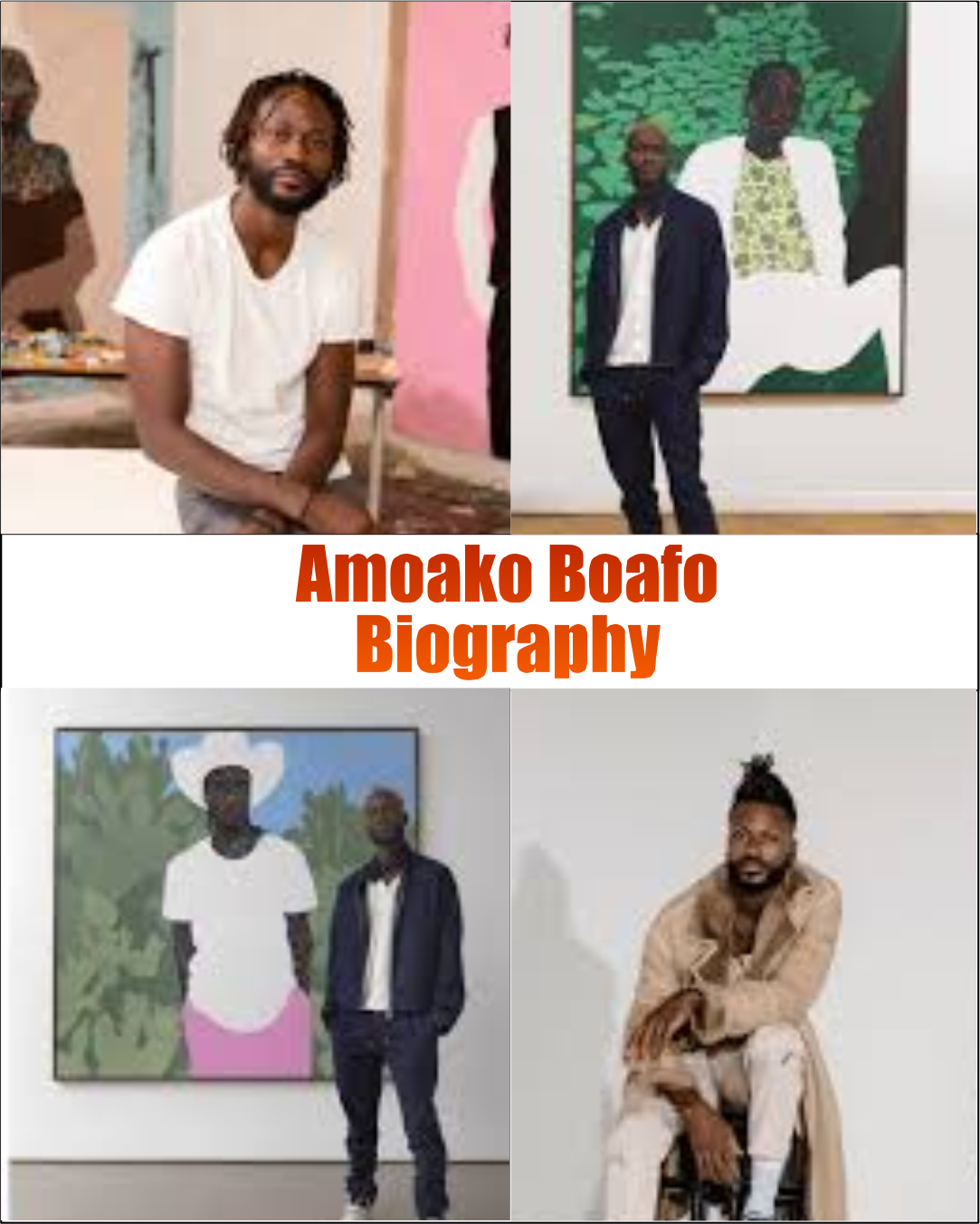
Amoako Boafo Biography
The Amoako Boafo Biography: The Painter Who Reclaimed Black Portraiture with His Bare Hands
Discover the life of Amoako Boafo, the Ghanaian artist whose finger-painted portraits redefined Black identity in global contemporary art.
The Artist Who Chose to Paint With His Hands
In a world of precision tools and polished techniques, some artists still choose to touch their work directly.
Amoako Boafo does not just paint.
He presses.
Smears.
Builds faces with his fingers—layer by layer—until something deeply human begins to emerge from the canvas.
There is no barrier between him and his subject.
No brush to soften the connection.
Just skin meeting surface.
And in that contact, something shifts.
Amoako Boafo Biography
| Information | Details |
|---|---|
| Full Name | Amoako Boafo |
| Date of Birth | 1984 |
| Age | ~42 years (as of 2026) |
| Place of Birth | Accra, Ghana |
| Nationality | Ghanaian |
| Occupation | Painter |
| Education | Academy of Fine Arts Vienna, Austria |
| Known For | Finger-painted portraits celebrating Black identity |
| Art Style | Figurative painting with expressive textures |
A Beginning Without Clear Direction
Amoako Boafo was born in 1984 in Accra, Ghana.
Unlike many artists who discover their path early, Boafo’s entry into art was unexpected. He did not grow up within a structured artistic environment, nor did he initially plan to pursue painting as a career.
His introduction came through curiosity.
Through experimentation.
Through the simple act of trying something new.
But once he began, something clicked.
See also: Nusrat Fateh Ali Khan Biography: The Voice That Carried Sufi Music to the World
Training That Opened New Possibilities
Boafo later studied at the Ghanatta College of Art and Design in Accra before continuing his education at the Academy of Fine Arts in Vienna, Austria.
This transition—from Ghana to Europe—introduced him to new artistic frameworks.
But it also brought a realization.
Black subjects—especially Black skin—were often underrepresented or misrepresented in classical and contemporary painting traditions.
This absence became a starting point.
A Signature Technique That Redefined Texture
Boafo’s most distinctive feature is his technique.
He paints skin using his fingers.
Not as a novelty.
But as a deliberate method.
The result is striking.
Thick, textured surfaces that carry movement and immediacy. Each fingerprint becomes part of the composition—visible, intentional, alive.
This technique does more than create texture.
It creates presence.
Most Famous Works That Captured Global Attention
Boafo’s portraits quickly gained recognition, particularly works such as:
- The Lemon Bathing Suit
- Yellow Dress
- Joy Adenuga
His subjects are often:
- Friends
- Acquaintances
- Members of his community
They are not anonymous figures.
They are individuals—presented with dignity, confidence, and quiet strength.
Inspiration Rooted in Representation
At the core of Boafo’s work is a clear intention.
Representation.
He paints Black subjects not as symbols, but as people—complex, expressive, and self-possessed.
His inspiration comes from:
- Everyday life
- Personal relationships
- Cultural identity
He focuses on moments that feel real, not staged.
Hidden Meanings in Simplicity
Boafo’s paintings can appear simple at first glance.
A figure.
A background.
A pose.
But within that simplicity lies intention.
The posture of the subject often conveys confidence.
The gaze—direct or averted—suggests inner life.
The backgrounds, often minimal, remove distraction.
Everything directs attention to the subject.
To their presence.
To their existence.
Struggles in Visibility and Access
Boafo’s rise may seem rapid.
But it reflects deeper structural challenges.
For many African artists, access to global platforms has historically been limited. Recognition often comes late—or not at all.
Boafo entered a system where visibility was uneven.
But his work disrupted that pattern.
It demanded attention.
And it received it.
A Rapid Rise in the Global Art World
Boafo’s breakthrough came quickly once his work reached international audiences.
Galleries began to take notice.
Collectors followed.
His exhibitions sold out.
His name entered conversations about the future of contemporary painting.
This rapid ascent was unusual.
But it was also earned.
Influence on Contemporary Portraiture
Boafo’s work has had a clear impact on portraiture.
He re-centered the subject.
Moved away from external narratives.
Focused on internal presence.
His technique also challenged traditional approaches—showing that tools are not fixed, that process can be personal.
Younger artists now explore similar ideas, inspired by his approach.
Controversy Around Market Surge
With rapid success came scrutiny.
Some critics questioned the speed at which his work entered high-value markets.
Others debated whether the art world’s sudden interest in African artists reflected genuine recognition or market trends.
These discussions are ongoing.
Boafo’s work sits at the center of them.
Recognition and Global Reach
Boafo has exhibited in major galleries and institutions worldwide.
His work has been featured in international art fairs, and he has collaborated with global artists and brands.
He has become one of the most visible contemporary African painters.
Recognition came quickly.
But it continues to grow.
The Value of His Artworks
Boafo’s paintings have seen a dramatic rise in value.
Works that initially sold for modest amounts have later appeared at auction for hundreds of thousands of dollars.
In some cases, prices have exceeded expectations, reflecting strong demand.
This market trajectory places him among the most commercially successful contemporary African artists.
A Legacy Still in Motion
Boafo’s story is still unfolding.
He is not reflecting on a completed career.
He is building one.
Each new work adds to a growing body that continues to evolve.
The Intimacy of His Process
What sets Boafo apart is not just what he paints.
It is how he paints.
The use of his hands creates intimacy.
A direct connection between artist and subject.
Between creation and result.
It removes distance.
Closing Reflection
Some artists use tools.
Amoako Boafo uses touch.
He paints people not as objects, but as presences—real, grounded, and undeniable.
And in doing so, he shifts something important.
Not just how Black subjects are seen.
But how they are felt.
Through texture.
Through form.
Through the imprint of a human hand.
Frequently Asked Questions
1. Who is Amoako Boafo?
Amoako Boafo is a contemporary Ghanaian painter known for his vibrant portraits that celebrate Black identity and individuality.
2. Why is Amoako Boafo famous?
He gained international attention for his distinct finger-painting technique and bold, textured portraits of Black subjects.
3. What makes Amoako Boafo’s art unique?
He often paints skin using his fingers instead of brushes, creating rich textures and a strong emotional presence in his work.
4. What themes does Amoako Boafo explore?
His work explores identity, representation, Black culture, and self-expression, often highlighting marginalized voices.
5. What is Amoako Boafo’s legacy?
He is shaping contemporary art by redefining how Black subjects are represented, influencing a new generation of artists globally.