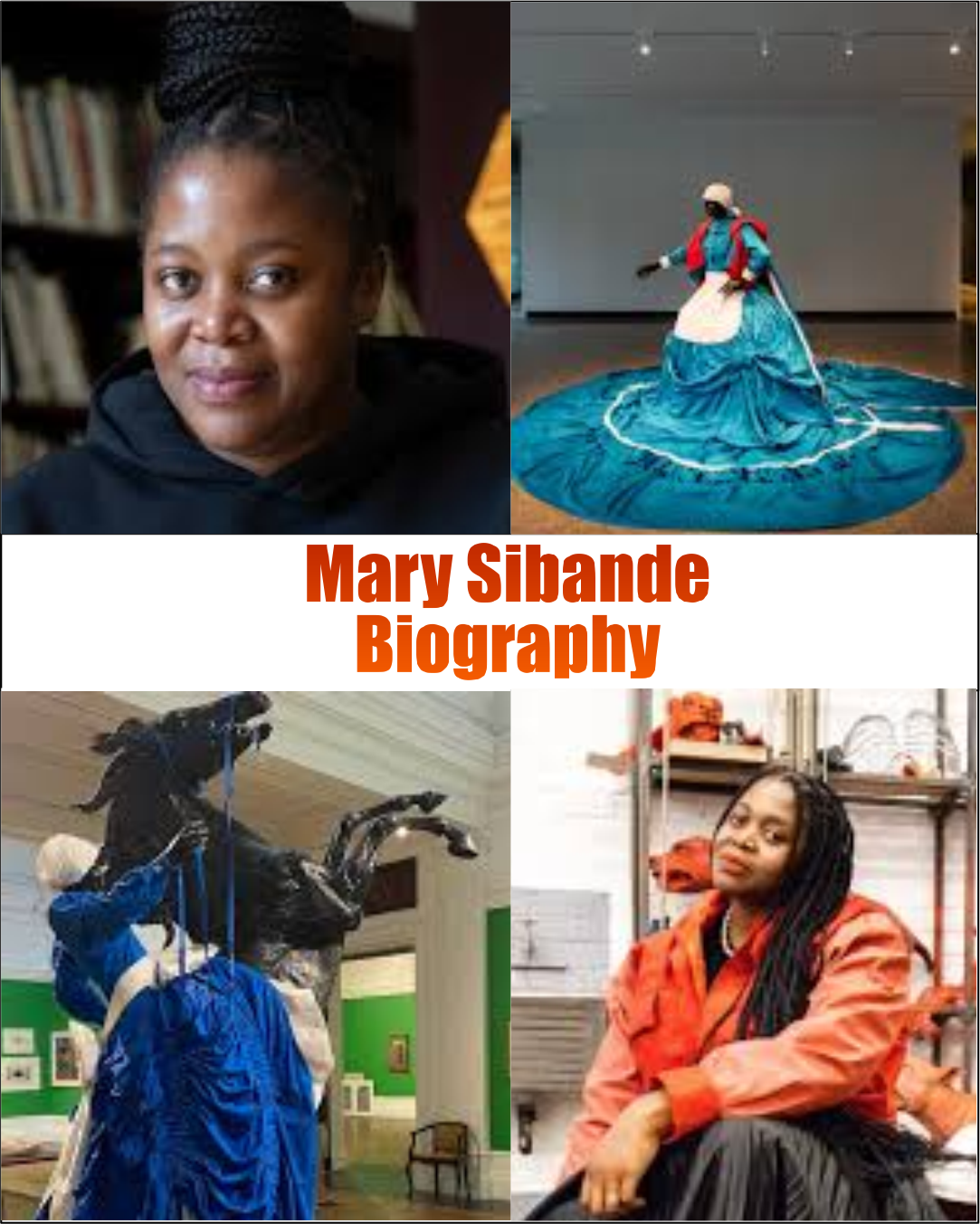
Mary Sibande Biography
The Mary Sibande Biography: The Artist Who Reimagined Identity Through Sculpture and Fantasy
Discover the life of Mary Sibande, the South African artist who transformed domestic worker history into powerful sculptural narratives of identity and freedom.
The Artist Who Turned a Uniform Into a Story
Some artists create characters.
Others become them.
Mary Sibande did something more complex—she created a character that carries generations.
Her name is Sophie.
Dressed in a domestic worker’s uniform, Sophie stands at the center of Sibande’s work. But she is not confined to that role.
She dreams.
She transforms.
She resists.
And through her, Sibande tells a story that is both deeply personal and historically rooted.
Mary Sibande Biography
| Information | Details |
|---|---|
| Full Name | Mary Sibande |
| Date of Birth | 1982 |
| Age | ~44 years (as of 2026) |
| Place of Birth | Barberton, Mpumalanga, South Africa |
| Nationality | South African |
| Occupation | Artist, Sculptor |
| Education | University of Johannesburg |
| Known For | Sculptural installations featuring her alter ego “Sophie” |
| Themes | Identity, race, gender, domestic labor, South African history |
A Childhood Shaped by Inherited Roles
Mary Sibande was born in 1982 in Barberton, South Africa, into a family of domestic workers.
Her mother, grandmother, and great-grandmother all worked in similar roles—cleaning, serving, maintaining households that were not their own.
This history was not distant.
It was immediate.
It shaped her understanding of identity, labor, and expectation from an early age.
From Observation to Expression
Sibande’s early exposure to this world did not immediately translate into art.
But over time, she began to reflect on what these roles meant—not just socially, but psychologically.
What does it mean to inherit a profession?
To be expected to follow a path defined before you were born?
These questions became central to her work.
The Creation of Sophie
Sophie is Sibande’s alter ego.
But she is more than that.
She is a composite—built from the experiences of the women in Sibande’s family, combined with the artist’s own imagination.
In her earliest appearances, Sophie is dressed in a domestic worker’s uniform.
But as the work evolves, so does she.
Her dresses expand.
They transform into elaborate, almost fantastical garments—blurring the line between servant and royalty.
A Signature Style Built on Sculpture and Fabric
Sibande works primarily with sculpture, often using life-sized mannequins dressed in intricately designed garments.
Fabric plays a central role.
The color blue—often associated with domestic work uniforms—is reimagined, becoming something bold, expansive, almost regal.
Her sculptures are carefully staged.
Each pose, each detail, contributes to a larger narrative.
Most Famous Works That Brought Sophie to Life
Some of Sibande’s most recognized series include:
- Long Live the Dead Queen
- The Purple Shall Govern
In Long Live the Dead Queen, Sophie appears in various forms—sometimes grounded, sometimes elevated, always in transition.
The Purple Shall Govern introduces new color and symbolism, expanding the narrative beyond domesticity into resistance and political expression.
Inspiration Rooted in Personal and Collective History
Sibande’s work is deeply inspired by:
- Family history
- South Africa’s apartheid past
- Gender roles
- Social expectations
But she does not present these themes directly.
She transforms them.
Through Sophie, she creates a space where history and imagination intersect.
Hidden Meanings in Fabric and Form
At first glance, Sibande’s sculptures can appear theatrical.
The garments are elaborate.
The poses are dramatic.
But beneath this visual richness lies meaning.
The expanding dresses suggest transformation.
The use of uniform references speaks to labor and identity.
The dream-like elements represent aspiration—what could be, rather than what is.
Sophie is not just a figure.
She is a process.
Struggles of Representation and Expectation
Sibande’s work emerges from a context where representation is complex.
South Africa’s history has shaped how identities are viewed, categorized, and understood.
Creating work that engages with these themes requires navigating expectations—both local and global.
There is pressure.
To represent accurately.
To be understood.
To be accepted.
Sibande does not simplify these challenges.
She incorporates them.
Influence on Contemporary African Art
Sibande’s work has contributed to broader conversations about identity in contemporary African art.
She has shown that:
- Personal history can be a powerful artistic source
- Sculpture can carry narrative as effectively as painting
- Identity can be explored through imagination, not just documentation
Her influence is visible in artists who now engage with similar themes—using storytelling as a central tool.
See also: William Onyeabor Biography: The Enigmatic Genius Who Vanished and Became a Legend
Controversy and Interpretation
Sibande’s work has sparked discussion.
Some viewers question whether the use of fantasy elements distances the work from reality.
Others argue that this is precisely its strength—that imagination allows for deeper engagement with difficult histories.
There are also conversations about how her work is interpreted internationally, and whether its cultural context is fully understood.
These tensions remain part of its impact.
Recognition on the Global Stage
Sibande has exhibited internationally, with her work featured in major galleries and art fairs.
Her sculptures have been widely recognized for their originality and depth.
She has received awards and critical acclaim, establishing herself as a significant voice in contemporary art.
Her work resonates across borders.
The Value of Her Artworks
Sibande’s sculptures are highly valued within the contemporary art market.
Collectors and institutions recognize their narrative strength and cultural significance.
Her pieces are included in major collections, and their value continues to grow as her influence expands.
A Legacy Built on Reimagining Identity
Sibande’s legacy is not about documenting history.
It is about reimagining it.
Through Sophie, she creates a space where inherited roles can be questioned, transformed, and expanded.
She offers not just reflection.
But possibility.
Still Evolving, Still Expanding
Sibande continues to develop her work, introducing new elements, new colors, new narratives.
Sophie evolves with her.
The story does not remain fixed.
It grows.
The Power of Transformation
What makes Sibande’s work compelling is its ability to transform.
A uniform becomes a statement.
A figure becomes a narrative.
A personal history becomes a shared experience.
Closing Reflection
Some artists tell stories.
Mary Sibande builds them.
She takes fragments of history—family, labor, identity—and reshapes them into something larger.
Through Sophie, she shows that identity is not fixed.
It can expand.
It can evolve.
It can dream.
And in that space, something new becomes possible.
Frequently Asked Questions
1. Who is Mary Sibande?
Mary Sibande is a South African contemporary artist known for her powerful sculptures and installations that explore identity, history, and gender roles.
2. Why is Mary Sibande famous?
She gained recognition for her recurring character “Sophie”, a domestic worker figure used to challenge historical and social narratives.
3. What does “Sophie” represent in her work?
“Sophie” represents Black women’s experiences, particularly domestic workers in South Africa, while also symbolizing dreams, resistance, and transformation.
4. What themes does Mary Sibande explore?
Her work focuses on race, gender inequality, colonial history, and the legacy of domestic labor in South Africa.
5. What is Mary Sibande’s legacy?
Her legacy lies in giving voice to overlooked histories and reshaping how African women’s stories are told through contemporary art.