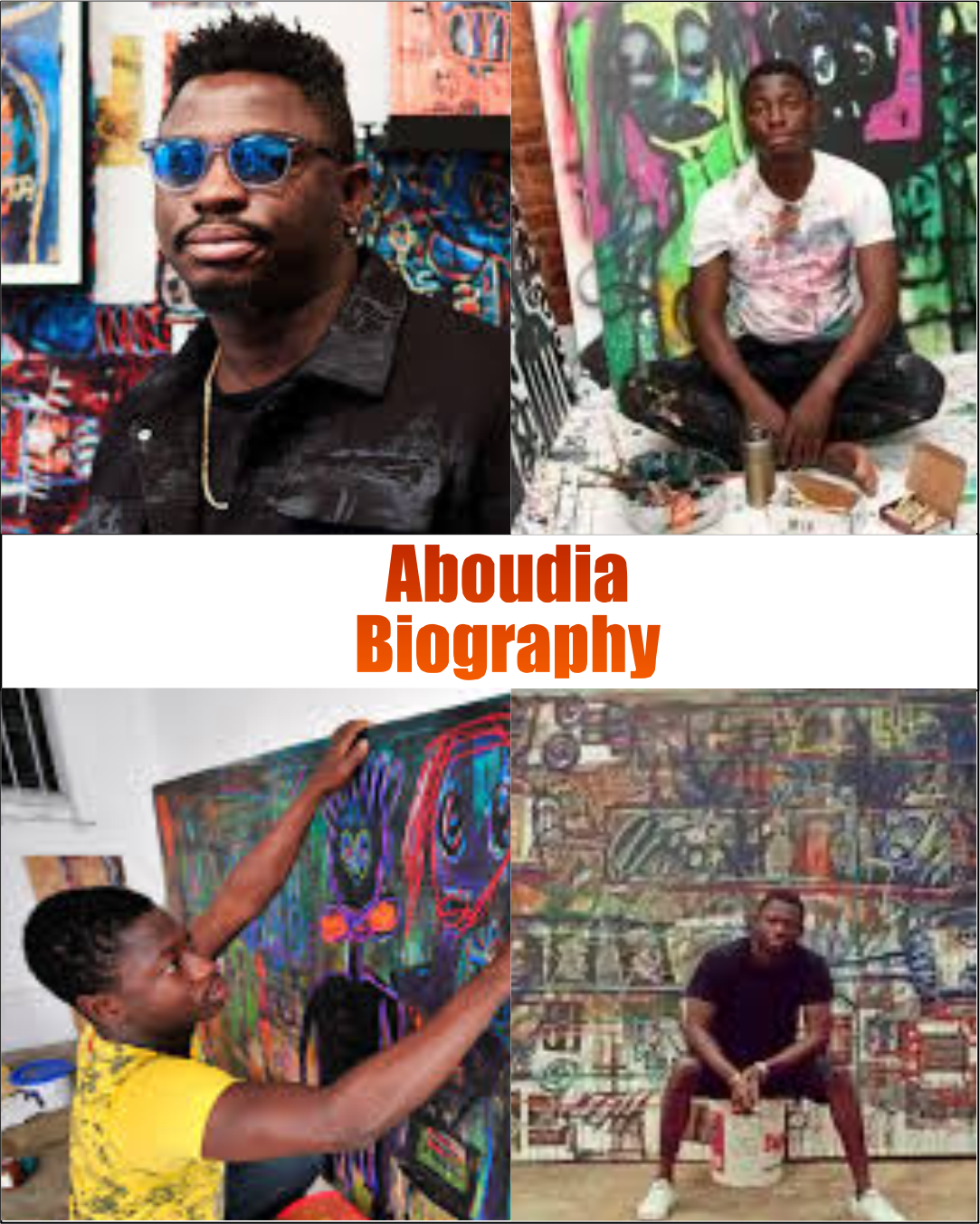
Aboudia Biography
The Aboudia Biography: The Painter Who Captured War on the Streets of Abidjan
Discover the life of Aboudia, the Ivorian artist whose raw, chaotic paintings document civil war, street survival, and the voice of a generation.
The Artist Who Painted While the World Collapsed Around Him
Some artists wait for the right moment.
Others create in the middle of chaos.
Aboudia did not step away from conflict.
He painted through it.
Gunfire in the distance.
Streets filled with tension.
A city on edge.
And inside a small studio in Abidjan, he worked—fast, instinctive, urgent—capturing a reality that could not be paused.
Aboudia Biography
| Information | Details |
|---|---|
| Full Name | Abdoulaye Diarrassouba |
| Stage Name | Aboudia |
| Date of Birth | 1983 |
| Age | ~43 years (as of 2026) |
| Place of Birth | Abidjan, Côte d’Ivoire |
| Nationality | Ivorian |
| Occupation | Painter |
| Known For | Graffiti-inspired paintings reflecting urban African life |
| Art Style | Neo-expressionism, street art influence |
A Childhood Shaped by Absence
Aboudia, born Abdoulaye Diarrassouba in 1983 in Ivory Coast, grew up in a world that required independence early.
After losing his parents at a young age, he moved to Abidjan, where he navigated life largely on his own.
The streets became both environment and teacher.
He observed.
He adapted.
He absorbed the rhythms, struggles, and energy of urban life.
This experience would later define his artistic voice.
Finding Art Without a Roadmap
Unlike many artists who follow structured training, Aboudia’s path was less defined.
He eventually studied at the École des Beaux-Arts in Abidjan, but his real education came from lived experience.
From graffiti.
From street culture.
From the visual noise of the city.
His work did not emerge from tradition.
It emerged from survival.
See also: Ben Enwonwu Biography: The Nigerian Master Behind Tutu and the Rise of Modern African Art
A Signature Style Built on Raw Expression
Aboudia’s paintings are immediately recognizable.
They are:
- Chaotic
- Layered
- Energetic
He uses bold colors, rough lines, and overlapping figures that often resemble childlike drawings.
Faces appear distorted.
Bodies are fragmented.
Words and symbols are scattered across the canvas.
This is not accidental.
It reflects the environment he was painting.
Most Famous Works That Captured a Nation in Crisis
Aboudia gained international attention during the Ivorian civil war around 2010–2011.
While many fled, he stayed.
And he painted.
His works from this period—often referred to as his “Nouchi” series—document life during conflict.
Children appear frequently in his paintings.
Not as symbols of innocence alone, but as witnesses to chaos.
These works became some of his most recognized pieces.
Inspiration Rooted in Street Life and Conflict
Aboudia draws inspiration directly from his surroundings.
His influences include:
- Street children in Abidjan
- Graffiti and urban markings
- Political unrest
- Everyday survival
He does not distance himself from his subjects.
He paints what he sees.
What he experiences.
Hidden Meanings in Chaos
At first glance, Aboudia’s work can feel overwhelming.
The colors clash.
The figures overlap.
The compositions seem almost uncontrolled.
But within that chaos, there is structure.
The repetition of certain forms.
The placement of symbols.
The presence of text—often in Nouchi, a local street language.
These elements create layers of meaning.
The work is not random.
It is coded.
Struggles Beyond the Canvas
Aboudia’s journey has been shaped by more than artistic challenges.
Growing up without stable support, navigating life in a city marked by inequality, and creating during political instability all contributed to his perspective.
Recognition did not come immediately.
His work, rooted in street aesthetics, was not always taken seriously within formal art spaces.
But he continued.
A Breakthrough During Conflict
It was during the civil war that Aboudia’s work reached a wider audience.
International collectors and galleries began to take notice.
The urgency of his paintings—created in real time, under real conditions—carried weight.
They were not interpretations of conflict.
They were records of it.
Influence on Contemporary African Art
Aboudia’s work has influenced a new generation of artists who draw from urban culture and lived experience.
He demonstrated that:
- Street aesthetics can exist within fine art
- Personal experience is a valid artistic source
- Raw expression can carry deep meaning
His approach expanded the boundaries of what contemporary African art could look like.
Controversy and Criticism
With recognition came critique.
Some critics compare his work to Western artists like Jean-Michel Basquiat, raising questions about originality.
Others debate the commercialization of conflict—whether art created during war becomes a commodity once it enters global markets.
These discussions are complex.
Aboudia’s work sits within them, not outside them.
Recognition on the Global Stage
Aboudia now exhibits internationally, with his work shown in galleries and art fairs across Europe and beyond.
He has gained a strong following among collectors who value the immediacy and authenticity of his work.
His rise from local artist to global figure reflects both talent and timing.
The Value of His Artworks
Aboudia’s paintings have seen a steady increase in value.
Works that once sold for modest amounts now command significantly higher prices.
Collectors are drawn not only to the visual impact, but to the story behind each piece.
The context matters.
A Legacy of Witnessing
Aboudia’s legacy is rooted in documentation.
He captures moments that might otherwise be forgotten.
Not through photography or journalism.
But through paint.
His work preserves a perspective that is often overlooked.
Still Creating, Still Reflecting
Aboudia continues to paint, though his themes have evolved.
While conflict remains part of his narrative, his work now also explores broader aspects of urban life and identity.
The energy remains.
The urgency remains.
But the focus expands.
The Power of Unfiltered Expression
What makes Aboudia’s work compelling is its honesty.
It does not attempt to refine or soften reality.
It presents it.
Directly.
Without apology.
Closing Reflection
Some artists create from distance.
Aboudia creates from within.
He paints what he has lived, what he has seen, what he has survived.
And in doing so, he offers something rare.
Not just representation.
But presence.
A record of a moment.
A voice from the middle of it.
Unfiltered. Unresolved. Unforgettable.
Frequently Asked Questions
1. Who is Aboudia?
Aboudia, born Abdoulaye Diarrassouba, is an Ivorian contemporary artist known for his raw, expressive paintings depicting life in Abidjan.
2. Why is Aboudia famous?
He gained international attention during the Ivorian civil conflict (2010–2011), when he created powerful artworks reflecting the chaos and resilience of everyday life.
3. What themes does Aboudia explore?
His work focuses on urban youth culture, conflict, poverty, resilience, and the energy of African street life.
4. What makes Aboudia’s art unique?
His style combines childlike figures, graffiti elements, and bold colors, creating a chaotic yet deeply meaningful visual language.
5. What is Aboudia’s legacy?
He is redefining African contemporary art by bringing street narratives and raw social realities into global art conversations.