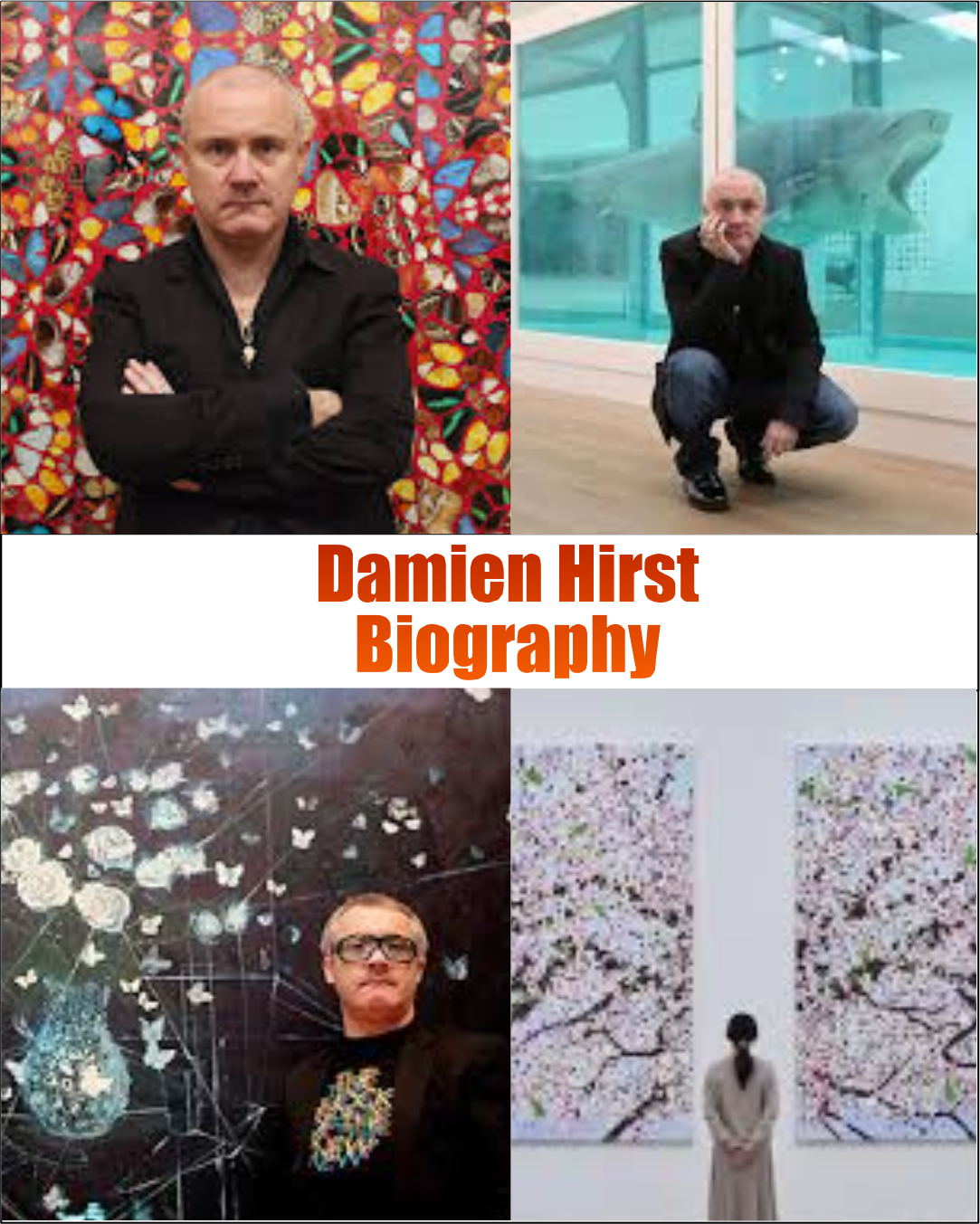
Damien Hirst Biography
The Damien Hirst Biography: The Artist Who Turned Death Into Contemporary Art
Discover the life of Damien Hirst, the British artist known for controversial works exploring death, value, and the boundaries of art.
The Artist Who Made Death Impossible to Ignore
Most people avoid thinking about death.
Damien Hirst built an entire career around it.
Not quietly.
Not subtly.
But directly—placing it in glass tanks, suspending it in formaldehyde, turning it into something you cannot walk past without reacting.
His work does not comfort.
It confronts.
And whether admired or criticized, it leaves very little room for indifference.
Damien Hirst Biography
| Information | Details |
|---|---|
| Full Name | Damien Steven Hirst |
| Date of Birth | June 7, 1965 |
| Age | 61 years (as of 2026) |
| Place of Birth | Bristol, England, United Kingdom |
| Nationality | British |
| Occupation | Artist, Entrepreneur |
| Art Movement | Young British Artists |
| Known For | Controversial artworks involving death, science, and preservation |
| Famous Work | The Physical Impossibility of Death in the Mind of Someone Living |
A Beginning Without Clear Direction
Damien Hirst was born in 1965 in Bristol, England, and grew up in Leeds.
His early life was not structured around art. In fact, his path toward becoming an artist was uncertain, marked by moments of experimentation rather than clear intention.
But when he entered Goldsmiths College in London, something shifted.
There, he became part of a generation that would later be known as the Young British Artists (YBAs)—a group that challenged traditional ideas of art and presentation.
A Mind Drawn to Mortality
From early on, Hirst was fascinated by themes most people avoid:
- Death
- Decay
- Preservation
- The fragility of life
This fascination did not remain conceptual.
He made it visible.
A Signature Technique That Shocked the World
Hirst’s most iconic works involve real animals preserved in formaldehyde.
The most famous example is The Physical Impossibility of Death in the Mind of Someone Living—a tiger shark suspended in a glass tank.
The scale is overwhelming.
The presence is undeniable.
The viewer is forced into confrontation—not with a symbol of death, but with death itself.
See also: Mercedes Sosa Biography: The Voice That Carried a Continent
Most Famous Works That Redefined Contemporary Art
Among Hirst’s most recognized works are:
- The Physical Impossibility of Death in the Mind of Someone Living
- Mother and Child (Divided)
- For the Love of God
Mother and Child (Divided) presents a cow and calf split into sections, allowing viewers to walk between them.
For the Love of God features a human skull cast in platinum and covered in diamonds.
These works are not subtle.
They are designed to provoke.
Inspiration Rooted in Science and Reality
Hirst’s work draws heavily from scientific imagery and methods.
He references:
- Medical displays
- Laboratory environments
- Anatomical studies
The clean, clinical presentation contrasts with the subject matter.
This tension—between order and decay—is central to his work.
Hidden Meanings Behind the Shock
At first glance, Hirst’s work can appear purely provocative.
But beneath the shock lies intention.
He explores:
- The inevitability of death
- The illusion of control
- The value placed on life and objects
By presenting death in controlled environments, he questions whether it can ever truly be contained.
Struggles of Acceptance and Definition
Hirst’s work has never been universally accepted.
From early in his career, critics questioned whether his pieces should even be considered art.
Was it concept?
Was it spectacle?
Was it too dependent on shock value?
These questions followed him—but they did not stop him.
Influence on Contemporary Art
Hirst became a central figure in the Young British Artists movement, which reshaped the art scene in the 1990s.
He demonstrated that:
- Art could be conceptual as much as visual
- Presentation could be as important as creation
- Controversy could drive conversation
His influence extended beyond his own work, shaping how art is marketed, displayed, and discussed.
Controversy at Every Stage
Hirst’s career is defined as much by controversy as by creation.
Criticism includes:
- The use of real animal bodies
- Questions about authorship (due to studio assistants)
- The commercialization of art
Some view his work as groundbreaking.
Others see it as excessive or driven by market value.
These debates are ongoing.
Recognition and Market Dominance
Despite criticism, Hirst achieved significant recognition.
His works have been exhibited globally, and he has become one of the most commercially successful living artists.
In 2008, he bypassed traditional galleries and sold works directly through auction, generating unprecedented sales.
This move disrupted the art market.
The Value of His Artworks
Hirst’s works command extremely high prices.
Pieces have sold for millions, placing him among the most valuable contemporary artists.
But his relationship with value is complex.
His work often questions the very systems that assign it.
A Legacy Built on Disruption
Hirst’s legacy lies in disruption.
He challenged:
- What art can be
- How it is sold
- How it is experienced
He forced the art world to confront its own boundaries.
Still Creating, Still Provoking
Hirst continues to produce work, exploring new ideas while maintaining his core themes.
His approach evolves, but his focus remains consistent.
He continues to ask uncomfortable questions.
The Power of Confrontation
What makes Hirst’s work enduring is its directness.
It does not allow distance.
It places the viewer face-to-face with concepts often avoided.
Closing Reflection
Some artists create beauty.
Damien Hirst creates confrontation.
He takes what is often hidden—death, decay, fragility—and makes it visible.
And in doing so, he forces a reaction.
Whether acceptance or rejection, agreement or discomfort—
his work demands engagement.
And that, perhaps, is its greatest power.
Frequently Asked Questions
1. Who is Damien Hirst?
Damien Hirst is a British contemporary artist known for pushing the boundaries of art through provocative and unconventional works.
2. Why is Damien Hirst famous?
He became famous as a leading figure of the Young British Artists, known for shocking and thought-provoking pieces.
3. What are Damien Hirst’s most famous works?
His most iconic work is The Physical Impossibility of Death in the Mind of Someone Living, featuring a shark preserved in formaldehyde.
4. Why is Damien Hirst controversial?
His work often explores death, mortality, and science, using real animals and unconventional materials, which has sparked ethical debates.
5. What is Damien Hirst’s legacy?
His legacy lies in redefining contemporary art, blending conceptual thinking, commerce, and shock value to challenge traditional art norms.