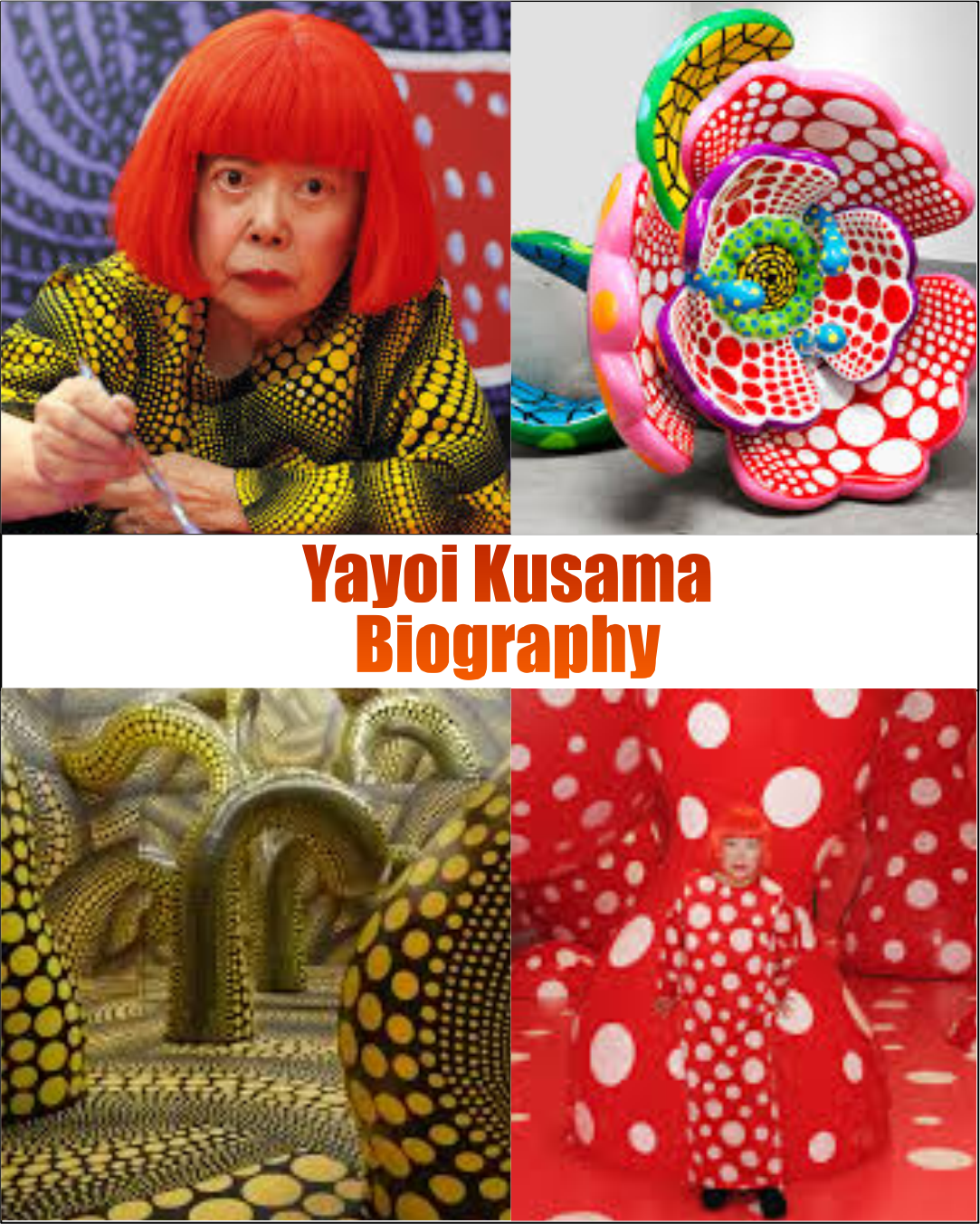
Yayoi Kusama Biography
The Yayoi Kusama Biography: Infinity, Obsession, and the Art That Never Ends
Discover the life of Yayoi Kusama, the Japanese artist who transformed obsession into immersive art through polka dots, infinity rooms, and bold expression.
The Artist Who Turned Repetition Into Infinity
Some artists explore the world around them.
Yayoi Kusama turned inward—and found something endless.
Dots that multiply.
Patterns that repeat.
Spaces that stretch beyond perception.
Her work does not simply exist in front of you.
It surrounds you.
Consumes you.
And in that experience, the boundary between self and space begins to dissolve.
Yayoi Kusama Biography
| Information | Details |
|---|---|
| Full Name | Yayoi Kusama |
| Date of Birth | March 22, 1929 |
| Age | 97 years (as of 2026) |
| Place of Birth | Matsumoto, Nagano, Japan |
| Nationality | Japanese |
| Occupation | Artist, Writer |
| Known For | Polka dots and immersive Infinity Mirror Rooms |
| Art Style | Conceptual art, pop art, installation art |
| Notable Trait | Uses art to express psychological experiences |
A Childhood Marked by Visions
Yayoi Kusama was born in 1929 in Matsumoto, Japan.
From an early age, she experienced hallucinations—seeing patterns, dots, and fields that extended infinitely.
These were not occasional.
They were constant.
Flowers would speak.
Walls would pulse.
Surfaces would dissolve into repetition.
For Kusama, these visions were overwhelming.
But they would later become the foundation of her art.
Art as a Way to Cope
Kusama began creating art as a way to process these experiences.
Drawing and painting allowed her to externalize what she saw internally.
It was not just expression.
It was control.
By placing these patterns onto canvas, she could contain them.
At least partially.
See also: Ben Enwonwu Biography: The Nigerian Master Behind Tutu and the Rise of Modern African Art
A Journey Beyond Japan
In the late 1950s, Kusama moved to the United States, settling in New York.
There, she entered an art scene that was rapidly evolving.
But she remained distinct.
While others explored abstraction and minimalism, Kusama brought something deeply personal—her own psychological landscape.
A Signature Style Built on Repetition
Kusama’s most recognizable element is the polka dot.
But in her work, dots are not decorative.
They are structural.
They cover surfaces—canvas, sculpture, entire rooms.
They repeat endlessly, creating patterns that feel both controlled and overwhelming.
This repetition becomes her signature.
Most Famous Works That Created Immersive Worlds
Among Kusama’s most celebrated works are:
- Infinity Mirror Rooms
- Pumpkin sculptures
- Accumulation series
The Infinity Mirror Rooms are perhaps her most iconic.
These installations use mirrors and lights to create the illusion of endless space.
A single room becomes infinite.
The viewer becomes part of the artwork.
Inspiration Rooted in Obsession and Experience
Kusama’s work is deeply tied to her personal experiences.
Her inspirations include:
- Hallucinations
- Psychological states
- Repetition as a form of control
She does not separate art from life.
Her work is an extension of her internal world.
Hidden Meanings Behind the Dots
At first glance, Kusama’s work can appear playful.
Bright colors.
Repetitive patterns.
Immersive environments.
But beneath this lies deeper meaning.
The dots represent:
- Obliteration of the self
- Connection to the universe
- The infinite nature of existence
Her work explores what it means to disappear into something larger.
Struggles with Mental Health and Recognition
Kusama’s journey has been marked by personal challenges.
Her hallucinations and psychological struggles did not disappear.
They remained part of her life.
At times, she felt overlooked within the art world, particularly during her years in New York.
Recognition came unevenly.
And at times, slowly.
Choosing Isolation, Continuing Creation
Eventually, Kusama returned to Japan, where she chose to live in a psychiatric hospital.
This decision was not withdrawal from art.
It was a way to maintain stability.
From there, she continued to create—producing work consistently over decades.
Her studio remains nearby.
Her routine continues.
Influence on Contemporary Art
Kusama’s impact is significant.
She influenced:
- Installation art
- Performance art
- Immersive experiences
Her work anticipated the rise of interactive exhibitions—spaces where viewers do not just observe, but participate.
She redefined what engagement with art can look like.
Controversy and Recognition
Kusama’s work has sparked conversation over the years.
Some critics question the commercialization of her installations, particularly in the age of social media, where her Infinity Rooms are widely photographed.
Others debate how her personal experiences are framed—whether they are fully understood or simplified.
Despite this, her work continues to resonate.
Recognition Across the World
Kusama is now one of the most recognized contemporary artists globally.
Her exhibitions attract large audiences, often with long waiting lists.
Her work has been shown in major institutions, including:
- The Tate Modern
- The Museum of Modern Art
- The Hirshhorn Museum
Recognition, once delayed, has become widespread.
The Value of Her Artworks
Kusama’s works hold significant value in the global art market.
Her paintings, sculptures, and installations are highly sought after by collectors and institutions.
Prices have steadily increased, reflecting both demand and cultural impact.
But her work also exists beyond the market.
In public installations.
In shared spaces.
In experiences.
A Legacy Without End
Kusama’s legacy is built on continuity.
Repetition without conclusion.
Patterns without limit.
Her work does not aim for resolution.
It embraces endlessness.
Still Creating, Still Expanding
Even in her later years, Kusama continues to create.
Her themes remain consistent, but her work evolves in scale and form.
She remains active.
Present.
Engaged.
The Power of Immersion
What makes Kusama’s work powerful is its ability to transform space.
To take a room and turn it into an experience.
To take a pattern and make it infinite.
Closing Reflection
Some artists create objects.
Yayoi Kusama creates worlds.
She takes what exists within her—patterns, visions, repetition—and brings it outward.
Inviting others to step inside.
To lose themselves.
To become part of something larger.
And in that moment, something shifts.
The boundary disappears.
The self dissolves.
And all that remains – is infinity.
Frequently Asked Questions
1. Who is Yayoi Kusama?
Yayoi Kusama is a Japanese contemporary artist known for her immersive installations and signature use of repetitive patterns like polka dots.
2. Why is Yayoi Kusama famous?
She is globally recognized for her Infinity Mirror Rooms, which create endless reflections and unique sensory experiences.
3. What themes does Yayoi Kusama explore?
Her work explores infinity, mental health, obsession, and self-identity, often inspired by her personal experiences.
4. What makes Yayoi Kusama’s art unique?
Her use of repetition, bright colors, and immersive environments creates visually striking and psychologically engaging artworks.
5. What is Yayoi Kusama’s legacy?
Her legacy lies in transforming contemporary art through immersive experiences and inspiring discussions around mental health and creativity.