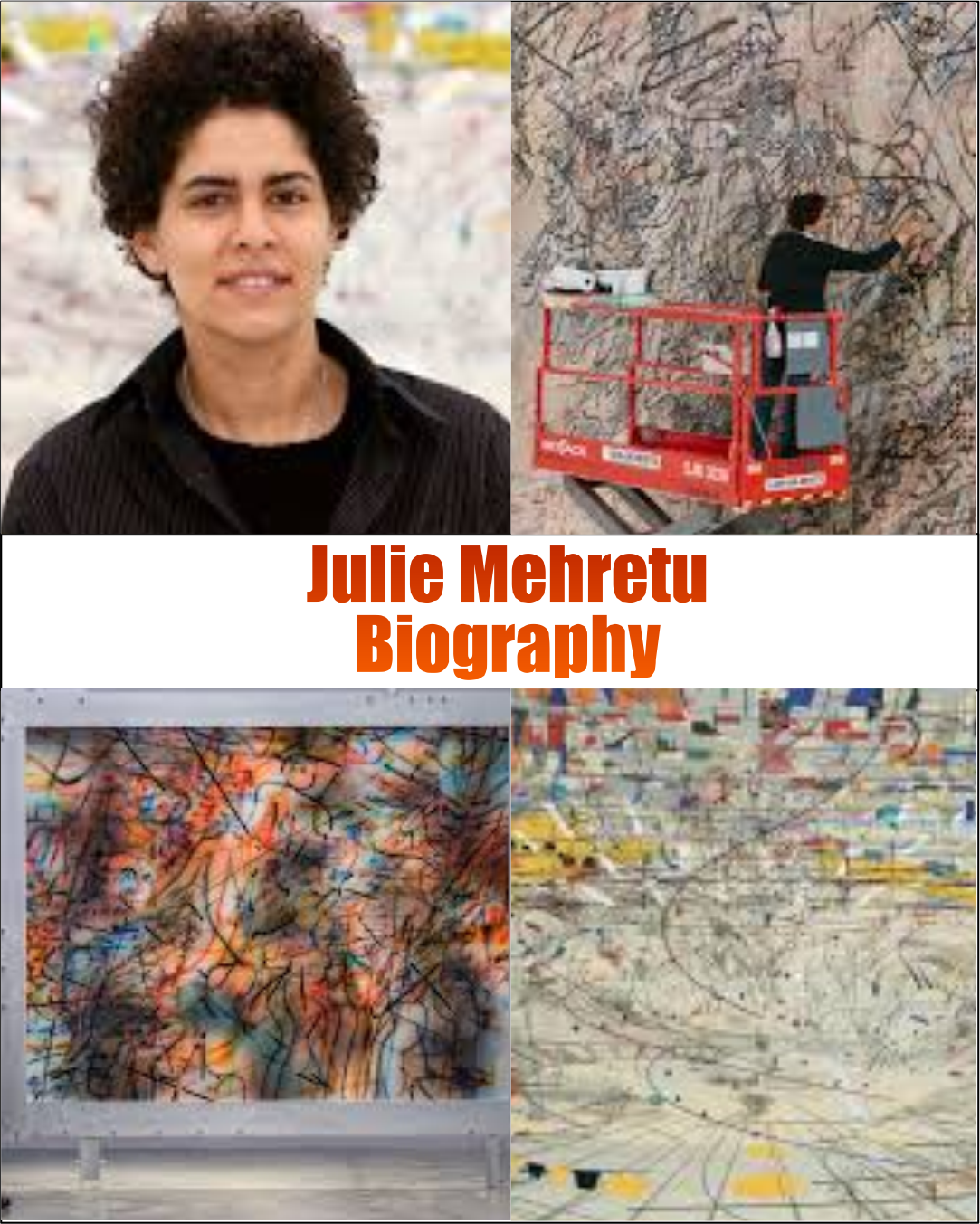
Julie Mehretu Biography
The Julie Mehretu Biography: Mapping Chaos, Power, and Global Movement Through Abstract Art
Discover the life of Julie Mehretu, the Ethiopian-American artist whose layered abstract paintings explore migration, power, and global systems.
The Artist Who Draws the World in Motion
Some artists paint what they see.
Julie Mehretu paints what cannot be held still.
Movement.
Migration.
Power shifting across borders.
Her canvases do not sit quietly.
They expand, collide, and fragment—like maps that refuse to stay fixed.
Because for Mehretu, the world is not stable.
It is constantly in motion.
Julie Mehretu Biography
| Information | Details |
|---|---|
| Full Name | Julie Mehretu |
| Date of Birth | 1970 |
| Age | ~56 years (as of 2026) |
| Place of Birth | Addis Ababa, Ethiopia |
| Nationality | Ethiopian-American |
| Occupation | Painter, Visual Artist |
| Education | Rhode Island School of Design (RISD) |
| Known For | Large-scale abstract paintings with layered mapping techniques |
| Art Style | Abstract expressionism, conceptual mapping |
A Life Shaped by Displacement
Julie Mehretu was born in 1970 in Addis Ababa, Ethiopia.
Her early childhood was interrupted by political unrest, forcing her family to leave the country.
They relocated to the United States, carrying with them the experience of displacement.
This early shift—between place, identity, and belonging—became central to her perspective.
She grew up between worlds.
And that in-between space would later define her art.
Education and the Language of Abstraction
Mehretu studied art in the United States, eventually earning her MFA from the Rhode Island School of Design.
During this time, she developed an interest in abstraction—but not in its traditional sense.
She was not interested in removing meaning.
She wanted to layer it.
To build complexity rather than reduce it.
See also: Miriam Makeba Biography: The Exiled Voice Who Sang Africa to the World
A Signature Style Built on Layering and Mapping
Mehretu’s paintings are large, often monumental.
They begin with architectural drawings—blueprints, city plans, structural outlines.
Over these, she layers:
- Lines
- Marks
- Gestures
- Symbols
The result is dense, dynamic compositions that feel like cities in motion.
Or histories overlapping.
Most Famous Works That Redefined Abstract Painting
Among Mehretu’s most recognized works are:
- Stadia II
- Mogamma (A Painting in Four Parts)
- Black City
These works do not present clear narratives.
Instead, they create environments—spaces where multiple events seem to unfold simultaneously.
Viewers are not guided.
They navigate.
Inspiration Rooted in Global Systems
Mehretu’s work draws from:
- Urban development
- Political conflict
- Migration patterns
- Historical events
She studies how systems operate—how power moves, how spaces are controlled, how people shift within them.
Her paintings become visual representations of these processes.
Hidden Meanings in Complexity
At first glance, Mehretu’s work can feel overwhelming.
Lines intersect.
Forms overlap.
There is no clear focal point.
But this complexity is intentional.
It reflects:
- The density of modern life
- The layering of history
- The instability of global systems
Her work resists simplification.
Because the subjects she explores cannot be simplified.
Struggles in Being Understood
Abstract art often faces a particular challenge.
It is expected to explain itself.
To justify its meaning.
Mehretu’s work does not offer easy interpretation.
This has led to moments where audiences struggle to engage with it.
But that resistance is part of the experience.
Her work requires time.
Attention.
Patience.
Influence on Contemporary Art
Mehretu has had a significant impact on contemporary painting.
She expanded abstraction into a space where it could engage directly with global issues.
She showed that:
- Abstract work can carry political meaning
- Scale can amplify complexity
- Painting can function like a map
Her influence is visible in artists who now explore similar intersections.
Controversy and Interpretation
Mehretu’s work has sparked discussion around accessibility.
Some critics argue that its complexity creates distance from broader audiences.
Others see this as necessary—that the work reflects the very systems it critiques.
There are also conversations about how her identity shapes interpretation, particularly in global art contexts.
These debates continue.
Recognition Across the Global Stage
Mehretu has achieved widespread recognition.
Her work has been exhibited in major institutions, including:
- The Museum of Modern Art
- The Guggenheim Museum
- The Whitney Museum of American Art
She has received numerous awards and honors, establishing her as a leading figure in contemporary art.
The Value of Her Artworks
Mehretu’s paintings are among the most valuable in contemporary art.
Her large-scale works command high prices at auction and in private sales.
Collectors value not only their visual impact, but their conceptual depth.
Her work exists at the intersection of art and global discourse.
A Legacy of Movement and Mapping
Mehretu’s legacy lies in how she visualizes complexity.
She does not present the world as fixed.
She shows it as layered, shifting, interconnected.
Her work becomes a record—not of a single moment, but of ongoing processes.
Still Creating, Still Expanding
Mehretu continues to produce work, exploring new ways to engage with global themes.
Her paintings evolve, but their core remains.
Movement.
Layering.
Transformation.
The Power of Scale and Density
What makes Mehretu’s work powerful is its scale.
Standing before one of her paintings is not a passive experience.
It requires engagement.
The viewer becomes part of the process—moving, scanning, interpreting.
Closing Reflection
Some artists create images.
Julie Mehretu creates systems.
She maps what cannot be easily seen—power, movement, history—and places it onto canvas.
Not as a fixed story.
But as something unfolding.
Something unresolved.
Something still in motion.
And in that space, her work does something rare.
It does not tell you what to see.
It asks you to look again.
Frequently Asked Questions
1. Who is Julie Mehretu?
Julie Mehretu is an Ethiopian-American contemporary artist known for her complex, large-scale abstract paintings that explore global systems and movement.
2. Why is Julie Mehretu famous?
She is celebrated for her layered compositions, combining architectural drawings, maps, and abstract marks to create dynamic visual narratives.
3. What themes does Julie Mehretu explore?
Her work addresses migration, globalization, politics, urbanization, and historical memory.
4. What makes her art unique?
Her technique involves layering digital and hand-drawn elements, creating dense, energetic compositions that reflect complex global realities.
5. What is Julie Mehretu’s legacy?
Her legacy lies in redefining abstraction by merging art, geography, and political commentary, influencing contemporary art globally.