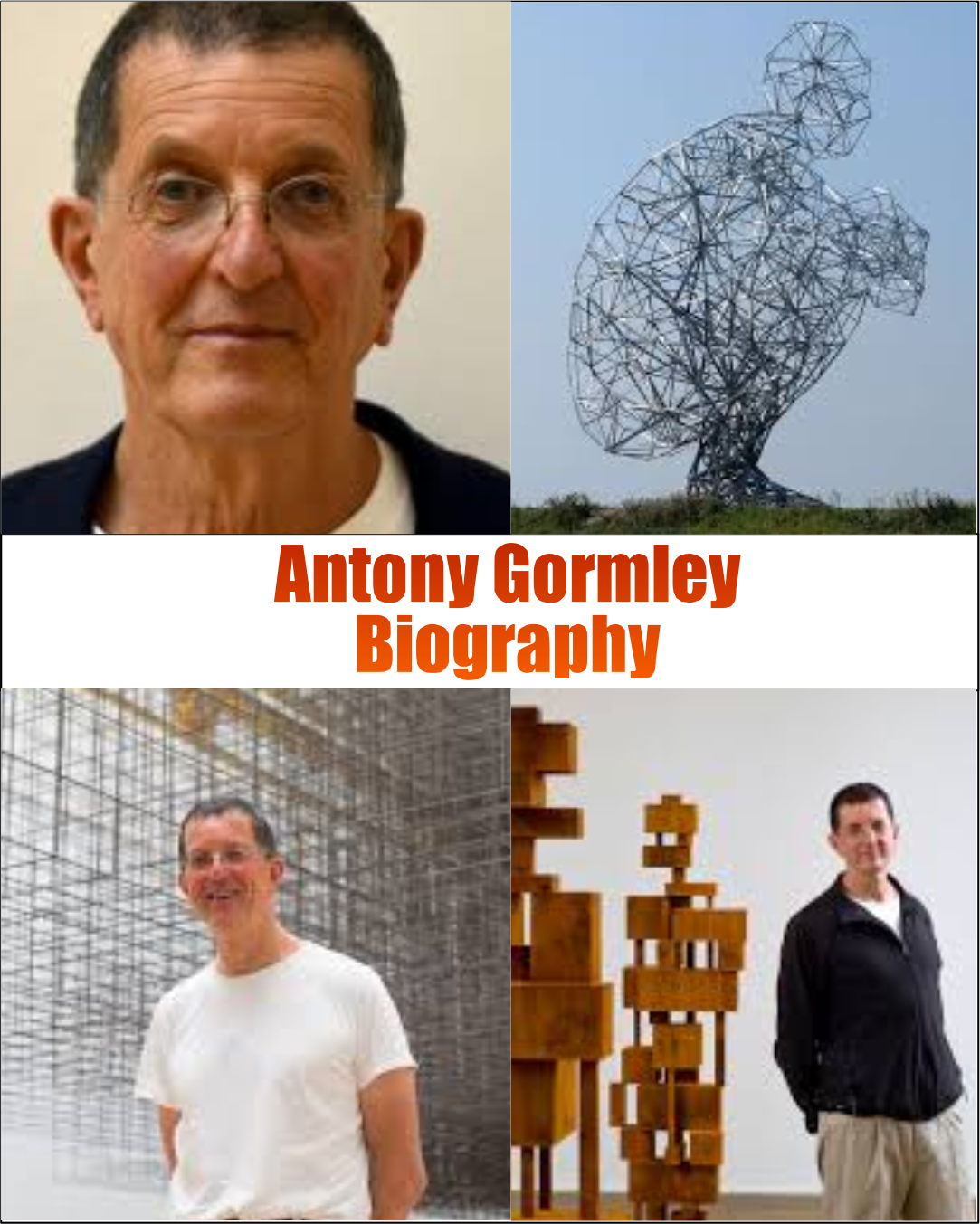
Antony Gormley Biography
The Antony Gormley Biography: Sculpting the Human Body Into Space and Silence
Discover the life of Antony Gormley, the British sculptor who uses the human body to explore space, presence, and the meaning of existence.
The Artist Who Turned the Human Body Into a Landscape
Most sculptures occupy space.
Antony Gormley does something different.
He reveals it.
Through still figures.
Through repetition.
Through the quiet presence of the human form.
His sculptures do not dominate their surroundings.
They exist within them—inviting you to notice space, distance, and your own place inside it.
Antony Gormley Biography
| Information | Details |
|---|---|
| Full Name | Antony Mark David Gormley |
| Date of Birth | August 30, 1950 |
| Age | 76 years (as of 2026) |
| Place of Birth | London, United Kingdom |
| Nationality | British |
| Occupation | Sculptor |
| Education | University of Cambridge; Central Saint Martins |
| Known For | Sculptures based on the human body |
| Famous Work | Angel of the North |
A Beginning Rooted in Reflection
Antony Gormley was born in 1950 in London, England.
His early life was shaped by a strong interest in philosophy and spirituality.
Before fully committing to art, he traveled extensively in Asia, spending time studying meditation and Buddhist practices.
These experiences would later influence his approach.
Not just what he created.
But why he created.
A Shift Toward the Body
Gormley’s decision to focus on the human body was not about representation in the traditional sense.
He was not interested in ideal forms.
Or perfect anatomy.
Instead, he used his own body as a starting point.
Casting it.
Reproducing it.
Not as identity—but as presence.
See also: Sanusi Lamido Sanusi Biography: The Banker Who Accused a Government of theft and Paid With His Throne
A Signature Technique Built on Casting and Space
Gormley’s most recognizable method involves creating casts of his own body, which are then transformed using materials such as:
- Iron
- Steel
- Lead
These figures are often simplified—reduced to essential forms.
They stand, sit, or lie in stillness.
But their power comes from placement.
On rooftops.
In open fields.
Along coastlines.
The environment becomes part of the work.
Most Famous Works That Redefined Public Sculpture
Among Gormley’s most iconic works are:
- Angel of the North
- Another Place
- Event Horizon
Angel of the North stands as a massive steel figure in northern England, its wings stretched wide across the landscape.
Another Place features multiple cast-iron figures placed along a beach, facing the sea.
Event Horizon installs figures on rooftops across a city, creating moments of unexpected encounter.
These works are not confined to galleries.
They exist in public space.
Inspiration Rooted in Existence and Perception
Gormley’s work is driven by fundamental questions:
- What does it mean to exist in space?
- How do we perceive ourselves in relation to the world?
- What is the relationship between body and environment?
His sculptures are not narratives.
They are prompts.
Hidden Meanings in Stillness
At first glance, Gormley’s figures can appear simple.
Static.
Silent.
But within that stillness lies complexity.
The repetition of identical forms removes individuality.
The placement creates context.
A figure on a beach means something different from a figure on a rooftop.
The work changes depending on where it exists.
Struggles in Minimal Expression
Gormley’s work does not rely on detail or decoration.
This minimalism can be challenging.
Some viewers struggle to connect with forms that appear repetitive or restrained.
But this restraint is intentional.
It creates space.
For interpretation.
For reflection.
Influence on Contemporary Sculpture
Gormley has had a significant impact on contemporary sculpture, particularly in how art interacts with public space.
He demonstrated that:
- Sculpture can extend beyond galleries
- The human form can be used as a universal reference
- Space itself can be a medium
His influence is visible in artists who now explore site-specific installations.
Controversy and Public Reaction
Public installations often invite strong reactions.
Some viewers find Gormley’s works powerful and contemplative.
Others see them as unsettling—figures appearing unexpectedly in everyday environments.
There have also been debates about placement, scale, and the role of public art.
These reactions are part of the work’s impact.
Recognition Across the World
Gormley’s work has been exhibited globally, and his public installations are among the most recognized in contemporary sculpture.
He has received numerous awards, including the Turner Prize.
His works are held in major collections and continue to attract attention worldwide.
The Value of His Artworks
Gormley’s sculptures hold significant value in the art market.
Large-scale installations, limited editions, and smaller works are collected by institutions and private collectors.
Their value reflects both artistic significance and public recognition.
A Legacy Built on Presence
Gormley’s legacy is not about narrative.
It is about presence.
He creates works that exist quietly, but powerfully—inviting viewers to become aware of themselves and their surroundings.
Still Creating, Still Exploring
Gormley continues to produce work, experimenting with new materials and forms.
His approach evolves, but his focus remains consistent.
The body.
Space.
Perception.
The Power of Simplicity
What makes Gormley’s work compelling is its simplicity.
A single figure.
Placed in space.
And yet, that simplicity opens up complex questions.
Closing Reflection
Some artists fill space.
Antony Gormley reveals it.
Through repeated forms and quiet placement, he creates moments of awareness—where the viewer becomes conscious of their own presence.
In that moment, something shifts. The sculpture is no longer separate. It becomes part of a shared space.
A shared experience. A reminder that even in stillness, there is meaning.
Frequently Asked Questions
1. Who is Antony Gormley?
Antony Gormley is a British sculptor known for creating large-scale works that explore the human body and its relationship with space.
2. Why is Antony Gormley famous?
He is famous for his iconic sculpture Angel of the North, one of the most recognized public artworks in the UK.
3. What themes does Antony Gormley explore?
His work explores human existence, space, body awareness, and the relationship between individuals and the environment.
4. What makes Antony Gormley’s art unique?
He often uses his own body as a template, creating sculptures that are both personal and universal.
5. What is Antony Gormley’s legacy?
His legacy lies in transforming public spaces with thought-provoking sculptures and redefining how the human body is represented in contemporary art.