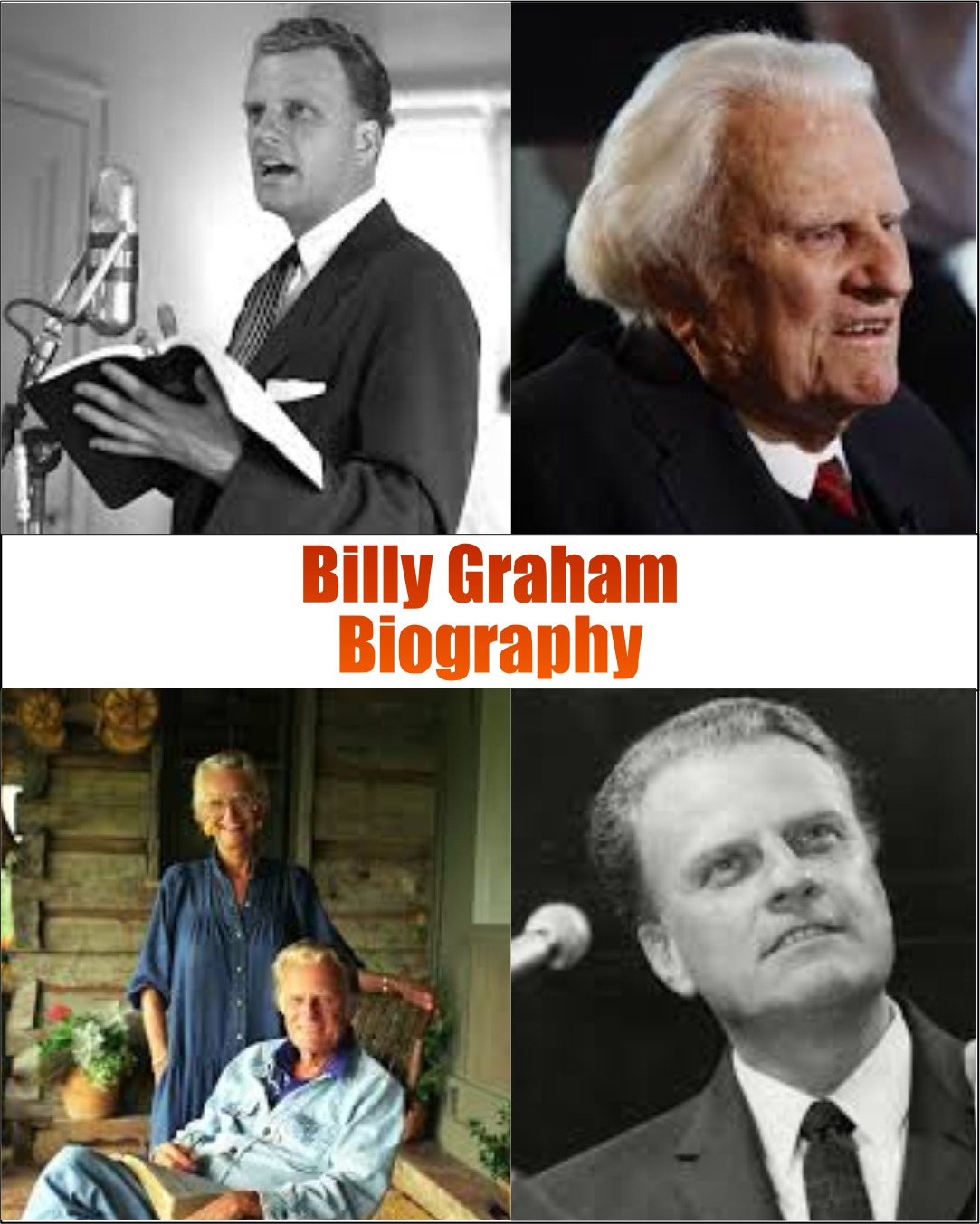
Billy Graham Biography
The Billy Graham Biography: The Evangelist Who Preached Faith to the World.
A deeply human biography of Billy Graham—his early spiritual journey, divine calling, teachings and doctrines, controversies, global influence, ministry growth, lifestyle conversations, societal impact, and enduring legacy.
The Man Who Spoke Faith Across Continents
In the chilly dawn of November 7, 1918, William Franklin Graham Jr. was born on a dairy farm near Charlotte, North Carolina—a place of humble beginnings that few would have predicted as the launching ground for a man who would one day preach to millions across continents. Billy Graham was not an intellectual theologian or a doctrinal innovator. Instead, he became one of the most recognizable voices of evangelical Christianity in the 20th century precisely because of his simplicity, sincerity, and unrelenting commitment to what he believed was a divine calling: to proclaim the Gospel of Jesus Christ to every corner of the world. Over six decades, Graham’s ministry wove its way into stadiums, living rooms, and hearts spanning more than 185 countries, leaving an imprint on global Christianity that endures to this day.
Billy Graham Biography
| Information | Details |
|---|---|
| Full Name | William Franklin Graham Jr. |
| Popular Name | Billy Graham |
| Date of Birth | November 7, 1918 |
| Date of Death | February 21, 2018 |
| Age at Death | 99 years |
| Place of Birth | Charlotte, North Carolina, USA |
| Nationality | American |
| Occupation | Evangelist, Preacher, Author |
| Known For | Global crusades and mass evangelism |
Early Spiritual Journey: Charlotte’s Farm to a Larger Stage
Growing up on a working dairy farm during the Great Depression, young Billy learned resilience, discipline, and the dignity of labor. His earliest years were shaped by equally humble rhythms—family devotions, prayer meetings in the barn, and the earnest, if quiet, pulse of faith that beat in countless rural homes. It was here, amid milk pails and fields that stretched toward distant horizons, that Graham’s awareness of God first took deep root.
Yet it was not until age 15 that his faith became personal and decisive. Attending a revival led by evangelist Mordecai Fowler Ham in Charlotte, Billy experienced what he later called his “decision for Christ”—a moment that transformed him from a churchgoing youth into someone convinced that God was calling him to something far greater than he had ever imagined.
He pursued Christian education at the Florida Bible Institute (now Trinity College) and later at Wheaton College in Illinois, where he honed his thinking and preaching style while developing lifelong friendships and, importantly, meeting Ruth Bell, whom he married in 1943.
A Calling Forged in Conviction
Graham’s calling was not the thunderous moment of cinematic epiphany. Rather, it was the steady recognition of purpose that emerged through personal struggle and spiritual reflection. A period of self‑doubt and theological uncertainty almost led him toward seminary studies, but in 1949, while on a retreat in the San Bernardino Mountains of California, he resolved to dedicate his life to preaching the Gospel without hesitation.
This resolve set him apart. Many of his contemporaries had formal theological titles or positions within established churches, while Graham envisioned something more expansive. His ministry would be itinerant, direct, public, and centered on calling people to a personal relationship with Jesus Christ. This conviction would become the bedrock of his evangelistic style—simple, clear, heartfelt, and uncompromising in its focus on salvation.
Teachings and Doctrines: Salvation Through Faith
Billy Graham’s message was straightforward: humanity’s brokenness could be healed only through repentance, faith in Jesus Christ, and acceptance of his death and resurrection. He was neither a nuanced systematic theologian nor an academic in the ivory tower; rather, his teaching was pastoral, aimed at the hearts of everyday people. His sermons clearly articulated the essentials of evangelical Christianity—sin, redemption, divine grace, and the hope of eternal life.
Despite criticism from both liberal and fundamentalist camps, Graham maintained a core commitment to Scripture and evangelism. His approach emphasized personal transformation and spiritual surrender, rather than detailed doctrinal debates. The sheer reach of his teaching—whether on radio, television, or in vast stadiums packed with expectant crowds—made him a defining voice of evangelical Christianity for generations.
See also: Pastor Tunde Bakare Biography: The Muslim Boy Who Became a Christian Prophet
Controversies and Criticisms: Between Tradition and Engagement
As Graham’s influence grew, so did scrutiny. Some traditional fundamentalists criticized him for what they saw as theological broadness and cooperation with mainline denominations. In the 1950s, his decision to involve mainline Protestant clergy in his campaigns—breaking from the separatism of strict fundamentalism—alienated some critics who saw this as diluting doctrinal purity.
Others took issue with Graham’s political associations. Though he claimed to avoid partisan politics, his friendship with figures such as President Richard Nixon, and his involvement in discussions around electoral campaigns, drew both praise and reproach. Some thought his political proximity risked conflating religious authority with political influence—questions that persist in evaluations of his legacy.
Critics also argued that his focus on large altar calls and revivals risked simplifying Christianity into a series of emotional decisions rather than lifelong discipleship. While supporters saw this as pastoral immediacy, detractors worried that such emphasis left little space for deeper spiritual formation.
Growth of the Ministry: Crusades Without Borders
The growth of Billy Graham’s ministry was nothing short of unprecedented. In 1950, he founded the Billy Graham Evangelistic Association (BGEA) to organize crusades and global outreach. Over six decades, his ministry reached almost 215 million people in over 185 countries and territories through crusades, media outreach, and allied ministries.
His early Los Angeles campaign in 1949—initially met with skepticism—would become a turning point, drawing massive crowds and launching his national and eventually global calling. His Greater London Crusade in 1954 brought more than two million attendees, solidifying his international reputation.
The BGEA evolved to include radio and television ministries, print resources, followed by satellite broadcasts that connected worldwide audiences to his preaching, long before online streaming became ubiquitous. These efforts not only multiplied his reach but also inspired countless local evangelists and ministries globally.
Influence on Followers: “America’s Pastor” and Beyond
To many, Graham was more than an evangelist—he was a spiritual mentor and moral anchor. He met with U.S. presidents across political lines, from Dwight Eisenhower to Barack Obama, offering counsel, prayer, and public support in moments of national crisis. This earned him the informal title of “America’s Pastor,” but his influence was distinctly global.
Millions of individuals testify that attending a Graham crusade, hearing his voice on the radio, or reading his books marked a turning point in their spiritual lives. Even decades after his death, his sermons continue to be broadcast, studied, and shared among Christian communities.
Lifestyle and Wealth: Simplicity in Service
Unlike some modern religious leaders whose lifestyles raise questions about wealth and comfort, Billy Graham maintained a consistent posture of simplicity and service. He lived modestly, avoided extravagant displays of wealth, and insisted that his ministry focus resources on outreach rather than opulence. The BGEA operated with volunteer networks and reinvested ministry profits into furthering evangelistic efforts around the globe.
While his name became widely recognized, Graham personally avoided flaunting wealth. His home in Montreat, North Carolina, was known not for luxury but for hospitality—where friends, family, and visitors could experience genuine warmth and engagement.
Legacy and Global Reach: An Undeniable Influence
Billy Graham’s legacy is vast and multifaceted. He helped shape the evangelical movement of the 20th century, bringing international attention to evangelistic missions and encouraging cross‑denominational cooperation. Conferences inspired by his vision—most notably the Lausanne Movement on world evangelization—have continued to mobilize Christian leaders on every continent.
Though the man himself passed away in 2018 at age 99, the structures he helped build—crusades, training centers, media outreach, and a global network of believers—continue to propagate his message and mission.
Impact on Society and Morality: Beyond Pulpits and Platforms
Graham’s impact extended beyond church walls into society’s moral and cultural fabric. During periods of social change, conflict, and fear, his voice offered a consistent appeal to faith, repentance, and moral clarity. Even critics acknowledge that countless individuals found solace, hope, and inspiration through his ministry.
His emphasis on personal conversion shaped how many Christians across the world understood faith—not as mere affiliation, but as a transformed life grounded in spiritual encounter. Though debates continue about the long‑term effects of mass evangelism on religious practice, few dispute Graham’s role in shaping global Christianity’s narrative across the late 20th and early 21st centuries.
Closing Reflection: The Evangelist Who Preached Hope
Billy Graham’s life was an extraordinary journey—from a Southern farm boy to a global preacher whose words shaped millions of souls. Through his character, convictions, and tireless service, he embodied a version of Christian evangelism that resonated across continents and cultures. His legacy, both celebrated and debated, continues to influence Christian thought and practice, reminding generations that a single life, lived with purpose and faith, can echo across the world.
Frequently Asked Questions
1. Who is Billy Graham?
Billy Graham was an American evangelist and one of the most influential Christian preachers of the 20th century.
2. Why is Billy Graham famous?
He became famous for his large-scale evangelistic crusades, preaching to millions of people across the world.
3. What are Billy Graham’s crusades?
His crusades were mass gatherings where he preached the gospel, often held in stadiums and broadcast globally.
4. Did Billy Graham influence politics?
Yes — he served as a spiritual advisor to several U.S. presidents and was influential in national and global conversations on faith.
5. What is Billy Graham’s legacy?
His legacy lies in spreading Christianity globally, shaping modern evangelism, and influencing generations of Christian leaders.