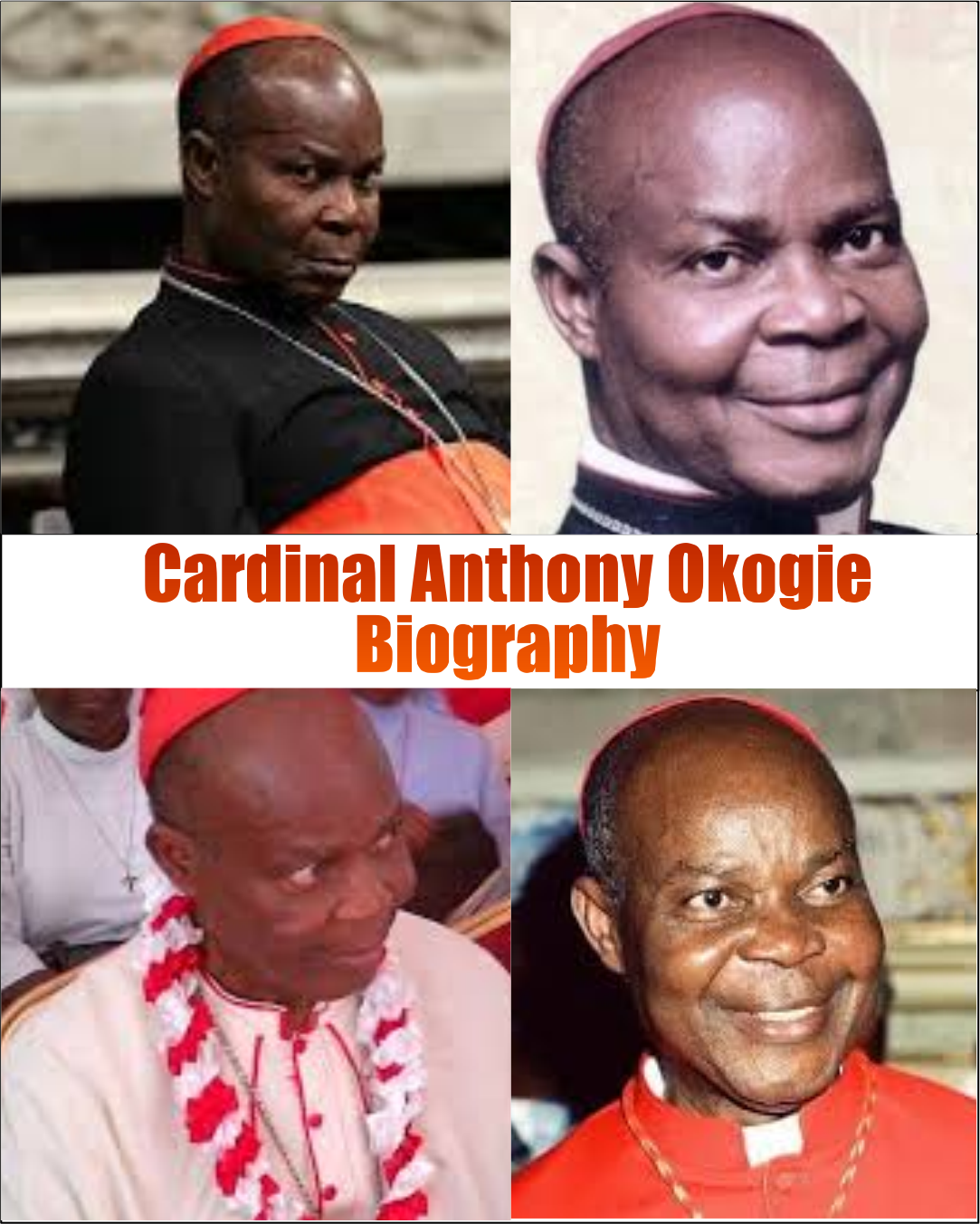
Cardinal Anthony Olubunmi Okogie Biography
The Cardinal Anthony Olubunmi Okogie Biography: The Archbishop Who Volunteered to Die for a Muslim Woman.
Cardinal Anthony Olubunmi Okogie served as Archbishop of Lagos for 39 years, grew 15 parishes to over 100, confronted Babangida and Abacha without flinching, volunteered to take the place of a Muslim woman sentenced to death by stoning, and built universities and hospitals with the same hands he used to sign letters that embarrassed heads of state. At 88 he is still writing them.
The Archbishop Who Offered to Die for a Muslim Woman — and Never Stopped Telling Nigeria the Truth: The Story of Cardinal Anthony Olubunmi Okogie
In 2002, a Nigerian woman named Safiya Hussaini Tungar-tudu was sentenced to death by stoning by a Sharia court in Sokoto State. She was thirty-five years old. She was still breastfeeding her eleven-month-old daughter. Her crime, under the court’s interpretation of Islamic law, was adultery.
The case produced international outrage. Human rights organisations filed petitions. Foreign governments issued statements. Lawyers appealed. And then, from Lagos, came a letter from a Catholic Archbishop that stopped everyone who read it cold.
Cardinal Anthony Olubunmi Okogie had written to the Sharia court authorities and volunteered to take Safiya’s place. To die instead of her. A Catholic Archbishop, offering his life for a Muslim woman condemned by a religious court that his own faith did not recognise.
“What I did was simply what any Christian would do,” he said afterward.
He was wrong about that. What he did was what almost nobody would do. It was the most compressed statement of his entire ministry — the belief that faith without justice is decoration, and that the walls between religions are far less important than the walls between the powerful and the powerless.
Cardinal Anthony Olubunmi Okogie Biography
| Information | Details |
|---|---|
| Full Name | Anthony Olubunmi Okogie |
| Date of Birth | June 16, 1936 |
| Age | 90 years (as of 2026) |
| Place of Birth | Lagos State, Nigeria |
| Nationality | Nigerian |
| Religious Role | Catholic Cardinal |
| Ordination | Ordained as priest in 1966 |
| Known For | Former Archbishop of Lagos and outspoken voice on national issues |
| Years Active | 1966 – present (retired from active archbishop duties in 2012) |
Early Spiritual Journey — Lafiaji, Lagos, and the Boy From Two Worlds
Anthony Olubunmi Okogie was born on June 16, 1936, in the Lafiaji neighbourhood of Lagos State, Nigeria. He was born into two worlds simultaneously. His father, Prince Michael Okojie, was the son of King Ogbidi Okojie of Uromi, making him Esan royalty from Edo State. His mother, Lucy Adunni Okojie née Afolabi, was Yoruba.
Lagos in the late 1930s and 1940s was a colonial city in ferment — economically alive, politically awakening, religiously diverse in ways that most African cities were not. Growing up in Lafiaji, a neighbourhood near Lagos Island’s historic waterfront, the boy who would become Nigeria’s most formidable Catholic voice absorbed the city’s complexity before he had words for it.
He attended Holy Cross School in Lagos, St. Patrick’s School in Sapele, and St. Gregory’s College in Lagos. The trajectory was consistently academic, consistently Catholic, and consistently shaped by institutions that the Church had built in colonial Nigeria. He enrolled in the seminary in Ibadan — discovering his love for serving God during his teenage years — and from there, his path seemed clear.
See also: Heroic deeds by African Priests in Europe
Calling or Divine Encounter — The War That Forged Him
After his ordination as a Catholic priest on December 11, 1966, at Holy Cross Cathedral, he was drafted into the Nigerian army and served as a chaplain during the Civil War.
He was thirty years old. He had been a priest for weeks. He was sent to the front lines of one of Africa’s most devastating conflicts — attached to General Benjamin Adekunle’s 3rd Marine Commando.
What a young priest sees at the front lines of a civil war is not the kind of thing that leaves the body quietly. He witnessed soldiers dying. He witnessed the specific cruelty that Nigerians were visiting upon other Nigerians in the name of ethnic and political grievances. He performed last rites. He listened to confessions of men who would be dead before morning. He expressed that his stay in the Nigerian army was one stacked with experiences — he witnessed how Nigerian soldiers struggled during the war and the molestations they endured.
The priest who returned from Port Harcourt was not the same man who had left Rome. Something had been burned away — the comfortable clerical distance between faith and consequences, between doctrine and the bodies it was supposed to protect. From that point forward, Okogie would never preach a gospel that did not have direct contact with the physical condition of the people listening to it.
Teachings and Doctrines — The Gospel According to Accountability
Okogie’s theology was never comfortable. It did not sit nicely in a pew and keep its head down. It walked into government offices, military barracks, and national newspapers and said things that made powerful people reach for their phones.
His foundational conviction was that the Church existed to speak for those who could not speak for themselves — that the pulpit was not a place for spiritual entertainment but a platform for prophetic confrontation. He preached social justice not as a supplement to the Gospel but as its core. The poor, the marginalised, the politically silenced — these were not a ministry option. They were the ministry.
He also held firm on Catholic doctrine in ways that made him equally uncomfortable for liberal observers. He defended priestly celibacy rigorously. In 2007, he condemned the government approval of a condom factory. He opposed homosexuality on doctrinal grounds. He was not a man whose beliefs could be assembled into a convenient political package — he was a Catholic, completely, which meant he was simultaneously to the left of Nigeria’s political class on justice and to the right of its progressive voices on sexual ethics.
That refusal to be categorised was itself a form of integrity.
Controversies and Criticisms — The Man Who Never Stopped Arguing
He argued with everyone. That was the point.
He argued with military governments. In 1986, under General Ibrahim Babangida’s administration, Okogie publicly protested Nigeria’s membership in the Organisation of Islamic Cooperation, interpreting it as a step toward Islamization that undermined the secular character of the state. This stance sparked riots in cities like Lagos and Port Harcourt and positioned him in direct confrontation with the regime. He did not retract. He escalated.
He argued with Pentecostal pastors. In a 2009 interview, he accused prominent Pentecostal figures of promoting a prosperity gospel that misinterprets Scripture for personal gain, through “claim it” theology and staged miracles that exploit believers. He named names — Enoch Adeboye, David Oyedepo — in an era when criticising these figures in Nigeria required significant institutional courage.
He argued with the democratic governments that replaced the military ones. His press conferences on the state of the nation were, as one award citation described them, thoroughly researched, incisive, and pertinent to meaningful and sustainable development. He confronted President Obasanjo over governance failures. He confronted Jonathan. He confronted Buhari. The face of the government changed. The letter from Lagos did not.
In 2021, at age 84, he penned a scathing letter criticising false claims about Boko Haram’s defeat: “Any government spokesman who says Boko Haram has been defeated will be answerable to God for every life they destroyed.”
Growth of Ministry — From 15 Parishes to Over 100
When Okogie arrived as Archbishop in 1973, Lagos Archdiocese had just 15 parishes. By the time he retired in 2012, that number had grown to over 100.
The growth was not simply numerical. Under his leadership, Augustine University, St. Raphael Divine Mercy Hospital, and St. Augustine’s College of Education were established, expanding access to quality education and healthcare. He also spearheaded the creation of a world-class dialysis centre and a water treatment plant to serve underserved communities.
He established Nigeria’s first privately owned College of Education. He built schools across the archdiocese consistently for thirty-nine years. The man who fought governments also built institutions — because he understood that fighting injustice without constructing alternatives was incomplete work.
Influence on Followers — The Cardinal Who Showed Up
He visited parishes personally. He engaged clergy and laity directly. In a country where religious leaders frequently became remote from their congregations once they achieved institutional prominence, Okogie maintained the pastoral visibility of a village priest while carrying the authority of a Cardinal.
His influence extended beyond Catholicism. He served as president of the Christian Association of Nigeria from 1988 to 1996 — meaning the voice of the entire Nigerian Christian community ran through him during some of the most politically turbulent years of the nation’s history. Muslim leaders respected him. Civil society organisations cited him. Journalists quoted him as a reliable source of institutional conscience in a country where such sources were rare.
The Safiya Hussaini case produced his most cross-religious moment of influence — an Archbishop whose intervention helped save a Muslim woman’s life generated a form of moral authority that no amount of institutional expansion could have produced.
Lifestyle and Wealth Discussions
Cardinal Okogie has never been associated with the accumulation of personal wealth. The institutions he built belong to the Church and the community — universities, hospitals, schools, a dialysis centre. He did not build a personal empire. He built a diocese.
His lifestyle was consistent with traditional Catholic clerical standards — austere by the measure of Nigeria’s religious celebrity culture, visible by the measure of a man who believed that pastoral presence was non-negotiable. He drove himself to appointments in later years. He lived in the Archbishop’s residence without the compound ostentation that has become associated with Nigerian religious leadership of other denominations.
His criticism of prosperity gospel preachers was not abstract theology. It came from someone who had watched his counterparts in other denominations accumulate private jets and multiple homes while their congregations remained poor — and who found it a straightforward contradiction of the Gospel he had been preaching since 1966.
Legacy and Global Reach
On October 21, 2003, Pope John Paul II elevated Okogie to the rank of Cardinal — making him the third Nigerian priest to receive this honour. He participated in the conclaves that elected both Pope Benedict XVI in 2005 and Pope Francis in 2013 — the Nigerian voice inside the rooms where the global Catholic Church chose its direction.
He was notably the one Cardinal in a wheelchair during the 2013 conclave proceedings, standing only to take the cardinal electors’ oath. The image — an elderly Nigerian man rising from a wheelchair in the Sistine Chapel to cast his vote for the future of the world’s largest Christian institution — contains its own sermon.
Impact on Society and Morality
Nigeria is a country where religious leaders shape public morality more directly than in most societies. The pulpit, the Friday sermon, the pastoral letter — these are not background noise. They are infrastructure.
What Okogie did with that infrastructure across thirty-nine years as Archbishop of Lagos was to make it impossible for the Church to be comfortable while the state was unjust. He set a standard — for what a Nigerian religious leader was obligated to do with their platform, for how the Church related to political power, for what the Gospel required of those who preached it.
Not every religious leader in Nigeria has followed that standard. Many have chosen proximity to power over accountability to it. But the standard exists, documented in press conferences and pastoral letters and the record of a man who offered to die in place of a Muslim woman because he believed that justice was indivisible.
Frequently Asked Questions
1. Who is Cardinal Anthony Okogie?
Cardinal Anthony Okogie is a prominent Nigerian Catholic leader who served as the Archbishop of Lagos for decades and is known for his strong stance on social justice, governance, and moral issues in Nigeria.
2. When did Anthony Okogie become a cardinal?
He was elevated to the rank of cardinal in 2003 by Pope John Paul II, recognizing his leadership and contributions to the Church.
3. What is Cardinal Okogie known for?
He is widely respected for his bold advocacy, frequently speaking out against corruption, injustice, and poor governance in Nigeria, making him a moral voice in national discourse.
4. When did he retire as Archbishop of Lagos?
Cardinal Okogie retired in 2012 after reaching the mandatory retirement age, handing over leadership of the Lagos Archdiocese.
5. What impact has Cardinal Okogie made in Nigeria?
His impact goes beyond the Church — he has influenced public opinion, governance debates, and moral leadership, earning recognition as one of Nigeria’s most outspoken religious figures.