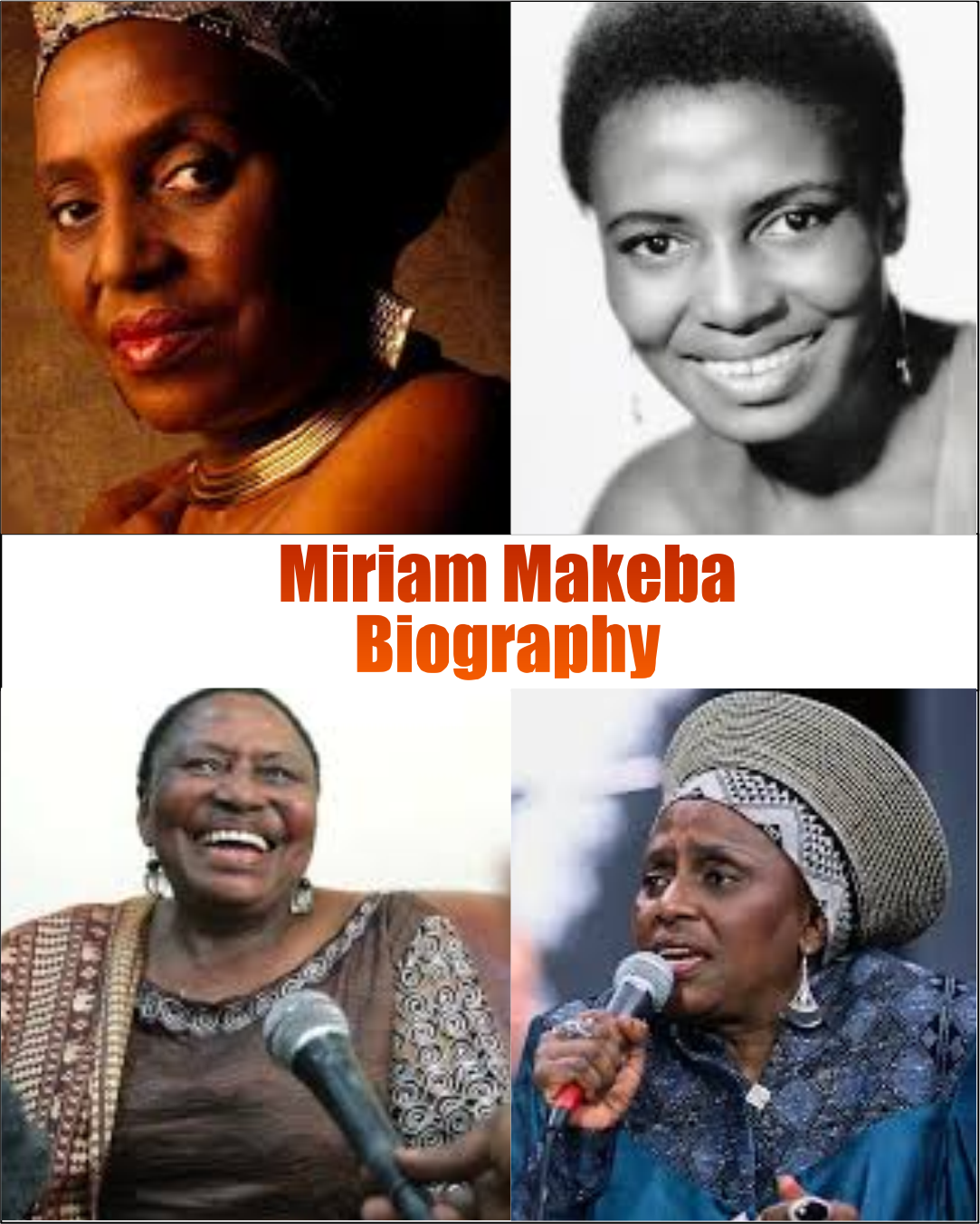
Miriam Makeba Biography
The Miriam Makeba Biography: The Exiled Voice Who Sang Africa to the World
Explore the life of Miriam Makeba, the South African icon who fought apartheid through music, lived in exile for decades, and became a global symbol of resistance.
The Voice They Tried to Silence
There are voices that entertain. There are voices that comfort. And then there are voices that carry the weight of a people’s pain, their hope, and their fight for dignity.
Miriam Makeba was not just a singer. She was a witness. A messenger. A living symbol of a country that tried to erase her—and failed.
For more than three decades, she was denied the right to return home. Her passport revoked. Her citizenship stripped. Her name watched. Her presence feared.
And yet, her voice traveled further than any border could contain.
She stood before the United Nations and told the world what apartheid was doing to her people. She sang in languages many could not understand—but felt deeply. And in doing so, she became something far greater than an artist.
She became Africa’s voice.
Miriam Makeba Biography
| Information | Details |
|---|---|
| Full Name | Zenzile Miriam Makeba |
| Stage Name | Miriam Makeba (“Mama Africa”) |
| Date of Birth | March 4, 1932 |
| Date of Death | November 9, 2008 |
| Age at Death | 76 years |
| Place of Birth | Johannesburg, South Africa |
| Nationality | South African |
| Occupation | Singer, Songwriter, Civil Rights Activist |
| Known For | Global hit Pata Pata and anti-apartheid activism |
A Childhood Marked by Struggle
Miriam Zenzile Makeba was born on March 4, 1932, in Johannesburg, South Africa, into a world already shaped by racial division and economic hardship.
Her first experience with injustice came almost immediately.
Her mother, a domestic worker and traditional healer, was imprisoned for brewing traditional beer—an act criminalized under oppressive laws targeting Black South Africans. Makeba spent the first months of her life in prison with her.
It was a beginning that would quietly shape everything that followed.
See also: Fela Kuti Biography: The Rebel Who Turned Music into a Weapon Against Power
Finding Her Voice in a Divided Country
By the 1950s, Makeba was already gaining attention as a performer. She joined groups like the Manhattan Brothers and later formed the Skylarks, blending jazz with traditional African sounds.
But South Africa was tightening under apartheid.
Opportunities for Black artists were limited. Movement was restricted. Expression was monitored. And yet, music found its way through.
Makeba’s breakthrough came when she appeared in the film Come Back, Africa, a documentary exposing the realities of apartheid. The film gained international attention—and so did she.
But that attention came at a cost.
Exile Begins
In 1959, Makeba traveled abroad to promote the film. While she was away, the South African government made a decision that would define the next three decades of her life.
They revoked her passport.
She was no longer allowed to return home.
What began as a trip became exile.
She would not set foot in South Africa again for more than 30 years.
A Voice on the World Stage
Exile could have silenced her. Instead, it amplified her.
Makeba settled in the United States, where her talent quickly gained recognition. She collaborated with major artists, including Harry Belafonte, who became both a mentor and a supporter.
Her music crossed borders.
Songs like “Pata Pata” introduced global audiences to African rhythms, while others carried deeper political messages. She sang in Xhosa, Zulu, and other African languages, refusing to dilute her identity for international appeal.
But her influence extended beyond music.
Standing Before the World
In 1963, Makeba addressed the United Nations.
She spoke about apartheid—not as an abstract issue, but as a lived reality. She described the violence, the systemic oppression, the daily humiliation faced by Black South Africans.
It was a powerful moment.
A singer, once silenced by her own country, now speaking to the world’s highest political body.
But once again, there were consequences.
The South African government officially banned her music. Her records were destroyed. Her name erased from public platforms within the country.
She became, in every sense, a voice without a home.
The Cost of Speaking Out
Makeba’s activism came with personal sacrifice.
Her marriage to Stokely Carmichael, a prominent figure in the Black Power movement, drew intense political scrutiny in the United States. As a result, she faced backlash, canceled performances, and increased surveillance.
Eventually, she left the U.S. and moved to Guinea, where she was welcomed by President Ahmed Sékou Touré.
Even in exile, she continued her work—performing, speaking, and representing African struggles on global platforms.
But exile is not just physical. It is emotional.
For years, she lived with the reality of being unable to return home—even when her mother passed away. She was denied the right to mourn her own family in her own country.
Music as Memory and Resistance
Despite everything, Makeba never allowed her music to lose its soul.
Her songs carried stories—of love, of loss, of identity. They were rooted in African traditions but spoke to universal experiences.
She did not separate art from politics. For her, they were inseparable.
Each performance was an act of remembrance. Each lyric, a quiet defiance.
She became known as “Mama Africa”—a name that reflected not just her origin, but her role.
She was not just representing South Africa. She was representing a continent.
The Return Home
In 1990, after decades of apartheid rule, change finally began.
Nelson Mandela was released from prison. One of his first public gestures was to invite Makeba back home.
After 31 years in exile, she returned to South Africa.
It was more than a homecoming. It was a restoration.
The country she had sung for, fought for, and been exiled from was finally ready to receive her again.
A Life That Refused to Slow Down
Even after her return, Makeba did not retreat into quiet reflection.
She continued to perform. To advocate. To speak.
Her voice, though aged, carried the same depth and clarity that had defined her career. She remained committed to causes beyond apartheid—human rights, equality, and African identity.
She had spent her life speaking for others. She was not about to stop.
The Final Performance
On November 9, 2008, Makeba performed at a concert in Italy.
It was an event organized to support a writer facing threats from organized crime. Even at 76, she chose to stand on that stage—for justice, once again.
After her performance, she suffered a heart attack.
She passed away that night.
There was something almost poetic about it.
A woman who had given her entire life to her voice—leaving the world just moments after using it one final time.
A Legacy Beyond Borders
Miriam Makeba’s legacy cannot be contained in records or awards.
She changed how the world heard Africa.
At a time when the continent was often misunderstood or ignored, she brought its sounds, languages, and stories to global audiences. But more importantly, she humanized its struggles.
She made people listen.
Her courage inspired generations of artists who saw in her a blueprint—not just for success, but for purpose.
The Voice That Still Echoes
Today, her music continues to travel.
“Pata Pata” still plays. Her ballads still resonate. But beyond the melodies, her message remains.
She showed that music could be more than entertainment. It could be testimony.
It could challenge systems. It could carry truth across borders.
It could outlive exile.
Closing Reflection
Some artists are remembered for their songs.
Miriam Makeba is remembered for what her songs stood for.
She lost her home—but never her voice. She faced silence—but chose to speak. She was exiled—but became global.
And in the end, the world listened.
Frequently Asked Questions
1. Who is Miriam Makeba?
Miriam Makeba was a South African singer and activist who used her music to fight against apartheid and promote African culture on the global stage.
2. Why is Miriam Makeba called “Mama Africa”?
She earned the nickname “Mama Africa” because she became a global symbol of African music, identity, and resistance, representing the continent with pride and authenticity.
3. What is Miriam Makeba’s most famous song?
Her most internationally recognized song is Pata Pata, which became a global hit and introduced African music to a wider audience.
4. What role did Miriam Makeba play in the anti-apartheid movement?
She spoke against apartheid at international platforms, including addressing the United Nations, which led to her exile from South Africa for many years.
5. What is Miriam Makeba’s legacy?
Her legacy lies in her contribution to African music, her role in the global fight against apartheid, and her influence on generations of artists and activists worldwide.