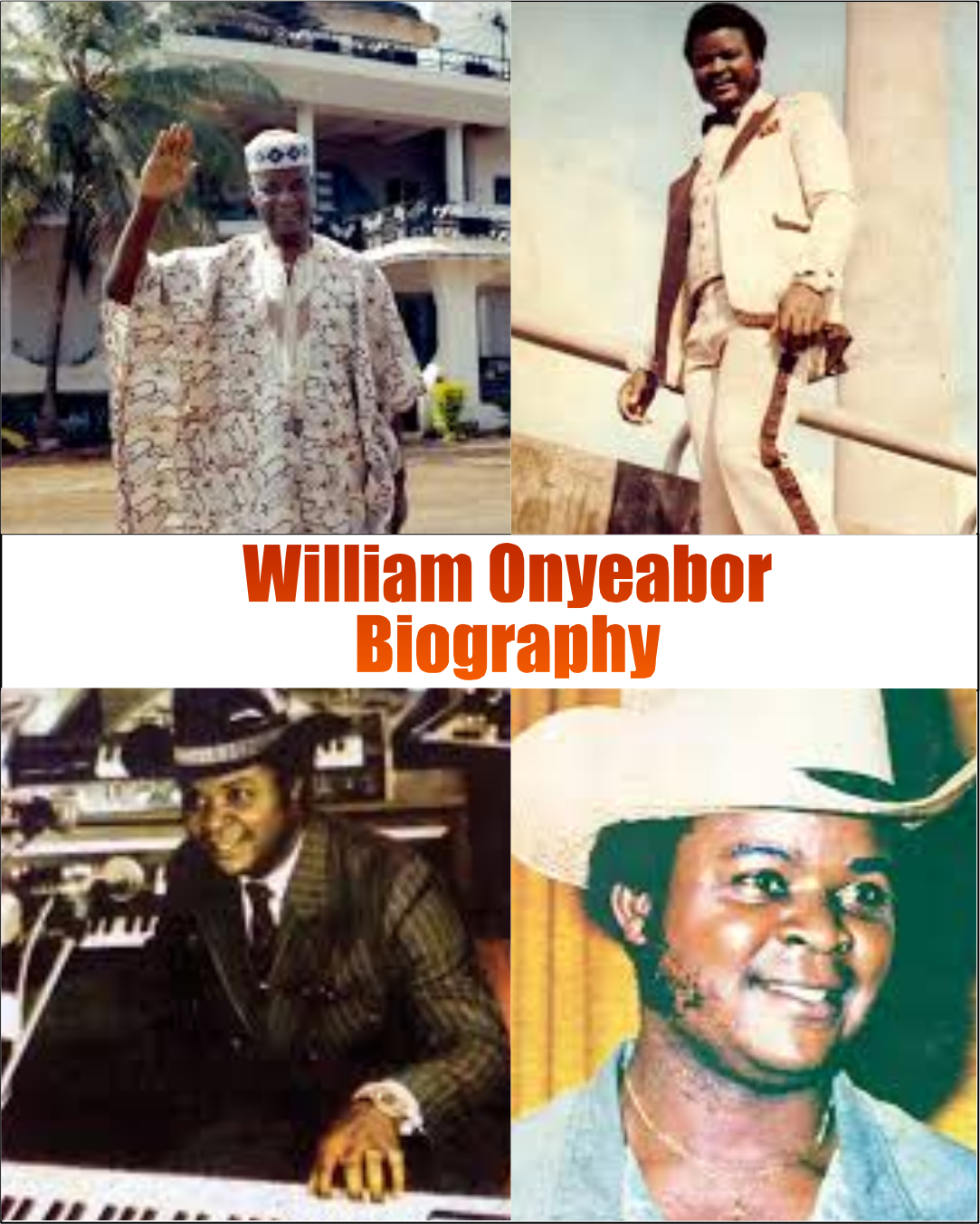
William Onyeabor Biography
The William Onyeabor Biography: The Enigmatic Genius Who Vanished and Became a Legend.
Discover the life of William Onyeabor, the mysterious Nigerian musician who created visionary electronic funk, disappeared from music for decades, and became a global cult icon.
The Man Who Refused to Explain Himself
Some artists build fame through visibility.
Others become unforgettable by disappearing.
William Onyeabor did something even stranger—he created a body of music so unique, so ahead of its time, that the world would spend decades trying to understand it… without ever hearing from him directly.
No interviews. No performances. No explanations.
Just music.
Between the late 1970s and mid-1980s, Onyeabor recorded a series of albums in Enugu, Nigeria—music filled with synthesizers, drum machines, hypnotic grooves, and lyrics that felt prophetic.
And then, just as quietly as he appeared, he stopped.
For over thirty years, he refused to speak about his work.
He became a mystery.
And in that silence, his legend grew.
William Onyeabor Biography
| Information | Details |
|---|---|
| Full Name | William Onyeabor |
| Date of Birth | March 26, 1946 (widely cited) |
| Date of Death | January 16, 2017 |
| Age at Death | 70 years |
| Place of Birth | Enugu State, Nigeria |
| Nationality | Nigerian |
| Occupation | Musician, Producer, Businessman |
| Known For | Pioneering African electronic funk and synth-driven music |
| Famous Label | Wilfilms Ltd (his independent record label) |
A Life Largely Untold
William Onyeabor was born on March 26, 1946, in Enugu State, Nigeria.
Unlike many artists whose early lives are documented in detail, much of Onyeabor’s story remains unclear. There are fragments—stories that circulate, details that appear in different forms—but very little that has been confirmed directly by him.
According to widely cited accounts, he studied film production abroad, reportedly in the Soviet Union. When he returned to Nigeria, he did not step into the spotlight as a filmmaker.
Instead, he built something else.
A recording studio.
A pressing plant.
A self-contained creative system that allowed him to make music entirely on his own terms.
See also: Fela Kuti Biography: The Rebel Who Turned Music into a Weapon Against Power
The Birth of a Sound That Had No Precedent
In the late 1970s, Nigerian music was thriving.
Highlife, Afrobeat, and traditional rhythms dominated the soundscape. Artists were experimenting, but within recognizable frameworks.
Onyeabor did not follow those frameworks.
He leaned into electronic instrumentation—synthesizers, drum machines, sequencers—at a time when such tools were rare in Nigerian music. His sound was minimal yet expansive, repetitive yet evolving.
It was not Afrobeat.
It was not disco.
It was not funk in the conventional sense.
It was something else entirely.
Eight Albums, No Compromise
Between 1977 and 1985, Onyeabor released eight albums.
He wrote, produced, arranged, and recorded them himself. He controlled the process from start to finish, using his Wilfilms studio in Enugu.
The songs were long, often stretching beyond typical radio formats. They built slowly, layering rhythms and textures in ways that felt hypnotic.
Tracks like “Better Change Your Mind,” “Fantastic Man,” and “Atomic Bomb” carried messages that ranged from philosophical to political.
There was a sense of urgency in his work.
A feeling that he was not just making music—but communicating something.
Music That Felt Ahead of Its Time
Listening to Onyeabor’s recordings, even decades later, can feel disorienting.
The sound does not sit neatly within its era.
His use of synthesizers feels modern. His structures feel experimental. His themes—technology, morality, change—carry a forward-looking tone.
Some listeners have described his music as prophetic.
Not because it predicted specific events, but because it seemed to exist outside of time.
He was not reacting to trends.
He was building something independent of them.
The Sudden Silence
Then, in the mid-1980s, he stopped.
No farewell announcement. No gradual fade.
Just silence.
Onyeabor withdrew from music completely. He became a devout Christian and reportedly distanced himself from his earlier work, choosing instead to focus on religion and business.
He refused interviews.
He declined offers.
He avoided public discussion of his music.
For decades, he remained unreachable.
The Mystery Deepens
In an age where artists often build their identity through visibility, Onyeabor’s absence created a vacuum.
And that vacuum filled with speculation.
Who was he, really? Why did he stop? What did his music mean to him now?
Journalists tried to track him down. Researchers searched for details. But Onyeabor remained consistent in his refusal.
He did not want to explain.
And in that refusal, he maintained control over his narrative.
Rediscovery by the Outside World
For years, Onyeabor’s records existed in relative obscurity—circulating among collectors, DJs, and a small group of dedicated listeners.
Then, in the 2010s, something shifted.
The American record label Luaka Bop, founded by David Byrne, began reissuing his work.
They introduced Onyeabor’s music to a global audience.
The response was immediate.
Listeners were fascinated—not just by the sound, but by the mystery surrounding the man behind it.
A Cult Figure Emerges
As his music reached new audiences, Onyeabor became something rare—a cult figure without participation.
Tribute concerts were organized. Musicians performed his songs live. His tracks appeared in DJ sets, playlists, and critical discussions.
Yet, through it all, Onyeabor remained silent.
He did not attend the events.
He did not comment.
He did not engage.
His presence was felt entirely through his work.
The Power of Refusal
There is something unusual about an artist who chooses not to capitalize on renewed fame.
Most would return. Rebrand. Reintroduce themselves.
Onyeabor did not.
His refusal became part of his identity.
It suggested that his music, once released, no longer belonged to him in the conventional sense. It existed independently—open to interpretation, free from explanation.
In a world that often demands constant visibility, his silence felt almost radical.
The Final Chapter
William Onyeabor passed away on January 16, 2017, at the age of 70.
Even in death, many questions remained unanswered.
There were no final interviews, no definitive accounts of his journey, no complete narrative.
But perhaps that was intentional.
A Legacy Built on Sound, Not Story
What Onyeabor left behind was not a carefully documented life.
It was music.
Eight albums. Dozens of tracks. A sound that continues to intrigue, inspire, and challenge listeners.
His work has influenced electronic musicians, DJs, and producers across genres. It has been studied, sampled, and celebrated.
But it has never been fully explained.
The Mystery That Remains
Even today, William Onyeabor’s story feels incomplete.
There are gaps. Unanswered questions. Contradictions.
But those gaps do not weaken his legacy.
They strengthen it.
They invite listeners to engage with the music on its own terms—without relying on biography or narrative to shape their understanding.
Closing Reflection
Some artists tell you exactly who they are.
William Onyeabor did the opposite.
He gave the world music—and kept himself hidden.
In that space between sound and silence, something rare emerged. A legacy not defined by interviews or appearances, but by the work itself.
And perhaps that is what makes him unforgettable.
Not just what he created.
But what he chose not to say.
Frequency Asked Questions
1. Who is William Onyeabor?
William Onyeabor was a Nigerian musician, producer, and entrepreneur known for his unique electronic funk sound and mysterious public persona.
2. Why is William Onyeabor famous?
He became famous for blending synthesizers, funk, and African rhythms, creating a futuristic sound that was ahead of its time.
3. What made William Onyeabor unique?
His music stood out due to his early use of electronic instruments in Africa and his reclusive lifestyle, rarely granting interviews or public appearances.
4. What are some of William Onyeabor’s notable songs?
Some of his well-known tracks include Fantastic Man, Atomic Bomb, and Good Name, which later gained global cult popularity.
5. What is William Onyeabor’s legacy?
He is now regarded as a cult legend whose work influenced modern electronic and Afro-fusion artists, especially after his music was rediscovered internationally years later.