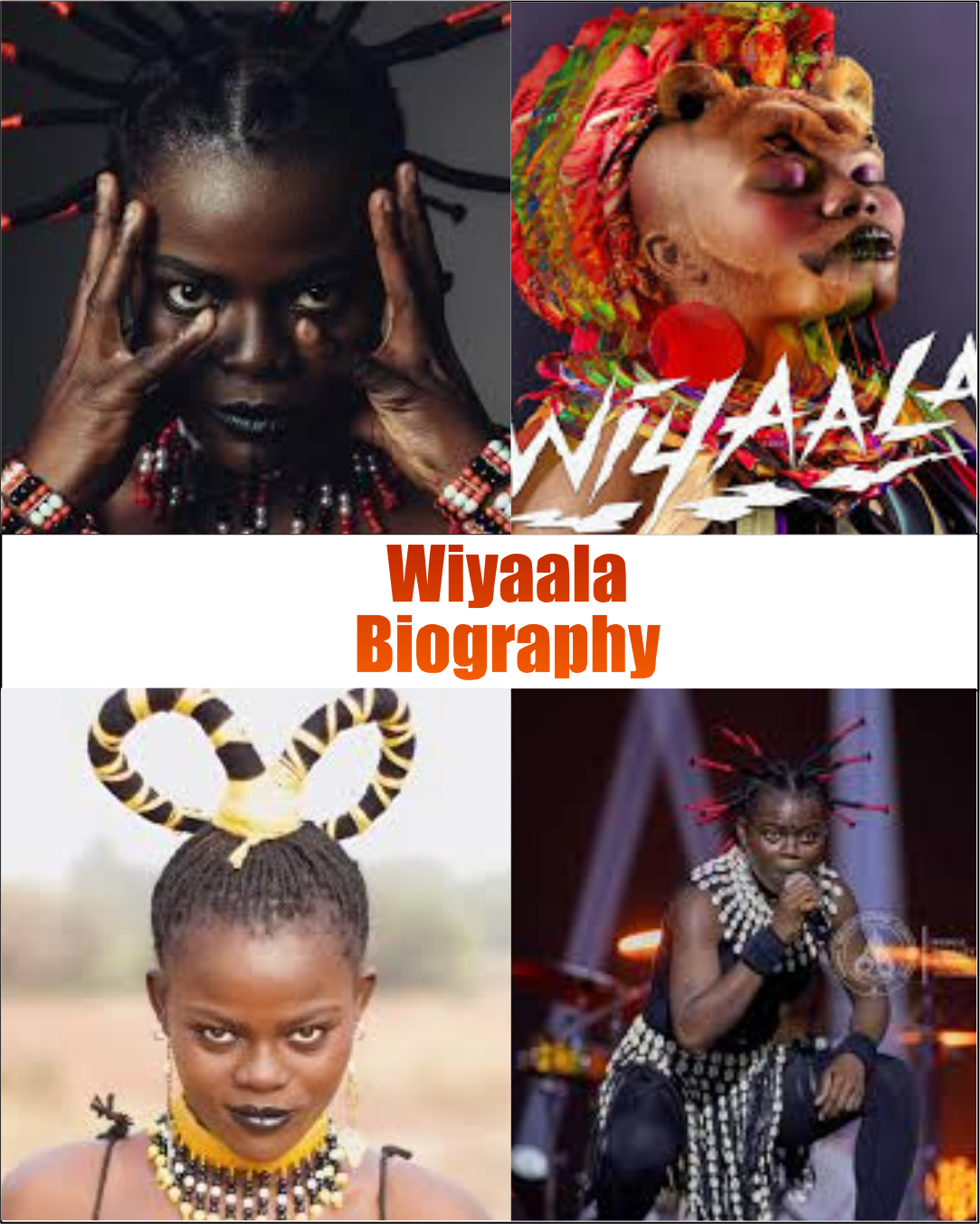
Wiyaala Biography
The Wiyaala Biography: The Fearless Voice Who Refused to Change Her Language.
Discover the story of Wiyaala, the Ghanaian artist who defied industry norms by singing in Sissala and rose to become an internationally recognized Afropop and rock performer.
The Voice That Refused to Translate Itself
In an industry that often rewards conformity, there are artists who succeed by adapting—changing their sound, their language, even their identity to fit a wider audience.
And then there is Wiyaala.
She did not adjust.
She did not translate.
She did not soften her roots for easier acceptance.
Instead, she stood firmly in a language spoken by roughly 100,000 people—Sissala—and carried it onto global stages without apology.
What makes her story remarkable is not just her success.
It is the path she refused to abandon.
Wiyaala Biography
| Information | Details |
|---|---|
| Full Name | Noella Wiyaala |
| Stage Name | Wiyaala |
| Date of Birth | December 22, 1986 |
| Age | 39 years (as of 2026) |
| Place of Birth | Funsi, Upper West Region, Ghana |
| Nationality | Ghanaian |
| Occupation | Singer, Songwriter, Performer |
| Known For | Unique fusion of Afro-pop, folk, and traditional African music |
| Awards | Winner of multiple All Africa Music Awards titles |
A Childhood Shaped by Rhythm and Resistance
Wiyaala, born Noella Wiyaala, grew up in northern Ghana, in a region far removed from the commercial centers that often shape musical careers.
Her environment was rich in culture but limited in opportunity.
There were no major studios. No industry connections. No clear roadmap to international recognition.
But there was music.
Traditional rhythms, community performances, and storytelling formed the foundation of her artistic identity. From an early age, she sang—not as a career move, but as a natural expression of her surroundings.
Her voice carried strength even then.
Not polished, not commercial—but powerful.
See also: Fela Kuti Biography: The Rebel Who Turned Music into a Weapon Against Power
The Road That Was Not Meant to Be Easy
Breaking into Ghana’s music industry is challenging on its own.
Doing so from the north, with a style that does not align with mainstream expectations, makes it even harder.
Wiyaala faced skepticism.
The dominant sounds in Ghanaian pop music leaned heavily toward languages like English and Twi, which had broader commercial reach. Singing in Sissala was not seen as viable for mainstream success.
She was advised—directly and indirectly—to change.
To adapt.
To become more “accessible.”
She refused.
A Breakthrough Without Compromise
Wiyaala first gained national attention through a reality music competition.
But even then, she did not present herself as a polished, industry-ready artist. She remained raw, energetic, and deeply connected to her roots.
Her performances stood out—not because they fit expectations, but because they broke them.
She combined Afropop with elements of rock and traditional Ghanaian rhythms. Her stage presence was electric—unpredictable, intense, and authentic.
People noticed.
Not just because she was different.
But because she was undeniable.
Singing in Sissala, Speaking to the World
Choosing to sing in Sissala was not just a linguistic decision.
It was a statement.
In a global industry where language often determines reach, Wiyaala chose identity over convenience. She trusted that emotion, rhythm, and performance could carry meaning beyond words.
And they did.
Audiences who did not understand her lyrics still connected with her music. There was a universality in her delivery—a sense that the message could be felt, even if it was not fully translated.
She proved that authenticity could travel.
Building a Sound That Refused Labels
Wiyaala’s music does not sit comfortably within a single genre.
It draws from Afropop, rock, folk, and traditional African sounds. Her songs shift between high-energy performances and more introspective moments, creating a dynamic listening experience.
But beyond genre, what defines her work is intention.
She is not trying to fit into a category.
She is creating something that reflects who she is.
That freedom is evident in her recordings—and even more so on stage.
A Stage Presence That Commands Attention
Live performance is where Wiyaala truly comes alive.
Her energy is physical, almost kinetic. She moves with intensity, her voice cutting through rhythms that feel both familiar and new.
She does not perform to impress.
She performs to express.
Audiences, regardless of background, respond to that honesty. Whether in Ghana or on international stages, her presence demands attention.
Not through spectacle.
Through authenticity.
International Recognition, On Her Own Terms
Wiyaala’s refusal to conform did not limit her reach—it expanded it.
She began performing internationally, appearing at festivals and events across Europe and beyond. Her music, rooted in a specific cultural context, resonated with diverse audiences.
She received awards and recognition, including honors that acknowledged not just her talent, but her commitment to cultural identity.
Importantly, none of this required her to change her core.
She remained exactly who she had always been.
Representation Beyond Music
Wiyaala’s impact extends beyond her recordings.
She represents something larger—a shift in how African artists can approach global platforms. She challenges the idea that success requires dilution or compromise.
For many young artists, especially those from underrepresented regions, her story offers a different possibility.
You can remain rooted.
You can be specific.
And still be heard.
The Power of Staying True
In an industry that often prioritizes marketability, Wiyaala’s journey highlights a different kind of strength.
Consistency.
She has maintained a clear sense of identity, even as her audience has grown. She has resisted pressure to conform, even when it might have offered quicker success.
That kind of discipline is rare.
And it is part of what makes her story compelling.
A Voice for the Margins
By choosing to sing in Sissala, Wiyaala gives visibility to a language and culture that might otherwise remain on the margins of global music.
She carries stories, sounds, and perspectives that are often overlooked.
Her work becomes more than entertainment.
It becomes representation.
Still Evolving, Still Grounded
Wiyaala continues to create, perform, and expand her reach.
But even as her career grows, her foundation remains the same.
She is not chasing trends.
She is building something consistent.
A body of work that reflects her identity, her culture, and her perspective.
The Sound of Refusal and Possibility
What makes Wiyaala’s story powerful is not just what she has achieved.
It is how she has achieved it.
She did not take the expected path.
She did not follow the easiest route.
She chose a direction that many believed would limit her—and turned it into her strength.
Closing Reflection
Some artists succeed by changing who they are.
Wiyaala succeeded by refusing to.
She trusted her voice, her language, and her identity—even when the industry suggested otherwise.
And in doing so, she created something rare.
A career built not on compromise, but on conviction.
Frequently Asked Questions
1. Who is Wiyaala?
Wiyaala is a Ghanaian singer and performer known for her energetic stage presence, powerful voice, and incorporation of traditional African culture into modern music.
2. Why is Wiyaala famous?
She gained fame through her unique musical style, blending Afro-pop with traditional Ghanaian sounds, and for her strong cultural identity and performances.
3. What languages does Wiyaala sing in?
She sings in multiple languages, including Sissala, Waala, and English, helping her connect with diverse audiences.
4. What awards has Wiyaala won?
She has won several prestigious awards, including honors at the All Africa Music Awards, recognizing her talent and contribution to African music.
5. What makes Wiyaala different from other artists?
Her authenticity stands out — from her traditional fashion style to her culturally rooted music, she represents African heritage boldly on the global stage.