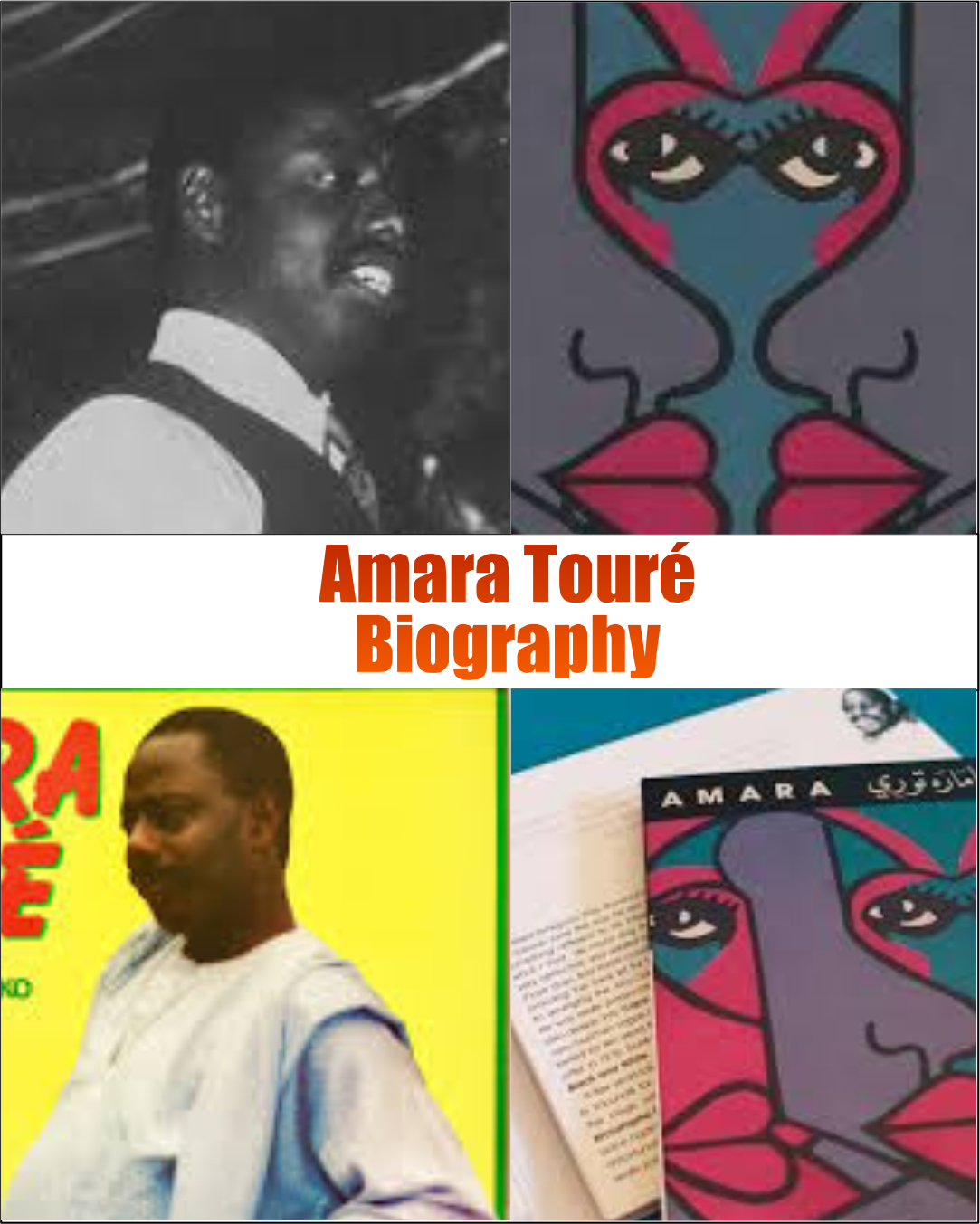
Amara Touré Biography
The Amara Touré Biography: The Keeper of Tradition Who Carried the Kora Across Continents.
Discover the life of Amara Touré, the West African musician who preserved and transformed the griot tradition, bringing the kora from ancestral courts to global stages.
The Sound That Carries Generations
In West Africa, music is not just performance.
It is memory.
It is history, carried not in books, but in voices and strings—passed from one generation to the next through tradition, discipline, and responsibility.
At the center of that tradition stands the griot: historian, storyteller, musician, and keeper of cultural identity.
Amara Touré belongs to this lineage.
But his story is not only about preservation.
It is about transformation.
He did not simply inherit tradition—he expanded it, carried it across borders, and introduced it to audiences far beyond the communities where it was born.
And in doing so, he ensured that something ancient would continue to live in a changing world.
Amara Touré Biography
| Information | Details |
|---|---|
| Full Name | Amara Touré |
| Date of Birth | Not publicly documented |
| Date of Death | Not widely confirmed (reportedly passed, exact details unclear) |
| Place of Birth | Guinea |
| Nationality | Guinean |
| Occupation | Musician, Vocalist |
| Known For | Afro-Cuban and West African fusion music |
| Famous Association | Member of Orchestre Syli National |
| Active Era | 1960s–1970s |
Born Into a Living Tradition
Amara Touré was born into a cultural system where music was not a choice.
It was a calling.
In the Mande regions of West Africa—spanning parts of Guinea, Senegal, Mali, and beyond—the griot tradition is deeply embedded in society. Families pass down musical knowledge through generations, with each new member trained from an early age.
Touré grew up within this structure.
From childhood, he was surrounded by music that carried stories of kings, battles, migrations, and lineages. These were not just songs—they were historical records, encoded in melody and rhythm.
Learning them required more than skill.
It required understanding.
See also: Cardinal Anthony Olubunmi Okogie Biography: The Archbishop Who Volunteered to Die for a Muslim Woman
The Kora: Instrument of Memory
At the heart of Touré’s music is the kora.
A 21-string instrument often described as a bridge between a harp and a lute, the kora produces a sound that is both intricate and fluid. Its tones can feel delicate, yet carry remarkable depth.
For griots, the kora is more than an instrument.
It is a tool of storytelling.
Touré mastered it.
His playing combined technical precision with emotional expression, allowing him to navigate complex compositions while maintaining a strong narrative presence.
He was not just playing notes.
He was telling stories.
Learning Through Discipline and Repetition
The training of a griot is rigorous.
It involves years of observation, repetition, and practice. Songs are not written down—they are memorized, internalized, and eventually interpreted.
Touré’s development followed this path.
He learned from elders, absorbing both technique and meaning. Each piece he practiced carried layers—historical references, cultural significance, emotional weight.
Mastery was not measured by speed or complexity alone.
It was measured by authenticity.
Moving Beyond the Familiar
While deeply rooted in tradition, Touré’s journey did not remain confined to local performance spaces.
As opportunities emerged, he began performing beyond his immediate environment—first within the region, then internationally.
This transition was not without challenges.
Traditional music, when presented to unfamiliar audiences, can lose context. The meanings embedded within songs are not always immediately understood.
Touré navigated this carefully.
He did not simplify his music to make it easier.
He trusted its integrity.
Bringing the Kora to Global Stages
As he performed across Europe and other parts of the world, Touré introduced audiences to the sound of the kora in its authentic form.
For many listeners, it was a first encounter.
The instrument’s cascading tones, its rhythmic patterns, and its emotional resonance created a powerful impression. Even without understanding the historical context, audiences felt its depth.
Touré’s performances became a bridge.
They connected cultures without forcing translation.
Preserving While Evolving
One of the defining aspects of Touré’s work is balance.
He remained committed to preserving the griot tradition—its structures, its stories, its essence.
At the same time, he allowed for subtle evolution.
Collaborations with other musicians, exposure to different musical environments, and the natural process of artistic growth introduced new elements into his work.
But these changes were never forced.
They emerged organically.
Teaching the Next Generation
As his reputation grew, Touré’s role expanded beyond performance.
He became a teacher.
Through workshops, residencies, and collaborations, he shared his knowledge with younger musicians—both within Africa and internationally.
This aspect of his work is critical.
The griot tradition survives through transmission.
Without teaching, it fades.
Touré understood this responsibility and embraced it.
Recognition Across Continents
Over time, Touré’s contributions gained recognition.
His music began to appear in academic settings, studied for its structure and cultural significance. Conservatories in cities like Paris and New York incorporated kora studies into their programs, often drawing on the work of artists like him.
This was a significant shift.
An instrument once associated primarily with oral tradition was now being examined within formal institutions.
Touré’s influence was part of that transition.
A Cultural Ambassador Without Labels
Though often described as a cultural ambassador, Touré’s work resists simple categorization.
He is not just a performer of traditional music.
He is a carrier of history.
His presence on stage represents more than individual expression—it reflects a lineage, a system of knowledge, and a way of understanding the world.
The Challenge of Modernity
As global music continues to evolve, traditional forms face new pressures.
Commercial trends, digital platforms, and changing audience expectations can push artists toward adaptation that risks losing authenticity.
Touré’s approach has remained steady.
He engages with the modern world, but does not allow it to redefine his core.
This balance is not easy.
But it is essential.
The Enduring Sound of the Kora
Listening to Touré’s music today offers something rare.
A connection to a past that is still alive.
The kora’s sound does not feel outdated.
It feels continuous.
Through his playing, centuries of history remain present—not as something distant, but as something ongoing.
A Legacy Rooted in Continuity
Touré’s legacy is not measured only by recordings or performances.
It is measured by continuity.
By the students he has taught. By the audiences he has reached. By the tradition he has helped sustain.
He has ensured that the griot system does not remain static.
It moves.
It adapts.
It survives.
Closing Reflection
Some artists create something new.
Amara Touré carried something ancient—and made sure it would not be lost.
He did not separate himself from tradition.
He became part of its continuation.
And in doing so, he offered the world something rare.
Not just music.
But memory, preserved in sound.
Frequently Asked Questions
1. Who is Amara Touré?
Amara Touré was a Guinean musician known for his contributions to African music during the 1960s and 1970s, blending traditional sounds with Afro-Cuban influences.
2. Why is Amara Touré famous?
He gained recognition for his role in shaping early West African modern music, especially through his work with Orchestre Syli National.
3. What type of music did Amara Touré perform?
He performed a mix of Afro-Cuban rhythms, Guinean traditional music, and early forms of modern African pop.
4. Why is there limited information about Amara Touré?
Many African artists from his era were not widely documented, leading to gaps in publicly available information about his life and career.
5. What is Amara Touré’s legacy?
His legacy lies in influencing the development of African popular music, especially in Guinea, and contributing to the cultural identity of post-independence African music.