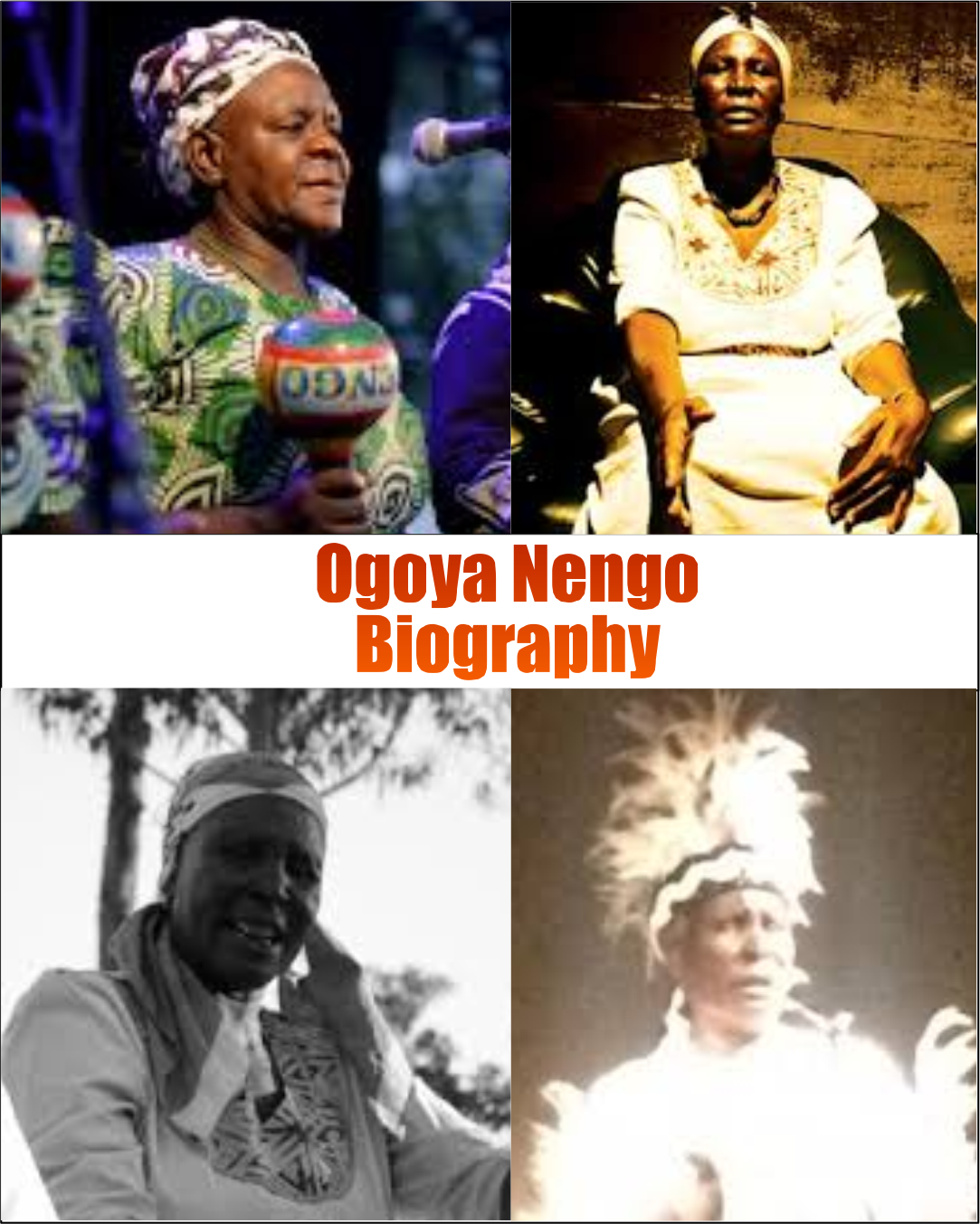
Ogoya Nengo Biography
The Ogoya Nengo Biography: The Last Voice of a Funeral Tradition That Refused to Fade.
Discover the life of Ogoya Nengo, the Kenyan singer preserving the sacred Luo dodo tradition, a funeral music form carried only by women and rooted in memory and loss.
The Voice That Sings for the Dead—and the Living
Some music is made for celebration.
Some for reflection.
And some exists for moments when words are no longer enough—when grief, memory, and farewell need something deeper than speech.
Ogoya Nengo carries that kind of music.
Her voice belongs to a tradition that is rarely heard outside its community, and rarely performed outside its purpose. Dodo music, among the Luo people of Kenya, is not entertainment.
It is ritual.
It is mourning.
It is remembrance.
And in a world that is rapidly changing, Ogoya Nengo stands as one of the last living voices keeping that tradition alive.
Ogoya Nengo Biography
| Information | Details |
|---|---|
| Full Name | Ogoya Nengo |
| Date of Birth | 1936 (approx.) |
| Age | ~90 years (as of 2026) |
| Place of Birth | Western Kenya |
| Nationality | Kenyan |
| Occupation | Traditional Singer, Cultural Performer |
| Known For | Preserving Luo traditional music |
| Music Style | Luo folk music and indigenous rhythms |
| Global Recognition | International exposure through world music compilations and collaborations |
A Tradition Rooted in Loss and Memory
Dodo is not a genre in the conventional sense.
It is a cultural practice.
Among the Luo people, it is traditionally performed by women during funerals—moments when grief is shared collectively, and music becomes a way to process loss.
The songs are not fixed.
They are shaped by the moment.
They carry the story of the person who has passed, the emotions of those left behind, and the weight of communal memory.
To sing dodo is not just to perform.
It is to hold space for grief.
Growing Into a Sacred Role
Ogoya Nengo was born in western Kenya, in a region where traditions like dodo remain deeply embedded in community life.
Her path into music was not defined by ambition or industry structure.
It was shaped by culture.
From an early age, she was exposed to dodo performances—observing, listening, absorbing the nuances of a practice that is both musical and spiritual.
Learning dodo is not formal.
It is experiential.
It comes through participation, through presence, through understanding the emotional and cultural weight of the songs.
Over time, Ogoya became not just a participant, but a carrier of the tradition.
A Voice That Holds Emotion Without Ornament
Dodo music does not rely on elaborate instrumentation.
It is centered on the voice.
Raw. Direct. Unembellished.
Ogoya Nengo’s singing reflects this.
Her voice carries a depth that does not come from technical display, but from emotional truth. There is a weight to it—a sense that each note is connected to something real, something lived.
She does not perform to impress.
She sings to express.
The Gendered Nature of the Tradition
One of the defining aspects of dodo is that it is traditionally performed by women.
This is not incidental.
It reflects broader cultural roles related to mourning, caregiving, and emotional expression within the community.
Ogoya’s position within this tradition is therefore not just musical—it is social.
She represents a lineage of women who have carried this responsibility across generations, using their voices to guide communities through loss.
From Local Ritual to Global Stage
For much of its history, dodo remained within its cultural context.
It was not recorded widely. It was not commercialized. It was not presented to external audiences.
That began to change as interest in traditional African music grew internationally.
Recordings of Ogoya Nengo’s work introduced dodo to listeners far beyond Kenya. What had once been a localized practice began to reach global audiences.
For many, it was a first encounter with a form of music so deeply tied to ritual.
See also: Fela Kuti Biography: The Rebel Who Turned Music into a Weapon Against Power
A Sound That Challenges Expectations
Listeners unfamiliar with dodo often approach it with expectations shaped by mainstream music.
But dodo does not follow those patterns.
It is not structured for entertainment.
It does not build toward predictable climaxes.
It moves according to emotion, according to the needs of the moment.
Ogoya’s recordings reflect this.
They require a different kind of listening—one that is patient, open, and willing to engage with something unfamiliar.
Preserving Without Transforming
As dodo reached wider audiences, there was a risk.
That it might be altered to fit external expectations.
Simplified. Restructured. Commercialized.
Ogoya Nengo’s approach has remained grounded.
She does not reshape the tradition to make it more accessible.
She presents it as it is.
This decision is significant.
It ensures that what listeners hear is not a version of dodo adapted for consumption, but the tradition itself.
The Fragility of Oral Traditions
Dodo, like many oral traditions, faces challenges in the modern world.
Urbanization, changing cultural practices, and the influence of global media all contribute to its decline.
Fewer people learn it.
Fewer opportunities exist to perform it in its traditional context.
This makes Ogoya’s role even more important.
She is not just a performer.
She is a link.
Recognition Without Commercialization
Ogoya Nengo has gained recognition within world music circles.
Her recordings have been appreciated for their authenticity and depth. Critics and listeners alike have acknowledged the significance of her work.
But her music has not been absorbed into mainstream commercial frameworks.
And perhaps that is appropriate.
Dodo is not designed for mass consumption.
Its power lies in its specificity.
A Voice That Carries More Than Sound
Listening to Ogoya Nengo is not just a musical experience.
It is a cultural encounter.
Her voice carries stories, emotions, and practices that are not always visible to those outside her community.
It invites listeners to engage—not just with sound, but with meaning.
Still Singing, Still Carrying
As one of the last prominent voices of dodo, Ogoya continues to perform and preserve the tradition.
Her work ensures that it does not disappear entirely.
But it also raises a question.
What happens when the last voices are gone?
The Importance of Continuity
Traditions like dodo survive through transmission.
They require new generations to learn, to practice, to carry forward what has been passed down.
Ogoya’s presence highlights both the strength and the fragility of this process.
She represents continuity.
But also the urgency of preservation.
Closing Reflection
Some music is created for the moment.
Ogoya Nengo’s music exists for moments that define life itself—loss, memory, farewell.
She does not perform for applause.
She sings for something deeper.
And in doing so, she carries a tradition that refuses to fade quietly.
Frequently Asked Questions
1. Who is Ogoya Nengo?
Ogoya Nengo is a Kenyan traditional singer known for preserving and promoting Luo cultural music through her performances and recordings.
2. Why is Ogoya Nengo famous?
She gained recognition for keeping indigenous African music traditions alive, especially Luo folk music, and bringing it to global audiences.
3. What type of music does Ogoya Nengo perform?
She performs traditional Luo folk music, often featuring rhythmic chanting, call-and-response, and indigenous instrumentation.
4. Has Ogoya Nengo gained international recognition?
Yes — her music has been featured in global world music collections and collaborations, helping introduce Kenyan traditional sounds internationally.
5. What is Ogoya Nengo’s legacy?
Her legacy lies in cultural preservation, ensuring that traditional Luo music continues to thrive and influence future generations.