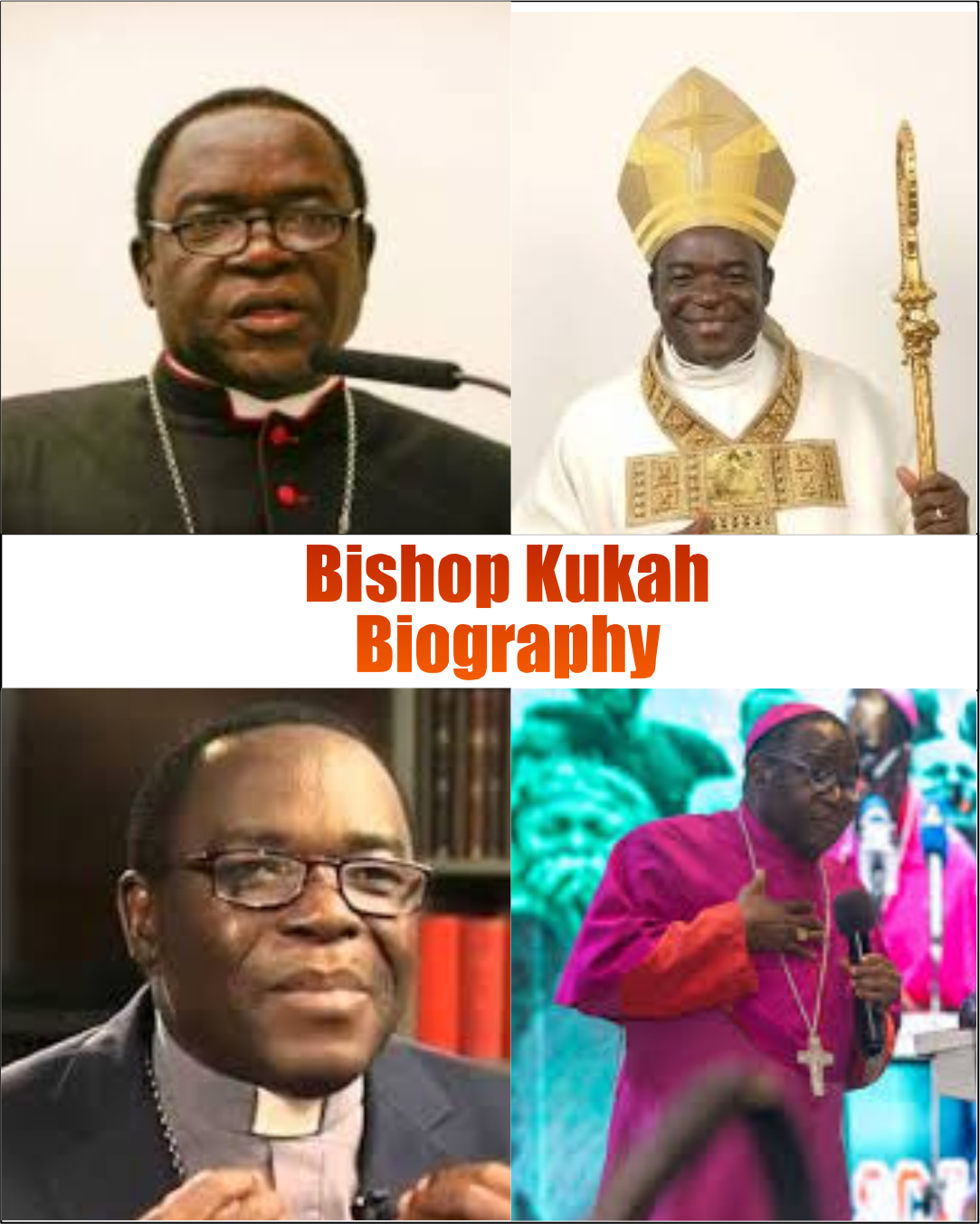
Bishop Kukah Biography
The Bishop Kukah Biography: The Catholic Bishop in Nigeria’s Most Muslim City
Meta Description: Matthew Hassan Kukah was born in a minority Christian community in Kaduna, became a Catholic bishop in Sokoto — the spiritual headquarters of Nigerian Islam — earned a PhD from London and fellowships at Oxford and Harvard, was summoned by the secret police for a Christmas message, and has spent fifty years producing the most consistently honest annual assessment of Nigeria’s soul that the country possesses. His Christmas homilies are read as state-of-the-nation addresses. They should be.
The Catholic Bishop in Nigeria’s Most Muslim City — Who Has Never Stopped Telling the Truth: The Story of Bishop Matthew Hassan Kukah
Every December, something happens in Nigeria that has no parallel in any other country’s public life.
A Catholic bishop in the northwestern corner of the country — in Sokoto, the spiritual headquarters of Nigerian Islam, the seat of the Sokoto Caliphate, the city whose Sultan is the most senior Islamic authority in West Africa — releases his Christmas homily. And the entire country stops to read it.
Not just Catholics. Not just Christians. Journalists, politicians, academics, civil society activists, Muslim intellectuals, diplomats, and ordinary Nigerians who have no particular religious affiliation read the annual Christmas message of Bishop Matthew Hassan Kukah because it is, year after year, the most precise and most honest account of what Nigeria has done to itself over the previous twelve months.
Governments have tried to silence it. The secret police have summoned him. Presidents have bristled. The message keeps coming — from the same city, from the same man, with the same refusal to be diplomatic when the country needs to hear something true.
That is the Kukah phenomenon. And it did not begin with a Christmas homily.
Bishop Kukah Biography
| Information | Details |
|---|---|
| Full Name | Matthew Hassan Kukah |
| Date of Birth | August 31, 1952 |
| Age | 73 years (as of 2026) |
| Place of Birth | Kaduna State, Nigeria |
| Nationality | Nigerian |
| Occupation | Catholic Bishop, Scholar, Public Intellectual |
| Religious Role | Bishop of Sokoto Diocese |
| Ordination | Ordained as priest in 1976 |
| Known For | Advocacy for peace, justice, and national unity |
Early Spiritual Journey — A Minority Child in a Contested Landscape
Bishop Matthew Hassan Kukah was born on August 31, 1952, in Anchuna, Ikulu Chiefdom in Zangon Kataf Local Government Area of Kaduna State.
Zangon Kataf. The name alone carries weight in Nigerian history — one of the most contested pieces of geography in the country, a region where the Atyap and Hausa-Fulani communities have clashed repeatedly across decades of religious and ethnic violence. To be born there, into a minority Christian community surrounded by a Muslim majority, is to grow up understanding from childhood that religion is not merely a private matter between a person and their God — it is a structural fact that shapes who gets land, who gets power, and who gets killed when the political temperature rises.
He attended St. Fidelis Primary School in Zagom, then St. Joseph Minor Seminary in Zaria, before proceeding to St. Augustine Major Seminary in Jos — the institutional pipeline of Nigerian Catholic clerical formation, each institution building on the last, producing a priest who understood Nigeria’s religious geography from the inside and had the academic discipline to analyse it from the outside.
What distinguished Kukah from other seminary students was the hunger for knowledge that the seminary alone could not satisfy. He kept going. He attended the University of Ibadan, where he obtained a diploma in religious studies. He received a Bachelor of Divinity at the Pontifical Urban University in Rome in 1976. Then a Master’s in Peace Studies from the University of Bradford. Then — the credential that set him apart from virtually every Catholic clergyman in Nigeria — a PhD in Political Science from the School of Oriental and African Studies, University of London in 1993.
See also: Sanusi Lamido Sanusi Biography: The Banker Who Accused a Government of theft and Paid With His Throne
Calling or Divine Encounter — The Priest Who Could Not Stop Thinking
Kukah was ordained a Catholic priest on December 19, 1976. He was twenty-four years old. His formation had given him the faith. His education was giving him the framework. What the next decades would give him was the specific anger — controlled, documented, publicly expressed — of a man who had studied how peace was built and watched his country systematically destroy the conditions for it.
His early assignments were pastoral and academic simultaneously. Associate Parish Priest, Kaduna (1977-1978). Lecturer and Dean of Students, St. Augustine’s Seminary (1978-1979). Rector of the Junior Seminary, Zaria (1981-1982). Cardinal’s Special Assistant, Abuja Catholic Church (1982-1986). Deputy Secretary General, Catholic Bishops Conference (1990-1993). Secretary General, Catholic Bishops Conference (1994-2000).
The trajectory from parish priest to Secretary General of the Catholic Bishops Conference in less than twenty-five years was not an accident. It reflected what people who worked with him consistently observed — that he combined pastoral warmth with an intellectual precision that was rare in the Nigerian church, and that he was willing to say things from the pulpit that other priests saved for private conversation.
Teachings and Doctrines — The PhD Who Preaches Like a Journalist
Kukah’s theology is grounded in one conviction that he has expressed in a hundred different ways across fifty years: the essence of government is to guarantee the welfare and security of ordinary citizens. When government fails that test — and in Nigeria, it fails it comprehensively and repeatedly — the Church has an obligation to name the failure publicly.
He does not preach prosperity. He does not preach miracles. He preaches accountability — the specific, structurally grounded accountability of a PhD political scientist who reads every government budget, who tracks every security failure, who counts the Chibok girls who have not come home, who notices when a president’s cabinet does not reflect Nigeria’s diversity.
He debunked the notion of insecurity as the direct result of conflict between Christians and Muslims — arguing that the perceived conflict is only an illusion created by those who try to distract Nigerians from the real issues of development. This argument — made from within the Catholic Church, in Sokoto, by a bishop who has lived among Muslims his entire career — carries an authority that no outsider could replicate.
He has also argued consistently for interfaith dialogue as a structural necessity rather than a diplomatic nicety. He serves as Chairman of the Committee on Inter-religious Dialogue of the Catholic Bishops’ Conference of Nigeria, a member of the Pontifical Council for Inter-religious Dialogue at the Vatican, and Chairman of the Committee on Inter-religious Dialogue for the Regional Episcopal Conference of West Africa. The institutional infrastructure of his dialogue work mirrors the intellectual conviction behind it — he has not simply argued for Muslim-Christian engagement, he has built the mechanisms for it at every level from his diocese to the Vatican.
Did you know?
Since 2011, Kukah has led the Diocese of Sokoto — in the extreme northwest of Nigeria, a staunchly Muslim area that is the seat of the Sokoto Caliphate. A Catholic diocese has operated continuously in Sokoto since 1964. Under Kukah’s leadership it has not simply survived — it has expanded, with a new diocese carved out of it in Katsina in October 2023. The institutional endurance of a Catholic presence in the spiritual heart of Nigerian Islam, under his leadership, is itself a form of prophetic statement.
Controversies and Criticisms — The Christmas Messages That Moved the Country
The controversies that define Kukah’s public ministry are not personal scandals. They are political ones — the specific controversies that arise when a man with a platform refuses to say what powerful people want to hear.
In December 2021, he released a Christmas message criticising President Muhammadu Buhari’s government for complicity in the face of kidnappings and other persecution of the country’s citizens — saying the government seemed to have left the fate of Nigerians in the hands of “evil men.” The message went national immediately. The SSS — federal secret police — reportedly ordered him to present himself for questioning.
He did not retract the message. He continued.
His 2020 Christmas message accused Buhari of overtly favoring Islam and predominantly Muslim northern Nigeria, excluding Christians from positions of influence. He described the years 2015 to 2023 as the worst phase in the history of interfaith relations in Nigeria.
His most recent controversy is perhaps his most nuanced. Speaking at the Vatican in October 2025 at the launch of Aid to the Church in Need’s Religious Freedom Report, he argued that all Nigerians faced insecurity due to a weak state — rather than framing the violence as specifically anti-Christian persecution. The response from fellow Catholic clergy and Christian rights groups was fierce. One civil liberties director asked: “Who the hell is he?” and accused him of being compromised by his ties to government.
Growth of Ministry — Diocese, Academy, and the Kukah Centre
In December 2020, Pope Francis appointed him as a member of the Dicastery on Integral Human Development — the Vatican body responsible for Catholic social teaching, justice, and ecology. The appointment placed his voice in one of the most significant policy-shaping bodies of the global Catholic Church.
In Sokoto, his diocese has grown physically and institutionally under his leadership. He serves as Pro-Chancellor and Chairman of Council of Nasarawa State University in Keffi, and Deputy Chairman of the Board of Trustees of American University in Yola — extending Catholic educational influence into predominantly Muslim regions without the triumphalism that such expansion could carry if led by someone less committed to interfaith respect.
The Kukah Centre — established as a think tank for democracy, development, and justice — has become one of Nigeria’s most respected civil society institutions. It produces research, hosts conversations, and provides institutional memory for democratic advocacy in a country whose political system has short institutional memory and shorter civic patience.
Influence on Followers — The Christmas Homily as National Conscience
The annual Christmas message is the most remarkable regular publication in Nigerian public life. He has publicly criticised governments, spoken on national television, granted interviews to major newspapers including The Punch, Vanguard, Premium Times, and Daily Trust, and issued Christmas homilies that have generated national debate.
What makes the homilies distinctive is their structure — they are not simply complaints. They are documented assessments, built from evidence, argued with the precision of a political scientist and delivered with the authority of a man who has been watching Nigeria from the front lines of its most religiously contested geography for fifty years.
Lifestyle and Wealth Discussions
Kukah’s lifestyle is consistent with traditional Catholic episcopal standards — and markedly different from the wealth display that characterises Nigeria’s Pentecostal religious culture. He lives in the bishop’s residence in Sokoto. He drives. He travels for academic engagements. He does not own a private jet. He has not built a personal empire.
The diocese he leads operates schools, clinics, and community development programmes — institutional wealth that belongs to the Church and the community, not to the individual who leads it. The Catholic Diocese of Sokoto donates wheelchairs to the Usman Danfodio University Teaching Hospital and the Federal Neuro-Psychiatric Hospital in Kware, Sokoto — the small, consistent, unglamorous acts of pastoral service that do not generate headlines but sustain communities.
Legacy and Global Reach
Bishop Kukah’s scholarship extends from pulpit to book. His published works — including Democracy and Political Reform in Nigeria, Witness to Justice, and Broken Truth — are taught in Nigerian universities and cited in international academic literature on religion and politics in Africa.
His global reach runs through the Vatican, through Oxford and Harvard alumni networks, through the international interfaith organisations he chairs, and through the specific credibility that comes from being a Catholic bishop who has spent fifteen years leading a diocese in the heartland of Nigerian Islam without being consumed by it and without abandoning the prophetic voice that makes his presence there meaningful.
Impact on Society and Morality
Nigeria’s public moral discourse is dominated by voices that are either too close to power to criticise it honestly or too far from it to be heard. Kukah occupies a specific and rare position — institutionally grounded enough to be taken seriously, intellectually independent enough to say what he actually thinks.
His enduring figure in the endless quest for peace in Nigeria sometimes casts him as the lone voice in the wilderness who speaks truth to power.
The wilderness metaphor is biblical — the prophet in the desert whose message the city does not want to hear but cannot stop listening to. Kukah has been that voice for fifty years. Every government has tried, in its own way, to manage him — through summoning, through criticism, through the specific Nigerian political technique of accusing independent voices of foreign manipulation.
None of it has stopped the Christmas message.
It comes every year. It says the thing Nigeria needs to hear. And the country — across faiths, across regions, across the political divisions that make everything else impossible — stops to read it.
That is the homily. That is the ministry. That is the man.
Frequently Asked Questions
1. Who is Bishop Kukah?
Bishop Matthew Hassan Kukah is a Nigerian Catholic cleric, scholar, and public intellectual known for his strong voice on national issues, including governance, peace, and social justice.
2. What is Bishop Kukah known for?
He is widely recognized for his bold sermons, critical commentary on Nigerian politics, and consistent advocacy for peace and unity.
3. Where does Bishop Kukah serve?
He serves as the Bishop of the Catholic Diocese of Sokoto, one of the prominent dioceses in northern Nigeria.
4. Has Bishop Kukah been involved in national affairs?
Yes — he has played roles in peace-building initiatives, conflict resolution, and has served on various national committees and advisory bodies.
5. What impact has Bishop Kukah made?
His impact lies in shaping public discourse, promoting interfaith dialogue, and challenging leaders to uphold justice and accountability in Nigeria.