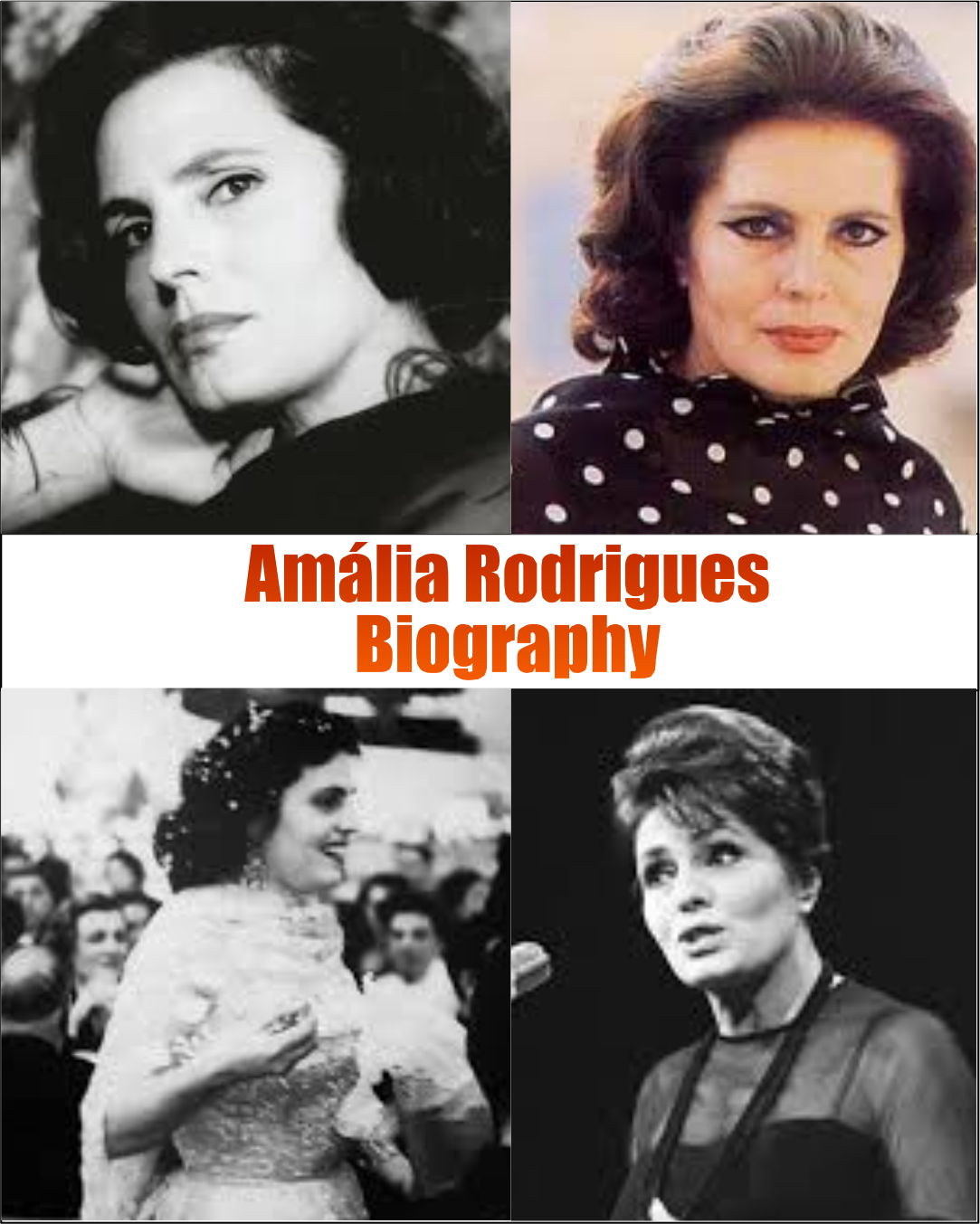
Amália Rodrigues Biography
The Amália Rodrigues Biography: The Voice That Turned Fado into Portugal’s Soul.
Discover the life of Amália Rodrigues, the legendary singer who transformed Fado into a national symbol and became the emotional voice of Portugal.
The Voice That Carried a Nation’s Emotion
Some artists represent a genre.
Others become inseparable from it.
Amália Rodrigues did not just sing Fado—she became its voice, its identity, its emotional center.
Before her, Fado lived in taverns and small gatherings, a music of the working class, shaped by longing, loss, and the quiet weight of everyday life.
After her, it became something else.
A national language of feeling.
A sound that carried Portugal to the world.
Amália Rodrigues Biography
| Information | Details |
|---|---|
| Full Name | Amália da Piedade Rebordão Rodrigues |
| Stage Name | Amália Rodrigues |
| Date of Birth | July 23, 1920 (commonly accepted) |
| Date of Death | October 6, 1999 |
| Age at Death | 79 years |
| Place of Birth | Lisbon, Portugal |
| Nationality | Portuguese |
| Occupation | Singer, Actress |
| Known For | Popularizing Fado worldwide |
A Childhood Marked by Hardship
Amália Rodrigues was born on July 23, 1920, in Lisbon, Portugal.
Her early life was far from the glamour that would later surround her name. She grew up in poverty, raised in a working-class environment where survival came before ambition.
As a child, she sold fruit in the streets.
Music was not a career plan.
It was simply present—woven into the fabric of daily life, heard in neighborhoods, gatherings, and informal performances.
But even then, her voice stood out.
There was something in it—something that carried more than melody.
The Sound of Saudade
To understand Amália’s music, one must understand saudade.
It is a Portuguese word often translated as longing, but the translation never fully captures it. Saudade is deeper—an emotional state that blends nostalgia, melancholy, desire, and absence.
Fado is built on saudade.
And Amália embodied it.
Her voice did not just express emotion.
It carried it, fully and without restraint.
Listeners did not simply hear her songs.
They felt them.
See also: Cardinal Anthony Olubunmi Okogie Biography: The Archbishop Who Volunteered to Die for a Muslim Woman
From Taverns to Recognition
Amália’s early performances took place in Lisbon’s Fado houses—intimate spaces where singers performed close to their audiences, without barriers.
It was in these settings that she developed her style.
Direct. Emotional. Unfiltered.
Word of her voice spread quickly.
She began to gain recognition, first locally, then nationally. What set her apart was not just her vocal ability, but her presence.
She did not perform Fado as it had always been done.
She transformed it.
Redefining a Tradition
Before Amália, Fado was often seen as a fixed tradition.
She changed that.
She introduced new poetic influences, incorporating works from prominent Portuguese poets into her songs. She expanded the themes, allowing Fado to explore a wider emotional and intellectual range.
Musically, she experimented with arrangements, bringing subtle changes that elevated the genre without losing its essence.
This was not a rejection of tradition.
It was an expansion.
Taking Fado to the World
Amália’s influence extended far beyond Portugal.
She toured internationally, performing across Europe, the Americas, and beyond. For many audiences, she was their first encounter with Fado.
Her performances introduced them not just to a genre, but to a feeling—a way of experiencing music that was deeply emotional and introspective.
Language was not a barrier.
Her voice communicated what words could not.
Fame, Complexity, and Criticism
With fame came complexity.
Amália’s career unfolded during a politically sensitive period in Portugal, under the Estado Novo regime. Her association with the country’s cultural identity led to scrutiny, and at times, criticism.
Some questioned her relationship with the regime, while others defended her as an artist navigating a complicated environment.
These debates added layers to her public image.
But they did not diminish her musical impact.
A Voice That Endured
Through changing times, Amália continued to perform and record.
Her voice evolved with age, gaining depth and texture. If anything, her later performances carried even more emotional weight.
She remained connected to Fado, even as the world around her changed.
She did not abandon the genre.
She carried it forward.
A National Loss
Amália Rodrigues passed away on October 6, 1999.
The response in Portugal was immediate and profound.
Her funeral brought the country to a standstill.
Thousands gathered. Streets filled. Silence spread in a way that felt collective.
It was not just the loss of a singer.
It was the loss of a voice that had come to represent something deeply national.
Fado After Amália
After her passing, Fado did not disappear.
It continued, carried by new artists and evolving forms.
But Amália’s influence remains central.
She set a standard—not just of vocal ability, but of emotional honesty.
Her interpretation of Fado became a reference point.
Something to learn from.
Something to measure against.
A Legacy Beyond Music
Amália’s impact extends beyond recordings and performances.
She helped define how a culture expresses itself.
She gave shape to saudade, turning an abstract feeling into something audible, something shared.
Her work continues to resonate—not just in Portugal, but globally, wherever listeners connect with the emotions she carried.
The Sound of Stillness and Depth
Listening to Amália today feels intimate.
Her recordings do not rely on elaborate production.
They are centered on voice and feeling.
There is space in her music.
Space that allows emotion to settle.
Space that invites reflection.
Closing Reflection
Some artists sing songs.
Amália Rodrigues sang a nation’s emotion.
She took something rooted in small spaces and carried it to the world without losing its essence. She expanded Fado, but never diluted it.
And in doing so, she created something lasting.
Not just a body of work.
But a voice that continues to echo—long after the final note.
Frequency Asked Questions
1. Who is Amália Rodrigues?
Amália Rodrigues was a legendary Portuguese singer, widely regarded as the “Queen of Fado,” who brought traditional Portuguese music to global audiences.
2. Why is Amália Rodrigues famous?
She became famous for her emotional voice and her role in popularizing Fado internationally.
3. What is Fado music?
Fado is a traditional Portuguese music style known for its melancholic tone, expressive lyrics, and themes of longing and fate.
4. Did Amália Rodrigues act in films?
Yes — in addition to music, she also appeared in several films, helping expand her influence beyond singing.
5. What is Amália Rodrigues’ legacy?
Her legacy lies in elevating Fado to a global stage and becoming a cultural symbol of Portugal.