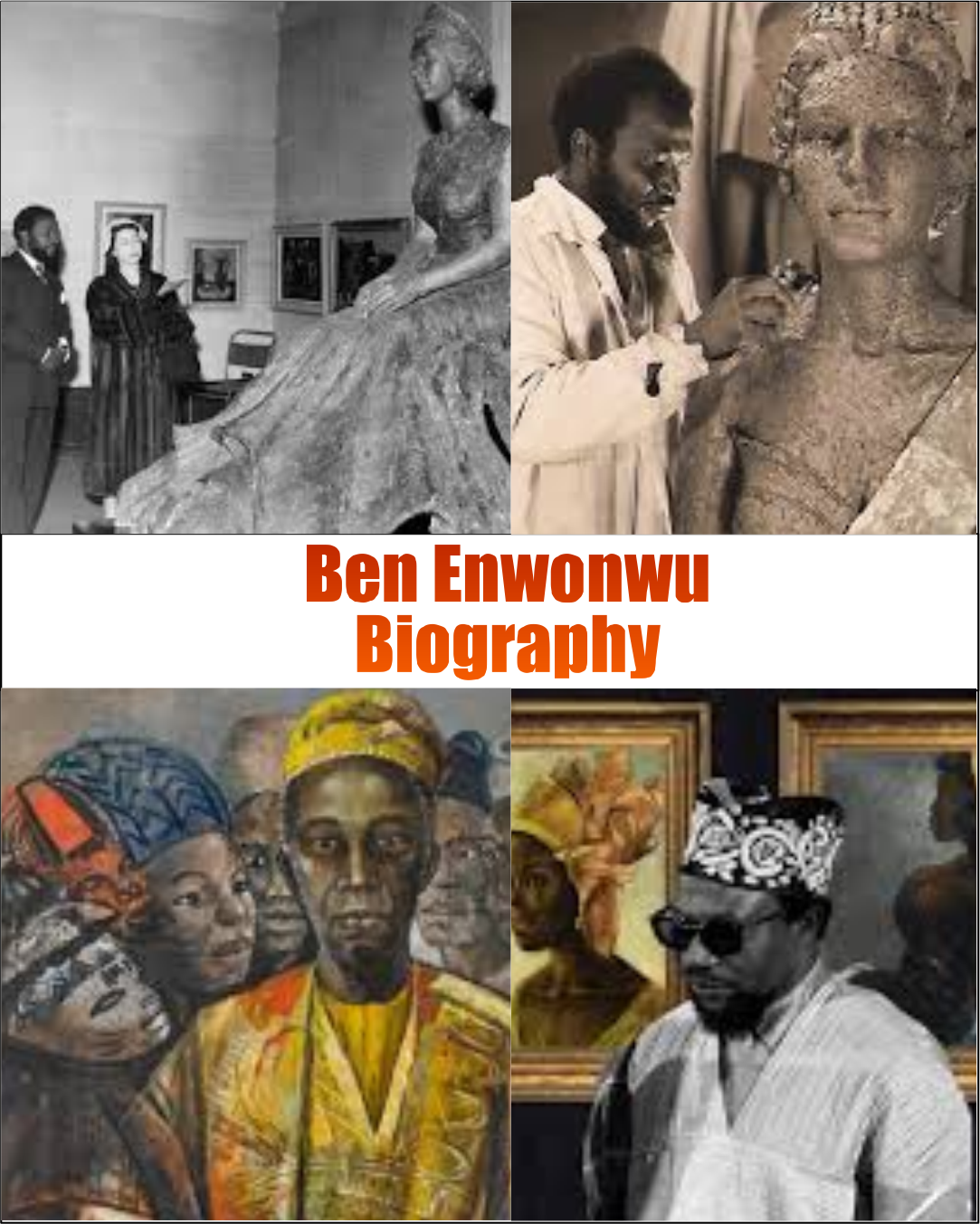
Ben Enwonwu Biography
The Ben Enwonwu Biography: The Nigerian Master Behind Tutu and the Rise of Modern African Art
Explore the life of Ben Enwonwu, the pioneering Nigerian artist whose lost masterpiece Tutu shocked the art world and redefined African modern art.
The Artist Who Painted a Nation Into Visibility
There are artists who follow movements.
And then there are those who quietly create one.
Ben Enwonwu belonged to the latter—a man who stood at the intersection of tradition and modernity and refused to choose between them.
At a time when African art was often dismissed, misinterpreted, or confined to ethnographic labels, Enwonwu did something radical.
He presented it as fine art.
Not as artifact.
Not as curiosity.
But as expression—complex, intellectual, and fully alive.
And decades after his death, one painting—lost, forgotten, and suddenly rediscovered—would remind the world just how far ahead he had been.
Ben Enwonwu Biography
| Information | Details |
|---|---|
| Full Name | Odinigwe Benedict Chukwukadibia Enwonwu |
| Popular Name | Ben Enwonwu |
| Date of Birth | July 14, 1917 |
| Date of Death | February 5, 1994 |
| Age at Death | 76 years |
| Place of Birth | Onitsha, Anambra State, Nigeria |
| Nationality | Nigerian |
| Occupation | Painter, Sculptor |
| Known For | Iconic sculpture Anyanwu and portrait of Queen Elizabeth II |
A Beginning Rooted in Tradition
Ben Enwonwu was born in 1917 in Onitsha, Nigeria, into a family where art was not foreign.
His father was a traditional sculptor—a respected figure who worked within Igbo artistic traditions. From an early age, Enwonwu was exposed to carving, form, and symbolism.
But his path would not remain within tradition alone.
He would step into a world that did not yet know how to receive him.
Training Between Two Worlds
Enwonwu’s education took him beyond Nigeria, into formal Western art institutions in the United Kingdom.
There, he studied at prestigious schools, absorbing techniques rooted in European traditions—life drawing, anatomy, oil painting, and sculpture.
But this exposure came with tension.
He was being trained in systems that often viewed African art as primitive, even as he carried within him a deep understanding of its complexity.
Rather than reject one for the other, Enwonwu did something more difficult.
He merged them.
See also: Miriam Makeba Biography: The Exiled Voice Who Sang Africa to the World
A Signature Style That Refused Simplification
Enwonwu’s artistic style became a fusion—African in spirit, modern in execution.
His paintings often featured elongated figures, rhythmic compositions, and a sense of movement that echoed traditional African aesthetics. At the same time, his use of oil painting, shading, and perspective reflected his academic training.
He did not imitate Europe.
He reinterpreted it through an African lens.
This became his signature.
A visual language that was neither fully Western nor purely traditional—but something new.
Sculpture That Breathed Movement
While widely known for his paintings, Enwonwu was also a powerful sculptor.
His works in bronze and wood carried a sense of fluidity—figures that seemed to move, to dance, to exist beyond static form.
One of his most notable sculptural works, Anyanwu, depicts a rising female figure reaching toward the sun.
It is not just a sculpture.
It is a statement—of rebirth, of identity, of a continent redefining itself.
The Creation of Tutu
In 1974, Enwonwu painted a portrait that would later become one of the most important artworks in Nigerian history.
Tutu.
The painting, often referred to as the “African Mona Lisa,” depicts Princess Adetutu Ademiluyi of Ife. Her expression is calm, composed, almost distant—carrying a quiet strength.
But the significance of Tutu goes beyond its subject.
It became a symbol.
Painted shortly after the Nigerian Civil War, it represented unity, memory, and cultural continuity.
And then, it disappeared.
The Lost Masterpiece
For decades, Tutu was missing.
No confirmed location. No public display. Only references, photographs, and memory.
It became almost mythical—a work people spoke about, but could not see.
Then, in 2017, something unexpected happened.
The painting resurfaced in a private collection in London.
Its rediscovery sent shockwaves through the art world.
The Value of Recognition
When Tutu was finally sold at auction, it fetched a price far beyond expectations—reportedly over £1 million.
This was not just about the painting.
It was about what it represented.
A recognition—long delayed—of African modern art as valuable, as significant, as worthy of global attention.
Enwonwu, decades after his passing, was being reintroduced to the world.
Inspiration Rooted in Identity
Enwonwu’s work was deeply connected to identity.
He drew inspiration from:
- Igbo cultural forms
- African dance and movement
- Colonial and post-colonial realities
- The tension between tradition and modernity
His art was not decorative.
It was reflective.
Each piece carried questions about who Africans were—and who they were becoming.
Hidden Meanings Beneath the Surface
At first glance, Enwonwu’s works can appear elegant, even serene.
But beneath that surface lies complexity.
His elongated figures suggest movement, but also transition. His compositions often balance harmony with tension, reflecting societies in flux.
Tutu, for example, is not just a portrait.
It is a meditation on identity—on what it means to exist within history, to carry both past and present in a single image.
Struggles in a World Not Ready
Despite his talent, Enwonwu faced challenges.
The global art world of his time was not structured to fully recognize African artists. There were limitations—expectations that African art should remain “traditional,” not modern.
He was navigating spaces that were not built for him.
And within Nigeria, the infrastructure to support fine art at a global level was still developing.
Recognition came—but not always proportionately to his contribution.
Controversy and Debate
Enwonwu’s approach was not without criticism.
Some argued that his fusion of Western techniques diluted traditional African art. Others believed he was too aligned with colonial structures due to his education and international recognition.
These debates reflect a larger tension.
What does authenticity mean?
Is it preservation, or evolution?
Enwonwu stood firmly in the space of evolution.
Recognition in His Lifetime
During his career, Enwonwu achieved significant recognition.
He became one of the first African artists to gain international acclaim, exhibiting in major galleries and receiving commissions that elevated his status.
He was appointed as an official portrait artist for Queen Elizabeth II—an indication of his global reach.
But even then, the full weight of his influence was not yet understood.
Influence on African Modern Art
Enwonwu’s impact on African art is profound.
He helped shift perceptions—from viewing African art as static tradition to recognizing it as dynamic and evolving.
Artists who came after him found a path that had been partially cleared.
A path where they could:
- Experiment
- Blend influences
- Claim space in global conversations
He did not just create art.
He expanded possibility.
A Legacy Rediscovered
When Enwonwu passed away in 1994, his legacy was respected—but not fully realized.
It took time.
Time for the global art world to shift.
Time for collectors to recognize value.
Time for narratives to change.
The rediscovery of Tutu accelerated that process—but it did not create it.
It revealed what had always been there.
The Market That Caught Up
Today, Enwonwu’s works are highly sought after.
Collectors, museums, and institutions recognize their significance—not just aesthetically, but historically.
The value of his artworks has increased steadily, reflecting a broader appreciation for African modernism.
What was once underpriced is now understood.
Closing Reflection
Some artists are understood immediately.
Others are understood later.
Ben Enwonwu belonged to the second group.
He created work that did not fit neatly into the expectations of his time. He challenged categories, blended traditions, and insisted on complexity.
And in doing so, he built something that would outlast misunderstanding.
A legacy that continues to grow.
A voice that continues to speak.
Through paint.
Through form.
Through time.
Frequently Asked Questions
1. Who is Ben Enwonwu?
Ben Enwonwu was a pioneering Nigerian artist, widely regarded as one of Africa’s most influential modern painters and sculptors.
2. Why is Ben Enwonwu famous?
He gained international recognition for blending African traditional art with modern European techniques, creating a unique artistic identity.
3. What are Ben Enwonwu’s most famous works?
His most famous works include the sculpture Anyanwu and his portrait of Queen Elizabeth II.
4. What impact did Ben Enwonwu have on African art?
He helped place African art on the global stage and inspired generations of artists by modernizing traditional African artistic expression.
5. What is Ben Enwonwu’s legacy?
His legacy lies in shaping modern African art, influencing global perceptions of African creativity, and leaving behind timeless works celebrated worldwide.