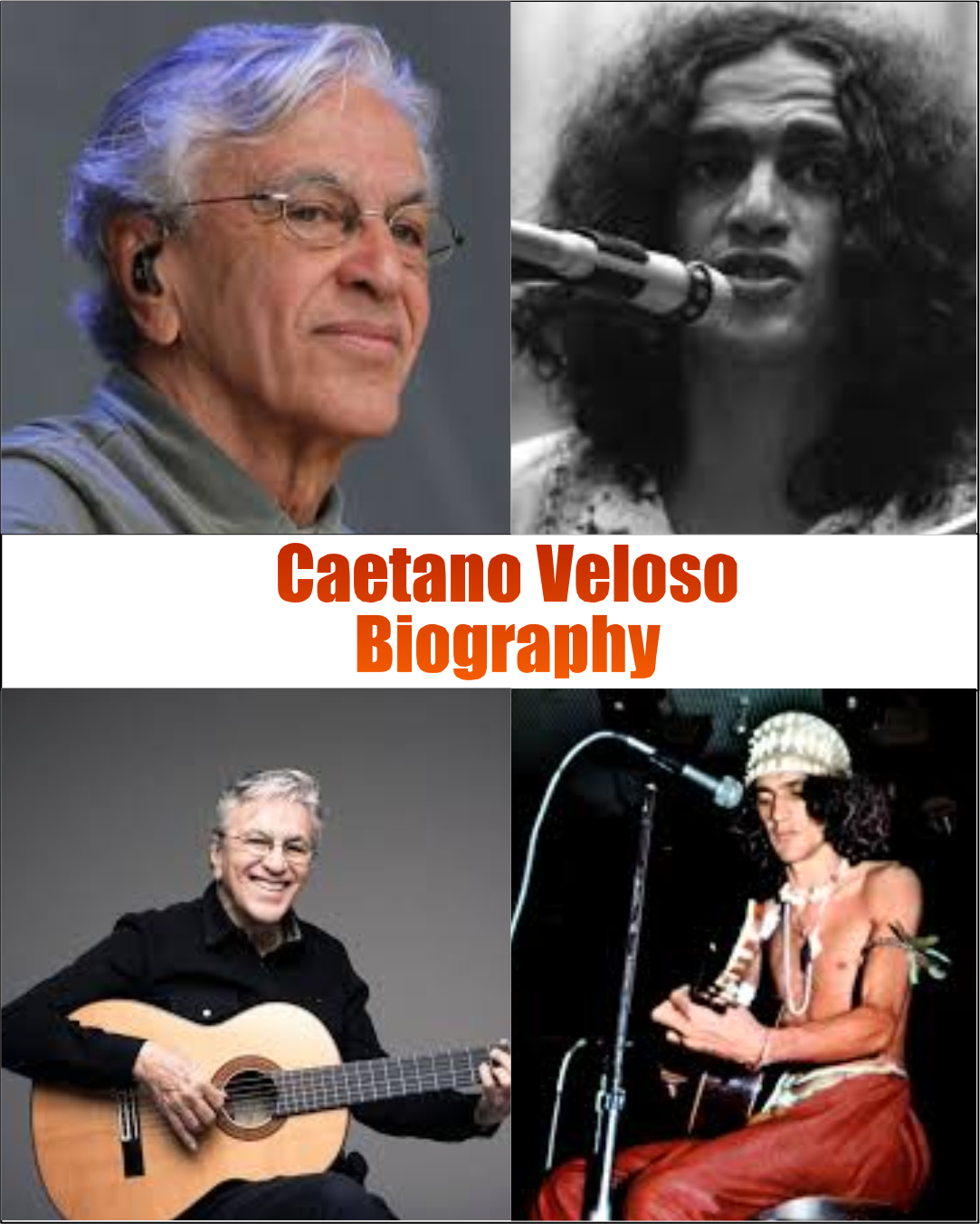
Caetano Veloso Biography
The Caetano Veloso Biography: The Exiled Artist Who Redefined Brazil’s Sound and Soul.
Discover the life of Caetano Veloso, the Brazilian icon exiled by a military regime who transformed music, culture, and political expression through Tropicália.
The Artist Who Refused to Stay in One Place
Some artists define a genre.
Others dismantle it—and rebuild something entirely new.
Caetano Veloso did not just contribute to Brazilian music. He challenged its boundaries, questioned its traditions, and reshaped its identity at a time when doing so carried real consequences.
He was not only an artist.
He was a disruption.
At the height of Brazil’s military dictatorship, when control over expression tightened and dissent was dangerous, Veloso stood at the center of a cultural movement that refused to be contained.
And for that, he was punished.
Arrested. Exiled. Forced out of the country he was helping to redefine.
But exile did not end his influence.
It expanded it.
Caetano Veloso Biography
| Information | Details |
|---|---|
| Full Name | Caetano Emanuel Viana Teles Veloso |
| Stage Name | Caetano Veloso |
| Date of Birth | August 7, 1942 |
| Age | 84 years (as of 2026) |
| Place of Birth | Santo Amaro, Bahia, Brazil |
| Nationality | Brazilian |
| Occupation | Singer, Songwriter, Guitarist, Writer |
| Known For | Leader of the Tropicália movement |
| Global Influence | Blending Brazilian music with rock, pop, and avant-garde styles |
A Beginning Rooted in Culture
Caetano Veloso was born on August 7, 1942, in Santo Amaro, Bahia, Brazil—a region rich in cultural diversity, where African, Indigenous, and Portuguese influences blend into a unique artistic identity.
From an early age, Veloso was immersed in music.
He grew up listening to traditional Brazilian sounds, but also to international music—absorbing influences that would later shape his approach. There was no strict boundary in his mind between what was “local” and what was “foreign.”
Everything was material.
Everything was possibility.
See also: Miriam Makeba Biography: The Exiled Voice Who Sang Africa to the World
The Seeds of Transformation
By the 1960s, Veloso had begun performing and writing music, gaining recognition within Brazil’s growing artistic scene.
But this was not a calm period.
Brazil was undergoing political upheaval, culminating in a military coup in 1964. The new regime imposed restrictions on expression, creating an environment where artists had to navigate carefully.
Veloso chose not to navigate quietly.
Instead, he began questioning the very structure of Brazilian music.
Why should it remain fixed? Why should it resist outside influence?
These questions would lead to something bigger than a personal style.
They would lead to a movement.
Tropicália: A Cultural Earthquake
Together with artists like Gilberto Gil, Veloso became a central figure in the Tropicália movement.
It was not just music.
It was a cultural revolution.
Tropicália blended traditional Brazilian sounds with rock, psychedelia, avant-garde art, and global influences. It challenged the idea that Brazilian culture needed to be “pure” or protected from outside elements.
Instead, it embraced contradiction.
Electric guitars met samba rhythms. Experimental sounds merged with familiar melodies. The result was something unpredictable—and deeply provocative.
Not everyone welcomed it.
Controversy and Confrontation
Tropicália did not just challenge musical norms.
It challenged ideology.
Some critics, particularly those aligned with nationalist or leftist movements, saw it as a betrayal—an unnecessary embrace of foreign influence. Others saw it as a bold reimagining of identity.
But the military government saw something else entirely.
A threat.
Veloso’s performances, his lyrics, his very presence began to draw attention from authorities. He was not directly calling for revolution—but he was questioning structures, and that was enough.
Arrest and Exile
In 1968, the tension reached its peak.
Veloso and Gilberto Gil were arrested by the military regime.
There were no clear charges. No formal explanation that made sense publicly. It was an act of control—a warning.
After months of detention, they were given a choice that was not really a choice.
Leave Brazil.
Veloso went into exile in London.
London: Distance and Transformation
Exile is often described as displacement.
For Veloso, it was both disorienting and transformative.
London in the late 1960s and early 1970s was a center of global music—rock, experimentation, cultural shifts. Yet, for Veloso, it was also a place of distance.
He was physically free, but emotionally disconnected from Brazil.
That tension shaped his work.
His music during this period carried a different tone—more introspective, more reflective. It was not the explosive experimentation of Tropicália, but something quieter, searching.
Exile changed him.
But it did not silence him.
Returning to a Changed Country
In 1972, Veloso returned to Brazil.
The country was still under military rule, but something had shifted.
His absence had not diminished his influence. If anything, it had amplified it.
He returned not just as an artist, but as a symbol—of resistance, of creativity, of survival.
And he continued to evolve.
Reinvention Without Losing Identity
One of Veloso’s defining qualities is his refusal to remain static.
He did not stay within Tropicália. He did not repeat past successes. Instead, he continued to experiment—moving through different styles, sounds, and themes.
From acoustic compositions to more contemporary arrangements, his work reflects a constant process of reinvention.
But through all these changes, there is a thread.
A commitment to exploration.
A refusal to accept limits.
A Voice That Shaped More Than Music
Veloso’s influence extends beyond sound.
He became a cultural figure—someone whose ideas about art, identity, and society carried weight. He wrote essays, engaged in public discourse, and remained an active participant in Brazil’s intellectual life.
He was not just reflecting culture.
He was shaping it.
Global Recognition
Over time, Veloso’s work reached international audiences.
He performed worldwide, collaborated with artists across genres, and became recognized as one of the most important figures in global music.
His songs crossed language barriers, much like his ideas.
Listeners who did not understand Portuguese still connected with the emotion, the structure, the intention behind his work.
The Long Arc of Influence
Decades after Tropicália, its impact remains visible.
Artists continue to draw from its principles—blending styles, questioning boundaries, embracing complexity.
Veloso stands at the center of that legacy.
Not as a static figure, but as a continuing force.
Still Present, Still Relevant
Unlike many artists whose influence is confined to a specific era, Veloso remains active.
He continues to perform, to record, to engage.
His voice has aged, but it has not lost its clarity.
His perspective has evolved, but it has not lost its edge.
The Power of Cultural Courage
Veloso’s story is not just about music.
It is about courage.
The courage to challenge expectations. To question norms. To create something new even when it is not immediately understood.
And to face the consequences when power pushes back.
Closing Reflection
Some artists follow history.
Caetano Veloso helped reshape it.
He took risks that carried real consequences. He embraced complexity when simplicity would have been safer. And he continued, even when forced away from home.
His music is not just something to hear.
It is something to think with.
And perhaps that is his greatest legacy.
Not just what he created.
But what he made possible.
Frequently Asked Questions
1. Who is Caetano Veloso?
Caetano Veloso is a legendary Brazilian singer-songwriter and cultural icon known for his innovative music and influence on modern Brazilian culture.
2. Why is Caetano Veloso famous?
He is famous for being a key figure in the Tropicália movement, which revolutionized Brazilian music by blending traditional sounds with global influences.
3. What is the Tropicália movement?
Tropicália was a cultural movement in the late 1960s that combined music, art, and political expression, challenging traditional norms in Brazil.
4. Did Caetano Veloso face political challenges?
Yes — during Brazil’s military dictatorship, he was arrested and later exiled, which significantly shaped his music and activism.
5. What is Caetano Veloso’s legacy?
His legacy lies in transforming Brazilian music, influencing generations of artists, and remaining a symbol of artistic freedom and cultural innovation.