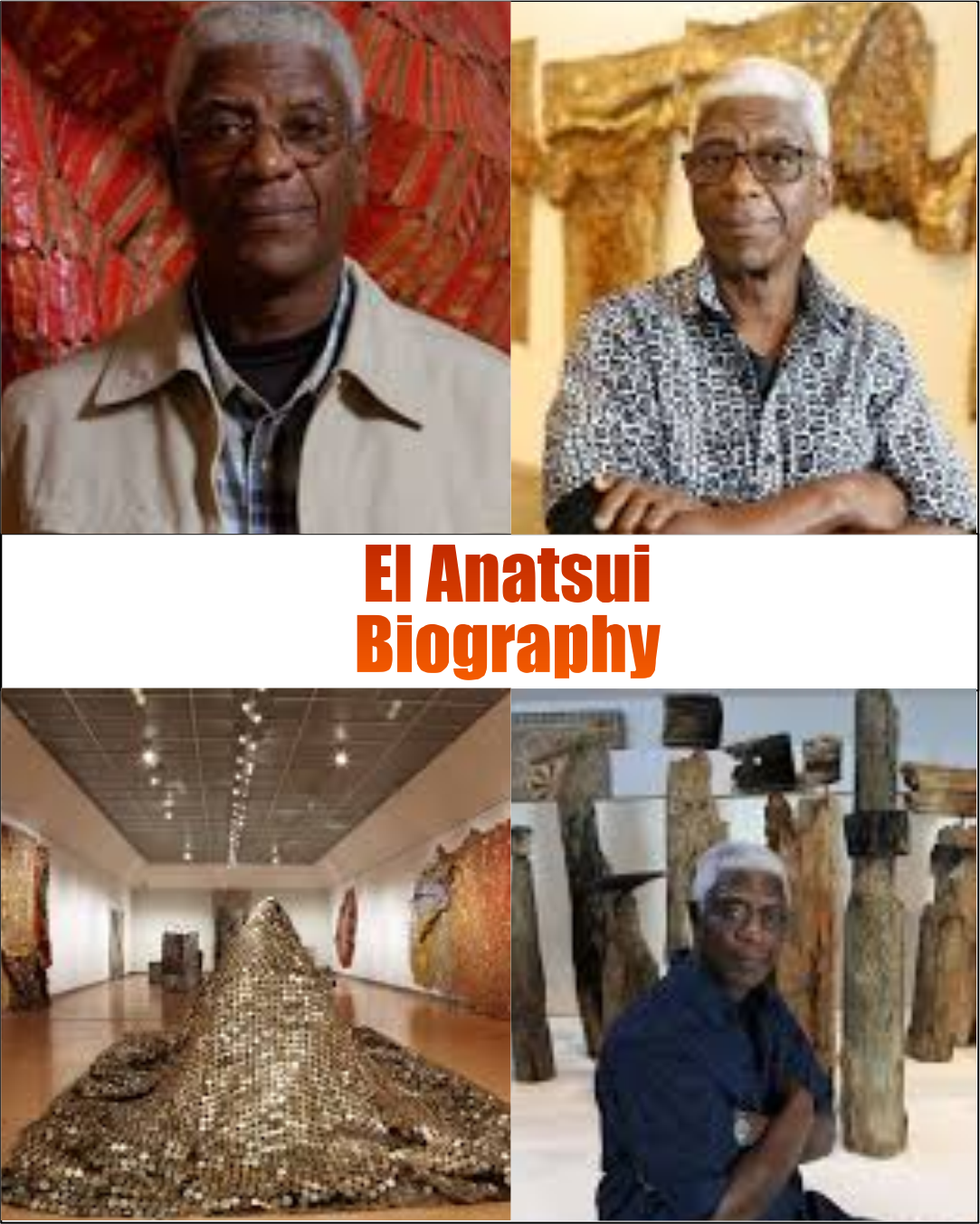
El Anatsui Biography
The El Anatsui Biography: The Sculptor Who Turned Waste into Global Masterpieces
Discover the life of El Anatsui, the Ghanaian artist who transforms discarded materials into monumental artworks, redefining sculpture and African contemporary art.
The Artist Who Saw Value Where Others Saw Waste
Most people throw things away.
Caps. Foil. Metal fragments. The small remnants of everyday consumption.
El Anatsui looked at those same objects and saw something else entirely.
Possibility.
Where others saw waste, he saw history—layers of trade, consumption, colonial exchange, and human habit embedded in materials that had passed through countless hands.
And from those fragments, he built something monumental.
Not just sculptures.
But statements.
El Anatsui Biography
| Information | Details |
|---|---|
| Full Name | El Anatsui |
| Date of Birth | February 4, 1944 |
| Age | 82 years (as of 2026) |
| Place of Birth | Anyako, Ghana |
| Nationality | Ghanaian |
| Occupation | Sculptor, Installation Artist |
| Base | Nigeria (longtime practice in Nsukka) |
| Known For | Monumental wall sculptures made from recycled materials |
| Signature Style | Bottle-cap tapestries exploring history, trade, and consumption |
A Beginning Shaped by Movement
El Anatsui was born in 1944 in Anyako, Ghana.
His early life was marked by change—personal, cultural, and geographic. After the loss of his parents, he was raised by extended family, navigating a childhood that required adaptation.
This sense of movement would later echo in his work.
His education took him to the College of Art at Kwame Nkrumah University of Science and Technology in Kumasi, where he trained formally as an artist.
But his journey would not remain in Ghana alone.
He would eventually settle in Nigeria, teaching at the University of Nigeria, Nsukka—a place that would become central to his artistic evolution.
See also: Amália Rodrigues Biography: The Voice That Turned Fado into Portugal’s Soul
From Wood to Metal: A Shift in Language
Early in his career, Anatsui worked primarily with wood and clay—materials deeply rooted in traditional African art.
But over time, his focus shifted.
He began experimenting with unconventional materials, moving away from expectations and into something more exploratory.
Then came the turning point.
Bottle caps.
The Signature Technique That Changed Everything
El Anatsui’s most recognizable works are made from thousands—sometimes tens of thousands—of discarded aluminum bottle caps and metal pieces.
These materials are:
- Flattened
- Cut
- Bent
- Wired together by hand
The process is labor-intensive, requiring patience and precision.
But the result is extraordinary.
Large, shimmering installations that resemble textiles—fluid, draped, almost fabric-like despite being made of metal.
This contradiction is central to his style.
Hard becomes soft.
Discarded becomes valuable.
Small becomes monumental.
Most Famous Works That Redefined Sculpture
Among his most celebrated works are pieces like Dusasa, Earth’s Skin, and Man’s Cloth.
These installations are not fixed.
They are flexible—rearranged and reshaped depending on the space in which they are displayed.
This adaptability is intentional.
Anatsui does not create static objects.
He creates works that respond to their environment.
Each installation becomes a new version of itself.
Inspiration Rooted in History and Consumption
At the heart of Anatsui’s work is a deep engagement with history.
The bottle caps he uses are not random.
They often come from liquor bottles—objects tied to trade routes, colonial exchange, and economic systems that shaped Africa’s past.
Through these materials, he references:
- The transatlantic trade
- The movement of goods and people
- The impact of consumption on culture
His work is not literal.
But it is layered.
Each piece carries traces of history, embedded in its very structure.
Hidden Meanings Beneath the Surface
At first glance, Anatsui’s works can appear purely aesthetic—beautiful, shimmering, almost decorative.
But beneath that beauty lies complexity.
The materials speak of waste.
The scale speaks of accumulation.
The fluidity speaks of change.
His installations invite multiple interpretations:
- As maps
- As garments
- As landscapes
- As cultural tapestries
There is no single meaning.
And that is intentional.
Struggles and Rejection Along the Way
Anatsui’s approach was not immediately embraced.
Using discarded materials—especially in large-scale art—was unconventional, even controversial in certain circles.
There were questions.
Was this fine art?
Was it craft?
Was it too experimental?
In a global art system that often prioritized traditional mediums, his work challenged expectations.
But he remained consistent.
He trusted the process.
Influence on Contemporary Art Movements
El Anatsui is now recognized as a key figure in contemporary art—not just in Africa, but globally.
His work intersects with multiple movements:
- Environmental art
- Conceptual art
- Postcolonial art
He has influenced a generation of artists who now see material differently—who understand that meaning can be constructed from the overlooked.
He expanded what sculpture could be.
Controversy and Interpretation
While widely celebrated, Anatsui’s work has sparked discussion.
Some critics question the heavy reliance on Western exhibition spaces for recognition. Others debate how his work is interpreted outside its cultural context.
There is also tension around how African art is framed globally—whether it is fully understood or simply appreciated aesthetically.
These conversations are ongoing.
And his work remains central to them.
Recognition on the Global Stage
El Anatsui’s recognition has grown steadily over the years.
He has exhibited in major institutions worldwide, including:
- The Venice Biennale
- The British Museum
- The Metropolitan Museum of Art
His works have been displayed on building facades, museum walls, and large-scale installations that command attention.
He has received numerous awards, cementing his position as one of Africa’s most important contemporary artists.
The Value of His Artworks
Anatsui’s pieces are among the most valuable works by an African artist today.
Individual installations have sold for hundreds of thousands—and in some cases, over a million dollars.
But their value is not just financial.
It is cultural.
Collectors recognize that his work represents a shift—a redefinition of material, scale, and meaning in contemporary art.
A Legacy Built on Transformation
What makes Anatsui’s legacy powerful is not just what he creates.
It is what he transforms.
Materials.
Perceptions.
Expectations.
He takes what is discarded and repositions it—forcing viewers to reconsider value, history, and beauty.
Still Creating, Still Evolving
Even in his later years, El Anatsui continues to create.
His process remains consistent, but his works continue to evolve—responding to new spaces, new contexts, new interpretations.
He has not become static.
He remains in motion.
The Quiet Power of His Work
There is no aggression in Anatsui’s art.
No loud declarations.
Instead, there is accumulation.
Layer upon layer of material, meaning, and history.
It invites viewers to look closely.
To think.
To question.
Closing Reflection
Some artists create from abundance.
El Anatsui creates from what is left behind.
He takes fragments of everyday life and builds something monumental—something that carries history, beauty, and meaning all at once.
And in doing so, he changes how we see.
Not just art.
But the world around us.
Frequently Asked Questions
1. Who is El Anatsui?
El Anatsui is a Ghanaian sculptor and installation artist celebrated for transforming everyday discarded materials into large-scale artworks.
2. Why is El Anatsui famous?
He is renowned for his shimmering, fabric-like sculptures made from bottle caps and aluminum, which reimagine waste as art and carry deep cultural meaning.
3. What materials does El Anatsui use?
He primarily uses recycled materials—especially liquor bottle caps and metal—stitched together with wire to create flexible, tapestry-like installations.
4. What themes does his art explore?
His work addresses history (including colonial trade routes), consumerism, environmental concerns, and African identity.
5. What is El Anatsui’s legacy?
His legacy lies in redefining contemporary African art on the global stage and inspiring sustainable, concept-driven artistic practices worldwide.