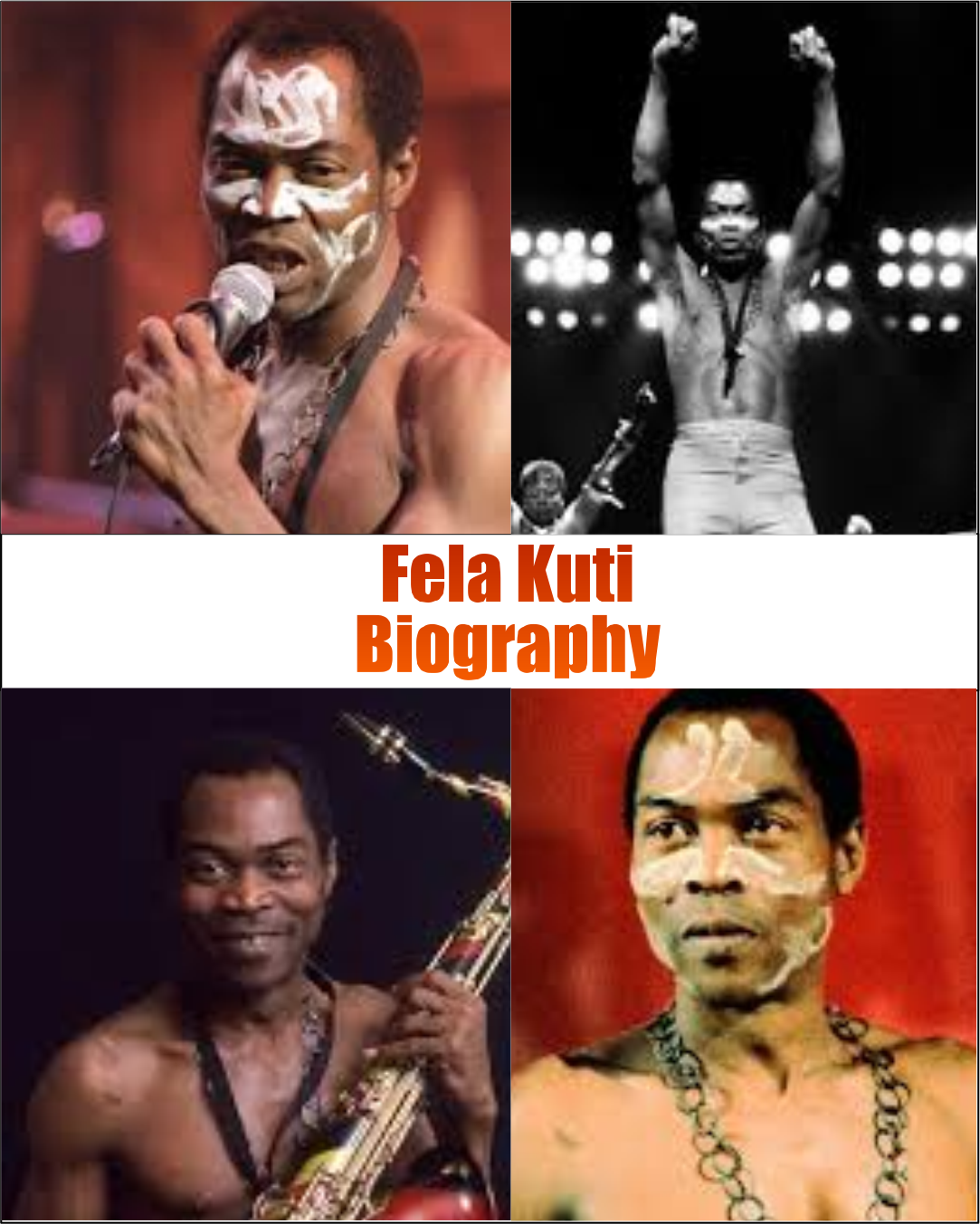
Fela Kuti Biography
The Fela Kuti Biography: The Rebel Who Turned Music into a Weapon Against Power
Discover the life of Fela Kuti, the Nigerian pioneer of Afrobeat who challenged military rule, faced repeated arrests, and transformed music into a fearless tool of resistance.
The Man Who Refused to Bow
There are artists who entertain. There are artists who inspire. And then there are those rare figures who make power uncomfortable—who turn sound into resistance and melody into confrontation. Fela Kuti belonged to that last category.
He did not simply create music. He built a movement.
At a time when Nigeria was gripped by military rule, when dissent could cost you everything, Fela stood in front of microphones and said what others whispered. He named names. He mocked authority. He exposed corruption. And he paid for it—again and again.
Arrested more than 200 times. Beaten. Silenced. Attacked. His home destroyed. His mother killed in a state raid.
And still, he never stopped.
To understand Fela is to understand a man who saw music not as escape, but as confrontation. A man who turned rhythm into rebellion—and refused to be quiet, no matter the cost.
Fela Kuti Biography
| Information | Details |
|---|---|
| Full Name | Olufela Olusegun Oludotun Ransome-Kuti |
| Stage Name | Fela Kuti |
| Date of Birth | October 15, 1938 |
| Date of Death | August 2, 1997 |
| Age at Death | 58 years |
| Place of Birth | Abeokuta, Ogun State, Nigeria |
| Nationality | Nigerian |
| Occupation | Singer, Songwriter, Bandleader, Activist |
| Known For | Pioneering Afrobeat and political activism |
Born Into Resistance
Fela Aníkúlápó Kuti was born on October 15, 1938, in Abeokuta, Nigeria, into a family that already understood the weight of resistance.
His mother, Funmilayo Ransome-Kuti, was a fearless political activist—a woman who openly challenged colonial authority and fought for women’s rights. His father was a respected educator and clergyman. From the beginning, Fela was surrounded by intellect, discipline, and defiance.
But his path would not be conventional.
In 1958, he was sent to London to study medicine. Instead, he chose music.
At the Trinity College of Music, he trained in classical composition and jazz. It was here that he began to shape his sound—drawing from highlife, jazz, and traditional African rhythms. But even then, the political fire that would define him had not yet fully ignited.
That transformation would come later.
See also: Pastor Tunde Bakare Biography: The Muslim Boy Who Became a Christian Prophet
America Changed Everything
In 1969, Fela traveled to the United States. What he encountered there altered the course of his life.
He was introduced to the Black Power movement, and figures like Sandra Smith exposed him to revolutionary ideas about race, identity, and resistance. For the first time, Fela began to see music as a weapon—not just expression.
He returned to Nigeria a different man.
Gone was the young musician experimenting with jazz. In his place stood an artist with a mission.
He renamed his music Afrobeat—a fusion of traditional Yoruba rhythms, highlife, jazz, and funk—but infused with sharp political commentary. His songs were no longer just about life. They were about power, oppression, and truth.
And he was ready to confront anyone.
Afrobeat: Sound as Resistance
Afrobeat was not designed to be subtle.
It was loud. It was hypnotic. It stretched songs into 10, 15, sometimes 20-minute journeys filled with relentless grooves, call-and-response chants, and biting lyrics.
Fela sang in Pidgin English so everyone—not just the elite—could understand him.
Songs like “Zombie” openly mocked Nigerian soldiers, portraying them as mindless followers of corrupt orders. Others attacked government officials, colonial mentality, and systemic injustice.
This was dangerous territory.
But Fela didn’t just criticize from a distance. He built his own world.
The Kalakuta Republic
Fela established a commune in Lagos called the Kalakuta Republic. It was more than a home—it was a statement.
He declared it independent from the Nigerian state.
Inside, musicians, dancers, and supporters lived together under his ideology. It was a place of artistic freedom, political thought, and cultural rebellion. His nightclub, The Shrine, became the epicenter of his performances—a place where music and resistance merged night after night.
To the government, this was not just eccentric. It was a threat.
When the State Struck Back
In 1977, everything changed.
After the release of “Zombie,” the Nigerian military responded with brutal force.
Hundreds of soldiers stormed the Kalakuta Republic. They beat residents, destroyed property, and set the compound on fire. Fela was severely assaulted.
But the most devastating blow was what happened to his mother.
She was thrown from a window during the raid. The injuries she sustained would later lead to her death.
For many, this would have been the breaking point.
For Fela, it became fuel.
Turning Grief into Defiance
After his mother’s death, Fela carried her coffin to the gates of a military barracks—a silent, powerful protest against the regime.
Then he went back to music.
He released songs that grew even more direct, more fearless. He refused to soften his voice or retreat into safety. If anything, the state had created a stronger opponent.
But the consequences continued.
He was arrested repeatedly—on charges ranging from currency violations to fabricated offenses. Each time, he returned. Each time, he spoke louder.
Arrests, Beatings, and an Unbreakable Will
Over the course of his life, Fela was arrested more than 200 times.
He was imprisoned, harassed, and targeted constantly by authorities who saw him as a destabilizing force. But what made Fela extraordinary was not just his courage—it was his consistency.
He never compromised.
Even when offered opportunities to step back, to soften his stance, to become more “acceptable,” he refused. His music remained raw, confrontational, and unapologetically political.
This wasn’t branding. It was belief.
The Shrine: Where Music Became Movement
Night after night, Fela performed at The Shrine in Lagos.
These weren’t ordinary concerts. They were sermons. Political lectures. Cultural gatherings. Explosions of rhythm and thought.
He spoke between songs, addressing the audience directly—challenging them to think, to question, to resist.
The stage was not just a platform. It was a battleground.
And Fela was its most relentless warrior.
A Complicated Legacy
Fela was not a simple man.
He was charismatic, brilliant, and fearless—but also controversial. His lifestyle, his relationships, and some of his personal choices sparked debate and criticism.
He married multiple women in a single ceremony. He held views that, even among supporters, were questioned. He lived on his own terms, often rejecting societal norms entirely.
But even his contradictions were part of his identity.
Fela was not trying to be perfect. He was trying to be free.
Global Recognition, Late but Lasting
For many years, Fela’s influence was strongest within Africa. But over time, the world began to catch up.
His music reached international audiences. Artists across genres—jazz, funk, hip-hop, and beyond—began to draw inspiration from Afrobeat.
Long after his peak years, his sound continued to grow, influencing generations of musicians who saw in his work a blueprint for combining art and activism.
Afrobeat was no longer just his creation. It was a global language.
The Final Years
By the 1990s, Fela’s health had begun to decline. But his spirit remained unbroken.
He continued to perform, to speak, to challenge authority. Even as his body weakened, his voice carried the same intensity that had defined his life.
On August 2, 1997, Fela Kuti passed away at the age of 58.
The announcement sent shockwaves through Nigeria and beyond.
A Nation in Mourning
More than a million people attended his funeral.
Streets filled with mourners. Music played. Voices rose—not in silence, but in tribute.
It was not just the death of a musician. It was the loss of a symbol.
A man who had spent his life confronting power had become part of the nation’s identity.
The Legacy That Refuses to Fade
Today, Fela Kuti’s influence is everywhere.
Afrobeat has evolved, expanded, and reached global heights. Artists across continents continue to draw from the foundation he built.
But his true legacy goes beyond music.
He showed that art could challenge authority. That a single voice, amplified through rhythm and truth, could shake systems designed to silence it.
He proved that resistance does not always wear a uniform. Sometimes, it wears a saxophone.
The Man Who Chose His Name
Fela eventually adopted the name “Aníkúlápó,” meaning “he who carries death in his pouch.”
It was a declaration.
A refusal to live in fear.
A statement that death itself did not control him—because he had already chosen his path.
A Story That Still Speaks
Decades after his death, Fela’s music remains urgent.
His words still echo in countries where power goes unchecked. His rhythms still move bodies, but his message continues to challenge minds.
He did not live quietly. He did not compromise. He did not stop.
And that is why his story endures.
Closing Reflection
Some artists leave behind songs.
Fela Kuti left behind a voice that still refuses to be silenced.
He stood in the face of power and chose defiance. He lost more than most would dare risk—and still gave more.
His life was not safe. It was not easy. But it was unmistakably his.
And in a world where silence is often rewarded, Fela chose something harder.
He chose to be heard.
Frequently Asked Questions
1. Who is Fela Kuti?
Fela Kuti was a Nigerian musician and activist who created Afrobeat — a fusion of jazz, funk, highlife, and traditional African rhythms — and used his music as a powerful tool for political expression.
2. Why is Fela Kuti famous?
He became globally famous for his unique sound, energetic performances, and fearless criticism of corruption and military rule in Nigeria.
3. What are Fela Kuti’s most popular songs?
Some of his most notable tracks include Zombie, Water No Get Enemy, Lady, and Shakara, all known for strong messages and rich instrumentation.
4. What controversies surrounded Fela Kuti?
Fela frequently clashed with the Nigerian government due to his outspoken activism. His commune, the Kalakuta Republic, was raided multiple times by military forces, leading to arrests and violence.
5. What is Fela Kuti’s legacy?
His legacy lives on through the global influence of Afrobeat, inspiring artists worldwide and shaping modern African music, while also symbolizing resistance and freedom of expression.