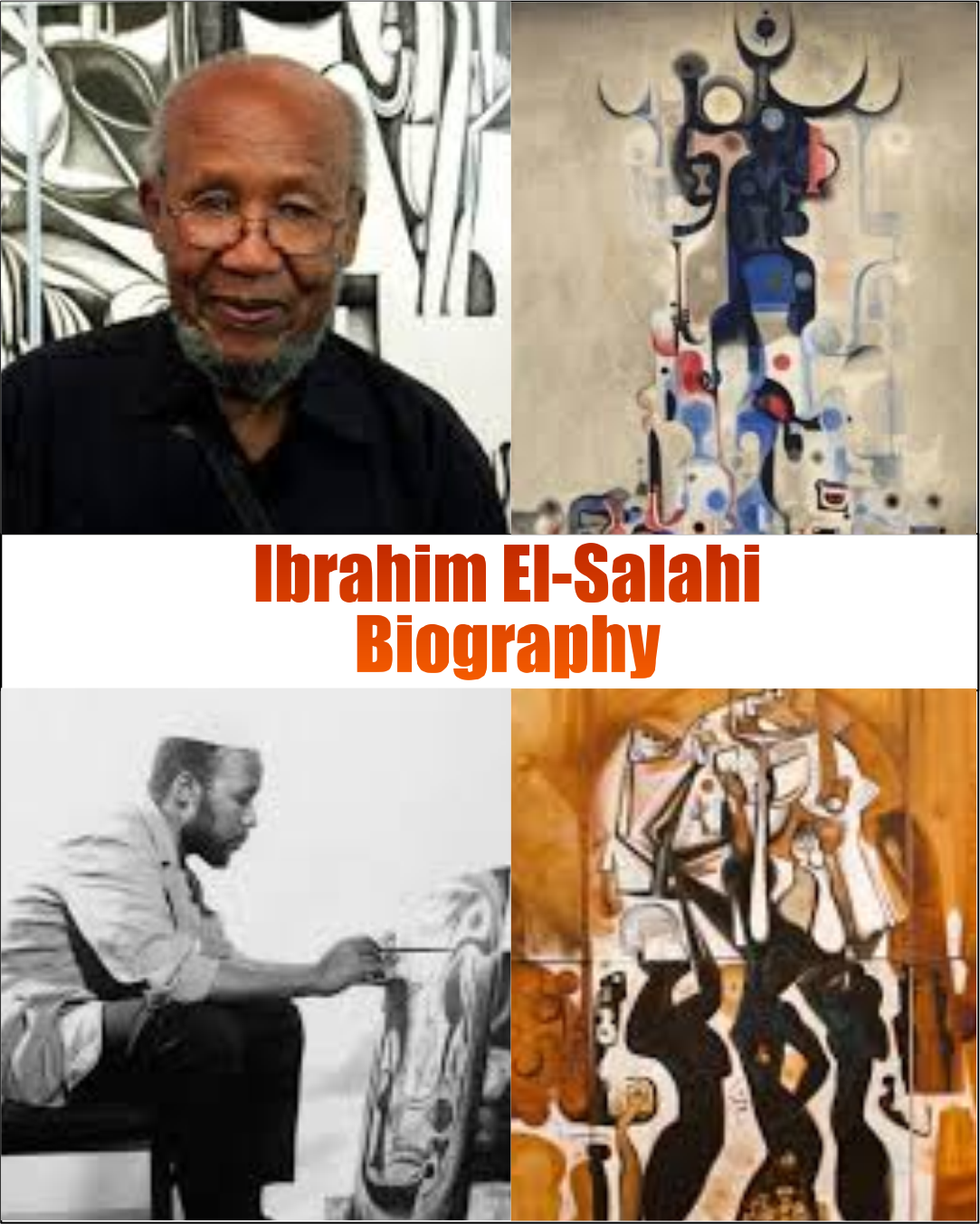
Ibrahim El-Salahi Biography
The Ibrahim El-Salahi Biography: The Artist Who Drew Freedom in Prison.
Discover the life of Ibrahim El-Salahi, the Sudanese pioneer of modern African art who created masterpieces in secret while imprisoned.
The Artist Who Refused Silence
Some artists create in studios.
Others create in exile.
Ibrahim El-Salahi created in prison.
Not metaphorically.
Literally.
Denied materials, stripped of freedom, and placed in isolation, he still found a way to draw—on scraps, in secret, under constant risk.
Because for him, art was not optional.
It was survival.
Ibrahim El-Salahi Biography
| Information | Details |
|---|---|
| Full Name | Ibrahim El-Salahi |
| Date of Birth | September 5, 1930 |
| Age | 95 years (as of 2026) |
| Place of Birth | Omdurman, Sudan |
| Nationality | Sudanese |
| Occupation | Painter, Artist, Calligrapher |
| Art Movement | Founder of the Khartoum School |
| Known For | Fusion of Islamic calligraphy with modern art |
| Notable Experience | Imprisoned in Sudan (1975–1976), influenced his art deeply |
A Beginning Between Faith and Form
Ibrahim El-Salahi was born in 1930 in Omdurman, Sudan, into a deeply religious family.
His father was a Quranic teacher, and from an early age, El-Salahi was exposed to Arabic calligraphy—not as art in the Western sense, but as spiritual discipline.
Letters were not just symbols.
They were expressions of faith.
This early influence would become central to his artistic identity, shaping how he approached line, form, and composition.
Training in a Foreign System
El-Salahi later traveled to London to study at the Slade School of Fine Art.
There, he was introduced to Western artistic traditions—portraiture, landscape, abstraction.
But something felt incomplete.
He mastered the techniques, but they did not fully reflect who he was.
When he returned to Sudan, he faced a question that would define his career:
How do you create art that is modern, but still rooted in your own culture?
A Signature Style Born from Fusion
El-Salahi’s answer was not imitation.
It was integration.
He began blending:
- Arabic calligraphy
- Islamic visual traditions
- African symbolism
- Modernist abstraction
The result was a unique visual language—one that felt both ancient and contemporary.
His lines often resemble script, but they do not form readable words. Instead, they create shapes—faces, figures, patterns—that feel alive with movement and meaning.
This became his signature.
Most Famous Works That Defined a Movement
El-Salahi is widely regarded as a pioneer of African modernism, particularly through works such as:
- The Mosque
- Reborn Sounds of Childhood Dreams
- Pain Relief Drawings
These pieces are not easily categorized.
They exist between abstraction and representation, between writing and image.
They invite interpretation rather than offering fixed meaning.
Inspiration Rooted in Identity and Spirituality
At the core of El-Salahi’s work is a search for identity.
He was navigating multiple influences:
- African heritage
- Islamic tradition
- Western education
Rather than choose one, he allowed them to coexist.
His work reflects this complexity.
It is spiritual without being rigid.
Modern without being detached.
Personal without being isolated.
The Hidden Language in His Art
One of the most striking aspects of El-Salahi’s work is its use of calligraphic forms.
At first glance, his paintings can look like abstract compositions.
But on closer inspection, they reveal structure—lines that echo Arabic script, shapes that suggest figures, patterns that feel intentional.
This creates a layered experience.
Viewers are drawn in visually, then challenged intellectually.
What appears abstract begins to feel meaningful.
A Sudden Fall: Imprisonment Without Trial
In 1975, El-Salahi’s life changed abruptly.
He was arrested in Sudan, accused of involvement in an attempted coup against the government.
There was no fair trial.
He was imprisoned.
For six months, he was held in harsh conditions, with limited access to the outside world.
And yet, even there, he continued to create.
Drawing in the Shadows
Without proper materials, El-Salahi used whatever he could find.
Scraps of paper.
Small surfaces.
Hidden spaces.
He drew secretly, often at night, hiding his work to avoid punishment.
These drawings—later known as the Prison Notebooks or Pain Relief Drawings—are among his most powerful works.
They are raw, immediate, and deeply personal.
They are not just art.
They are evidence of endurance.
See also: Mercedes Sosa Biography: The Voice That Carried a Continent
Struggle Beyond Prison
Even after his release, El-Salahi’s challenges did not end.
Political instability forced him into exile, moving between countries and rebuilding his life multiple times.
Recognition came slowly.
The global art world was still limited in how it engaged with African modernists, often overlooking their contributions.
But he continued.
Quietly.
Consistently.
Influence on African Modernism
El-Salahi’s work played a crucial role in shaping modern African art.
He demonstrated that African artists could:
- Engage with modernism
- Develop unique visual languages
- Contribute to global artistic conversations
He helped redefine what African art could be—not confined to tradition, but evolving.
Controversy and Interpretation
El-Salahi’s blending of Islamic and modernist elements has sparked discussion.
Some traditionalists questioned the abstraction of calligraphy, while others debated how his work fits within broader art movements.
There are also ongoing conversations about how African artists are categorized globally—whether their work is fully understood or framed through external perspectives.
These debates reflect the complexity of his position.
Recognition That Came With Time
In later years, El-Salahi received significant recognition.
Major retrospectives of his work were held in institutions such as:
- The Tate Modern
- The Museum of Modern Art (MoMA)
Critics began to acknowledge his role as a pioneer—not just within Africa, but within modern art as a whole.
His work was no longer overlooked.
It was studied.
The Value of His Artworks
El-Salahi’s works have gained increasing value in the global art market.
Collectors recognize their historical and cultural significance, with pieces selling for substantial amounts at international auctions.
But their value extends beyond price.
They represent a moment—a shift in how art is understood, created, and contextualized.
A Legacy of Persistence
What defines El-Salahi’s legacy is not just innovation.
It is persistence.
He created through imprisonment.
Through exile.
Through periods of limited recognition.
And yet, he never stopped.
Still Present, Still Relevant
Even in his later years, El-Salahi remains an important figure in contemporary art discussions.
His work continues to be exhibited, studied, and appreciated by new audiences.
It does not feel outdated.
It feels necessary.
Closing Reflection
Some artists create under ideal conditions.
Ibrahim El-Salahi created without them.
He turned restriction into expression, silence into form, and confinement into creativity.
And in doing so, he left behind something powerful.
Not just art.
But proof that expression can survive—even in the most difficult circumstances.
Frequently Asked Questions
1. Who is Ibrahim El-Salahi?
Ibrahim El-Salahi is a pioneering Sudanese artist known for blending traditional Islamic art with modern artistic expression.
2. Why is Ibrahim El-Salahi famous?
He is famous for developing a unique visual language that combines Arabic calligraphy, African motifs, and modern abstraction.
3. What is the Khartoum School?
Khartoum School is an artistic movement that sought to create a distinct Sudanese modern art identity by merging African and Islamic influences.
4. Did Ibrahim El-Salahi face political challenges?
Yes — he was imprisoned in Sudan during the 1970s, an experience that profoundly shaped his artistic themes and style.
5. What is Ibrahim El-Salahi’s legacy?
His legacy lies in redefining African modernism and inspiring generations of artists to integrate cultural identity into contemporary art.