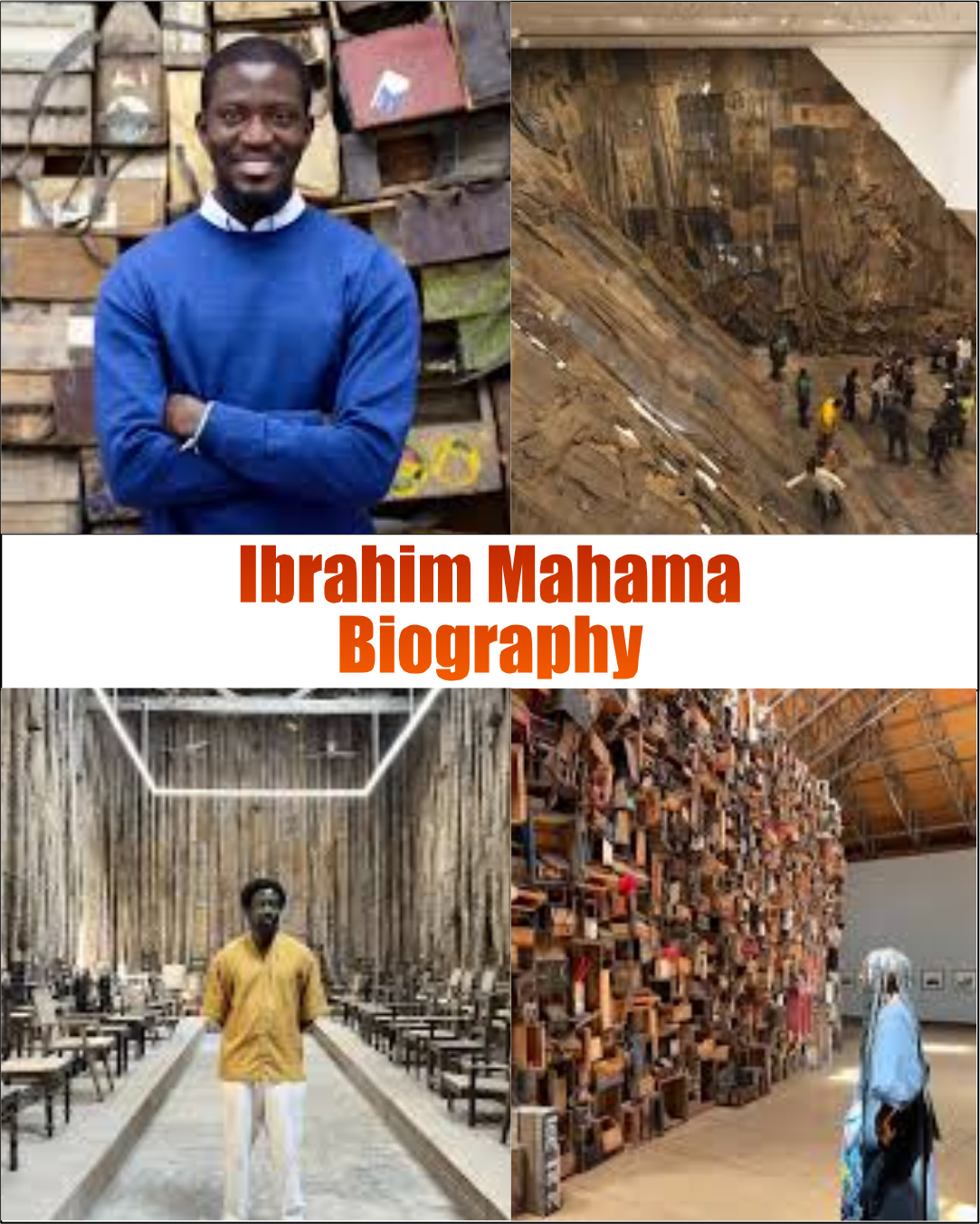
Ibrahim Mahama Biography
The Ibrahim Mahama Biography: Building Monuments from Migration, Labor, and Memory
Discover the life of Ibrahim Mahama, the Ghanaian artist who transforms discarded materials into large-scale installations exploring labor, trade, and history.
The Artist Who Wraps Buildings in History
Some artists create objects.
Ibrahim Mahama transforms entire structures.
Railway stations.
Markets.
Public buildings.
He covers them with worn, stitched-together materials—marking them with stories of movement, trade, and labor.
From a distance, it looks monumental.
Up close, it feels personal.
Because every piece carries a past.
Ibrahim Mahama Biography
| Information | Details |
|---|---|
| Full Name | Ibrahim Mahama |
| Date of Birth | 1987 |
| Age | ~39 years (as of 2026) |
| Place of Birth | Tamale, Ghana |
| Nationality | Ghanaian |
| Occupation | Artist, Installation Artist |
| Education | Kwame Nkrumah University of Science and Technology |
| Known For | Large-scale installations using jute sacks |
| Art Style | Conceptual art, installation art |
A Beginning Rooted in Observation
Ibrahim Mahama was born in 1987 in Tamale, Ghana.
Growing up, he witnessed the movement of goods across markets and borders—particularly through the use of jute sacks.
These sacks were not just objects.
They carried cocoa, charcoal, grain.
They moved between hands. Between regions. Between economies. And over time, they aged.
Tore.
Faded.
But they remained in circulation.
See also: Wiyaala Biography: The Fearless Voice Who Refused to Change Her Language
Finding Meaning in Materials
Mahama’s early artistic development was shaped by a simple realization.
Materials are not neutral.
They carry history.
Every mark, every stain, every tear is a record of use.
This understanding became central to his work.
He began collecting discarded jute sacks—materials often overlooked, even ignored.
A Signature Technique Built on Scale and Collaboration
Mahama’s work involves:
- Gathering used jute sacks
- Stitching them together
- Installing them across large architectural spaces
These installations often require teams of collaborators, reflecting the collective labor embedded in the materials themselves.
The result is immersive.
Buildings become wrapped in texture.
In history.
In movement.
Most Famous Works That Redefined Public Space
Among Mahama’s most recognized works are:
- Out of Bounds
- Check Point Sekondi Loco
- A Friend
These installations transform familiar spaces into something else.
A railway station becomes a site of reflection.
A public building becomes a monument to labor.
His work does not sit within galleries alone.
It expands into the world.
Inspiration Rooted in Labor and Migration
Mahama’s work draws from:
- Trade systems
- Migration patterns
- Labor histories
- Economic structures
The jute sacks he uses often come from the cocoa industry—a key part of Ghana’s economy.
But they also reflect global movement.
Goods traveling across borders.
People moving alongside them.
Hidden Meanings in Every Stitch
At first glance, Mahama’s installations can appear purely visual—large, textured surfaces covering architecture.
But within them lies meaning.
Each sack carries:
- Names
- Numbers
- Stains
- Repairs
These marks are not erased.
They are preserved.
They tell stories of use, exchange, and human effort.
The stitching itself becomes symbolic—connecting fragments into a larger whole.
Struggles of Scale and Perception
Working at such large scales presents challenges.
- Logistical.
- Financial.
- Conceptual.
There is also the question of perception.
Some viewers see only the visual impact.
Others engage with the deeper narratives.
Mahama’s work exists between these responses.
Influence on Contemporary Art
Mahama has expanded the possibilities of installation art.
He demonstrated that:
- Materials can carry social and economic meaning
- Scale can transform perception
- Collaboration can be part of the artistic process
His influence is visible in artists exploring similar approaches.
Controversy and Interpretation
Mahama’s work has sparked discussion around labor.
Particularly the use of materials tied to industries involving difficult working conditions.
Some critics question whether the transformation of these materials into high-value art changes their meaning.
Others see it as a way of bringing visibility to hidden systems.
These debates continue.
Recognition on the Global Stage
Mahama has gained international recognition, exhibiting at major events such as:
- The Venice Biennale
- Documenta
His installations have appeared across Europe, Africa, and beyond.
He has become one of the leading voices in contemporary African art.
The Value of His Artworks
Mahama’s works are highly valued in the global art market.
Large-scale installations, as well as smaller works derived from similar materials, are collected by institutions and private collectors.
Their value reflects both scale and significance.
A Legacy Built on Connection
Mahama’s legacy lies in connection.
He brings together fragments—materials, histories, people—and creates something unified.
But he does not erase their origins.
He highlights them.
Still Creating, Still Expanding
Mahama continues to work on new projects, including the development of cultural spaces in Ghana.
His focus extends beyond art objects.
Into infrastructure.
Into community.
The Power of What Is Overlooked
What makes Mahama’s work powerful is its origin.
He begins with what is discarded.
What is ignored.
And he transforms it into something impossible to overlook.
Closing Reflection
Some artists create from new materials.
Ibrahim Mahama creates from what has already lived.
He gathers fragments of movement, labor, and exchange—and brings them together into something monumental.
And in that process, he reminds us of something simple.
That nothing is truly empty.
Everything carries a story.
You just have to look closely enough to see it.
Frequently Asked Questions
1. Who is Ibrahim Mahama?
Ibrahim Mahama is a Ghanaian contemporary artist known for his large-scale installations that transform everyday materials into powerful visual statements.
2. Why is Ibrahim Mahama famous?
He gained global recognition for wrapping buildings and public spaces with used jute sacks, creating striking installations that tell stories of trade and labor.
3. What themes does Ibrahim Mahama explore?
His work explores economics, labor, migration, global trade, and postcolonial identity.
4. What makes Ibrahim Mahama’s art unique?
He uses materials with historical and economic significance, such as jute sacks, to reflect the movement of goods and people across borders.
5. What is Ibrahim Mahama’s legacy?
His legacy lies in redefining installation art by connecting material culture, history, and global systems in contemporary African art.