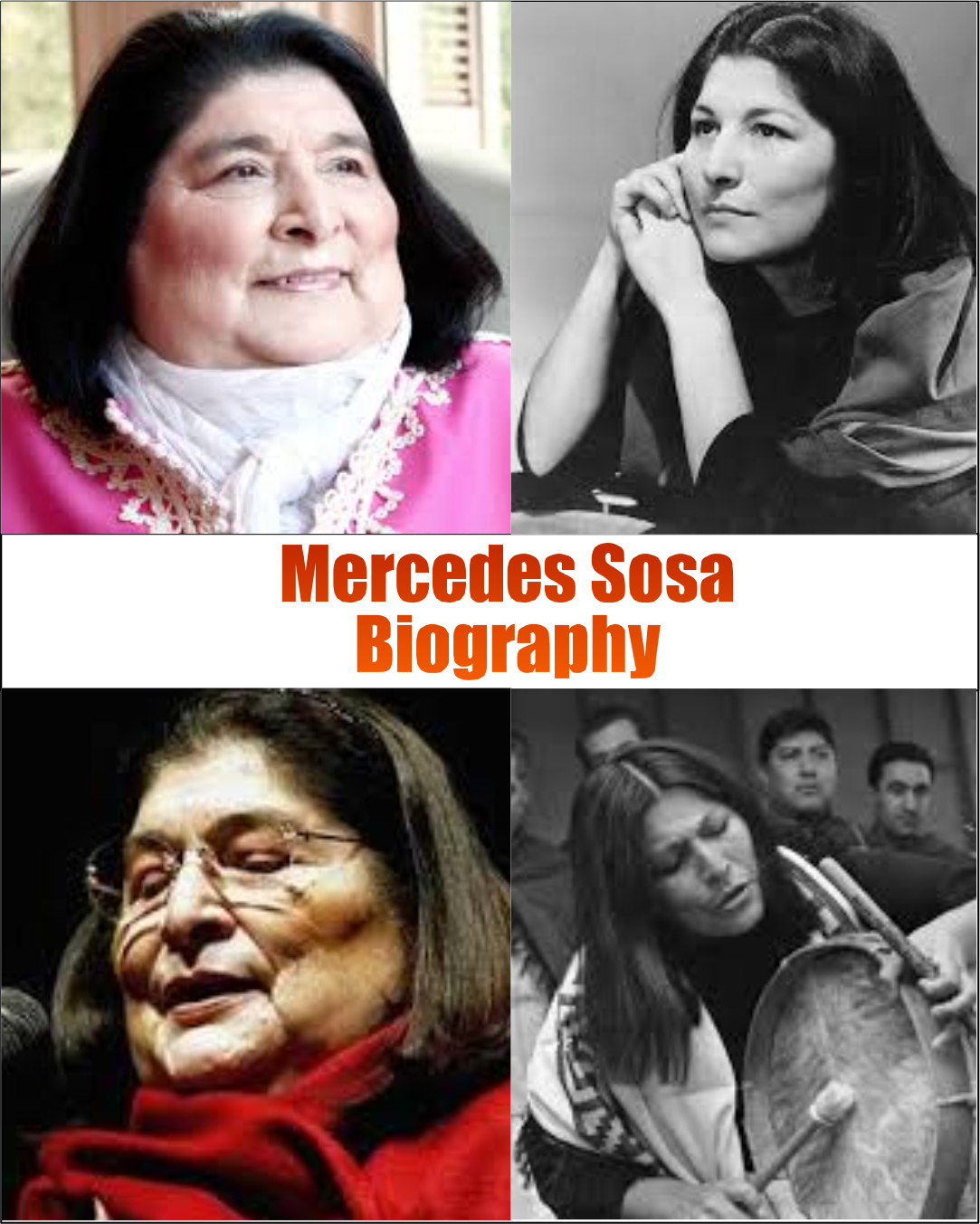
Mercedes Sosa Biography
The Mercedes Sosa Biography: The Voice That Carried a Continent.
Discover the life of Mercedes Sosa, the Argentine icon who sang for the oppressed, faced arrest and exile under a military dictatorship, and returned to become the voice of Latin America.
The Voice They Could Not Silence
There are voices that rise from talent—and there are voices that rise from necessity.
Mercedes Sosa did not sing because the world needed more music. She sang because silence had become unbearable.
In a time when Argentina was ruled by fear, when speaking out could lead to disappearance, imprisonment, or worse, she stood on stage and sang truths that many were too afraid to whisper.
She was arrested mid-performance. Forced into exile. Watched. Threatened.
And yet, when she returned, entire stadiums filled—not just to hear her sing, but to feel what her voice represented.
She was not just an artist.
She was a voice for the voiceless. The sound of resistance across a continent.
Mercedes Sosa Biography
| Information | Details |
|---|---|
| Full Name | Haydée Mercedes Sosa |
| Stage Name | Mercedes Sosa (“La Negra”) |
| Date of Birth | July 9, 1935 |
| Date of Death | October 4, 2009 |
| Age at Death | 74 years |
| Place of Birth | San Miguel de Tucumán, Argentina |
| Nationality | Argentine |
| Occupation | Singer, Activist |
| Known For | Voice of Latin American folk movement and protest music |
A Humble Beginning in the Shadows
Mercedes Sosa was born on July 9, 1935, in San Miguel de Tucumán, Argentina—a date that coincided with Argentina’s Independence Day. It was a symbolic beginning for someone who would spend her life fighting for freedom.
Her family was poor. Her parents were working-class, navigating a society deeply divided by class and power. From an early age, Sosa understood struggle—not as an abstract idea, but as daily reality.
Music entered her life quietly.
See also: Miriam Makeba Biography: The Exiled Voice Who Sang Africa to the World
The Birth of a Movement
By the 1960s, Sosa had become part of something larger than herself—the Nueva Canción movement.
It was not just music. It was cultural resistance.
Artists across Latin America were blending traditional folk sounds with political messages, creating songs that spoke about inequality, injustice, and identity. It was music rooted in the people—but aimed at power.
Sosa stood out.
Her voice was deep, grounded, unmistakable. She did not need theatrics. She did not need excess. When she sang, people listened.
And what they heard was truth.
Singing in a Time of Fear
In 1976, Argentina fell under military dictatorship.
The regime ruled through repression—censorship, surveillance, and violence. Thousands of people were “disappeared,” taken without explanation, never to return.
In this environment, music became dangerous.
And Sosa’s music was especially dangerous.
Her songs spoke about workers, about the poor, about injustice. She performed pieces written by banned composers. She stood on stage and sang what the government wanted buried.
She knew the risks.
But she did not stop.
Arrested on Stage
In 1979, during a live performance in La Plata, everything came to a head.
The military stormed the venue.
Mercedes Sosa was arrested in front of her audience. So were many of the people in attendance. It was not just an act of intimidation—it was a message.
No one was beyond reach.
For Sosa, it marked a turning point.
The pressure had become too great. The danger too immediate.
Soon after, she left Argentina.
Exile: A Voice Without a Home
Sosa’s exile took her first to Paris, then to Madrid.
Like many artists forced from their countries, she carried a complicated burden. She was safe—but far from home. Free—but disconnected from the people she sang for.
And yet, exile did not silence her.
If anything, it expanded her reach.
She performed across Europe and Latin America, bringing the stories of Argentina’s repression to international audiences. Her concerts became spaces of solidarity—where exiles, activists, and supporters gathered.
She was no longer just Argentina’s voice.
She was becoming the voice of Latin America.
Songs That Carried a Continent
Sosa’s repertoire was rich and deeply intentional.
She sang “Gracias a la Vida,” a song that, on the surface, expressed gratitude—but in her voice, carried layers of pain and resilience. She performed “Solo le pido a Dios,” a plea against war and injustice that resonated across borders.
Her music did not shout. It endured.
There was a quiet strength in her delivery—a sense that she was not just performing songs, but carrying stories.
Stories of people who could not speak. Of communities silenced by fear.
The Return That Shook a Nation
In 1982, as Argentina’s dictatorship began to weaken, Sosa returned home.
It was a moment charged with emotion.
Her comeback concerts in Buenos Aires were more than performances—they were collective acts of healing. People filled theaters night after night, not just to hear music, but to reclaim something that had been taken from them.
Her voice, once forced into exile, now filled the very spaces that had tried to suppress it.
It was not just a return.
It was a restoration.
A Presence That Transcended Music
Sosa’s influence extended far beyond her recordings.
She became a cultural symbol—a figure who represented dignity, resilience, and truth. Her presence carried weight. When she spoke, people listened. When she sang, people felt seen.
She collaborated with artists across genres and generations, bridging traditional folk with contemporary sounds. But no matter the setting, her essence remained unchanged.
She was grounded. Authentic. Uncompromising.
Recognition Without Compromise
As the years passed, Sosa received international recognition—awards, honors, invitations to global stages.
But unlike many artists who soften their edges over time, she did not dilute her message.
She continued to sing about inequality. About human rights. About the struggles that persisted long after dictatorship ended.
Her voice aged, but its power did not fade.
If anything, it deepened.
The Final Years
In her later years, Sosa faced health challenges. Performances became less frequent, but when she appeared, the impact was undeniable.
Audiences did not come for perfection.
They came for presence.
For the voice that had carried them through decades of uncertainty, fear, and hope.
On October 4, 2009, Mercedes Sosa passed away in Buenos Aires at the age of 74.
A Farewell Across a Continent
Her death was felt far beyond Argentina.
Leaders, artists, and ordinary people across Latin America mourned her passing. Tributes poured in, not just celebrating her music, but acknowledging what she had meant.
She had given voice to a continent’s struggles.
She had stood firm when silence was safer.
She had endured.
The Legacy of La Negra
Sosa was often called “La Negra,” a term of endearment that reflected her roots and identity.
But her true legacy goes deeper than any nickname.
She showed that music could be a form of resistance—not loud, not aggressive, but steady and unyielding. She proved that a voice, grounded in truth, could outlast fear.
Her influence continues in artists who use their platforms to speak about justice, identity, and humanity.
The Echo That Remains
Today, her songs still resonate.
They are played in homes, in protests, in quiet moments of reflection. They remind listeners of a time when speaking out required courage—and of a woman who did it anyway.
Her voice does not feel distant.
It feels present.
Closing Reflection
Some artists leave behind melodies.
Mercedes Sosa left behind meaning.
She sang when it was dangerous. She returned when it was possible. And she never forgot why she began.
In a world that often demands silence, she chose something braver.
She chose to sing.
Frequency Asked Questions
1. Who is Mercedes Sosa?
Mercedes Sosa was an Argentine singer and activist, widely regarded as one of the greatest voices in Latin American music and a central figure in the Nueva Canción movement.
2. Why is Mercedes Sosa famous?
She became famous for her powerful voice and songs that addressed social justice, human rights, and political struggles across Latin America.
3. What is the Nueva Canción movement?
Nueva Canción was a musical movement that combined traditional folk music with political lyrics, often opposing dictatorships and advocating for change — and Sosa was one of its leading voices.
4. Did Mercedes Sosa face political challenges?
Yes — during Argentina’s military dictatorship, she was harassed, arrested, and forced into exile, but continued to perform and speak out internationally.
5. What is Mercedes Sosa’s legacy?
Her legacy is rooted in her role as a voice of the oppressed, influencing generations of artists and remaining a symbol of resistance, culture, and truth in music.