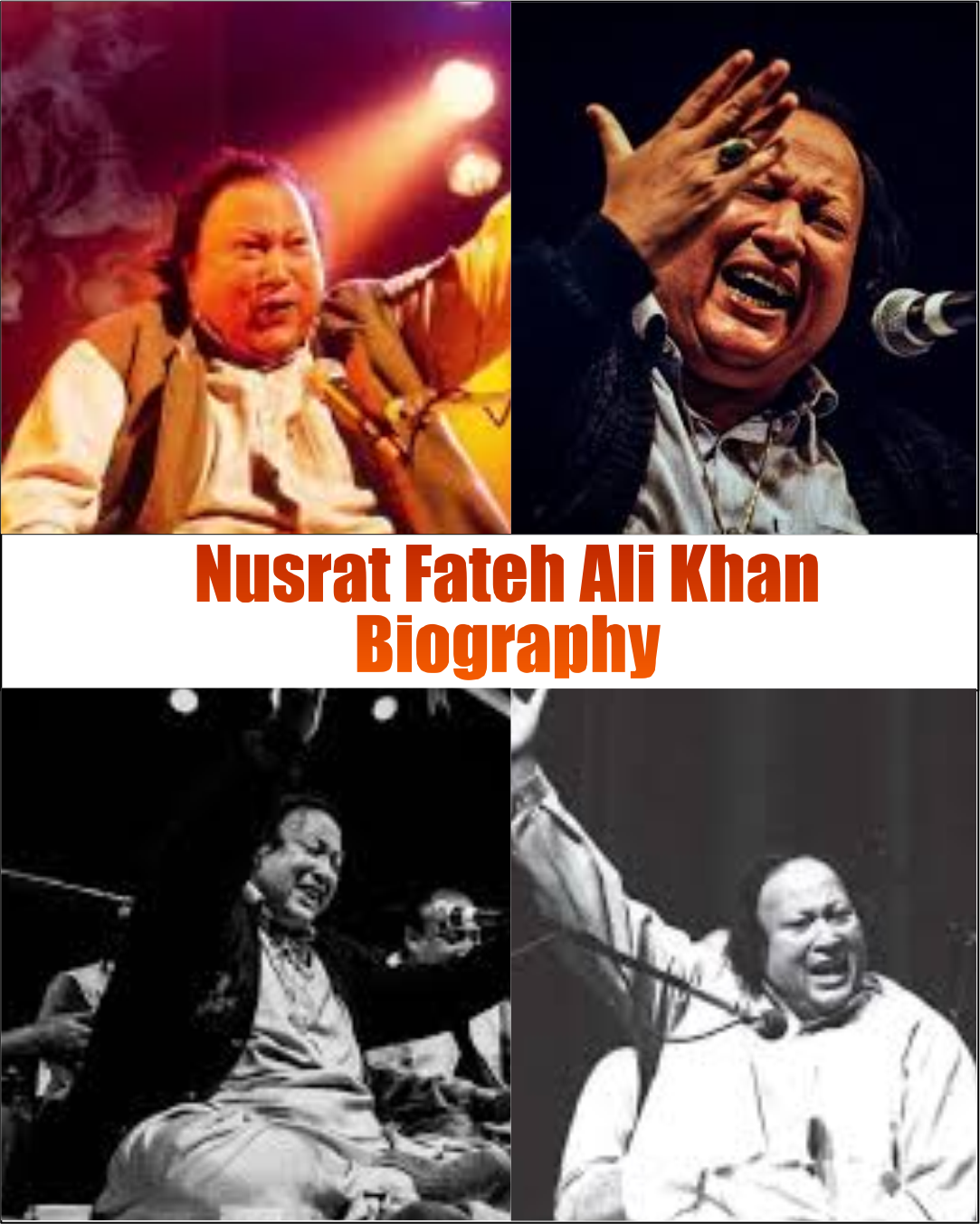
Nusrat Fateh Ali Khan Biography
The Nusrat Fateh Ali Khan Biography: The Voice That Carried Sufi Music to the World.
Explore the life of Nusrat Fateh Ali Khan, the legendary Qawwali singer who took Sufi devotional music from sacred spaces to global stages and redefined spiritual sound.
The Voice That Felt Like Something Beyond Human
Some voices impress. Some voices move.
And then there are voices that feel like they don’t belong to one person at all—as if they are carrying something older, deeper, and impossible to contain.
Nusrat Fateh Ali Khan possessed that kind of voice.
It did not just sing—it soared, stretched, and broke through limits that most singers never approach. It could whisper devotion and, moments later, erupt into something so powerful it felt like the room itself might not hold it.
For centuries, Qawwali music had lived within shrines and spiritual gatherings. It was sacred, intimate, rooted in devotion.
Nusrat changed that.
He carried it onto the world stage—without stripping it of its soul.
And in doing so, he introduced millions to a sound they had never heard, but somehow immediately understood.
Nusrat Fateh Ali Khan Biography
| Information | Details |
|---|---|
| Full Name | Nusrat Fateh Ali Khan |
| Date of Birth | October 13, 1948 |
| Date of Death | August 16, 1997 |
| Age at Death | 48 years |
| Place of Birth | Faisalabad, Pakistan |
| Nationality | Pakistani |
| Occupation | Singer, Musician, Composer |
| Known For | Master of Qawwali |
| Global Recognition | Popularized Sufi music worldwide through international collaborations |
Born Into a Sacred Tradition
Nusrat Fateh Ali Khan was born on October 13, 1948, in Faisalabad, Pakistan, into a family where music was not just profession—it was inheritance.
For over 600 years, his family had practiced Qawwali, a form of Sufi devotional music deeply connected to spiritual expression and poetry. It was not seen as entertainment. It was a form of prayer.
His father, Fateh Ali Khan, was a respected Qawwali singer who carried the weight of that lineage with discipline and reverence.
Interestingly, Nusrat was not initially expected to become a singer.
His father had hoped he would pursue a more conventional profession. But destiny, shaped by both tradition and circumstance, had other plans.
See also: Fela Kuti Biography: The Rebel Who Turned Music into a Weapon Against Power
A Reluctant Beginning
When Nusrat was still a teenager, his father passed away.
At the funeral, something unexpected happened.
Nusrat began to sing.
It was not a planned performance. It was not an audition. It was an outpouring.
Those who heard him understood immediately—this was not ordinary talent. This was something that had been waiting.
From that moment, his path was clear.
He began formal training under his uncles, immersing himself in the rigorous discipline of Qawwali. It required not just vocal strength, but spiritual depth, control, and endurance.
He learned not just how to sing—but how to feel every word.
The Making of a Master
Qawwali is not structured like conventional music.
It is expansive. Improvisational. Built on repetition, call-and-response, and emotional intensity. Performances can last for long durations, building slowly before reaching moments of transcendence.
Nusrat mastered it.
His voice had an extraordinary range. He could sustain notes for extended periods, shift between registers effortlessly, and deliver intricate vocal patterns with precision.
But technique alone does not explain his impact.
What set him apart was emotion.
He did not perform Qawwali as a routine. He lived it in real time. Each performance felt immediate—unrepeatable.
Breaking Out of the Courtyard
For generations, Qawwali had remained within South Asia, largely confined to spiritual spaces.
Nusrat expanded its reach.
By the 1980s, he began performing internationally. Audiences unfamiliar with the language or the tradition found themselves captivated.
They did not need translation.
They felt it.
His performances in Europe and North America introduced Qawwali to new audiences—people who had never encountered Sufi music, yet responded to its intensity.
He did not dilute the form to make it accessible.
He trusted its power.
A Voice That Crossed Boundaries
As his global presence grew, Nusrat began collaborating with international artists and producers.
One of the most notable was Peter Gabriel, who invited him to perform at the WOMAD festival and later worked with him on recordings.
Gabriel famously described Nusrat’s voice as one of the greatest he had ever heard.
Through such collaborations, Nusrat’s music reached even wider audiences. He contributed to film soundtracks, fusion projects, and experimental recordings—all while maintaining the essence of Qawwali.
He was not adapting to the world.
He was bringing the world to his tradition.
The Power of Devotion
At the heart of Nusrat’s music was devotion.
Qawwali draws heavily from Sufi poetry—verses that speak of love, longing, and the search for divine connection. But this love is often layered, blurring the lines between the spiritual and the human.
Nusrat’s delivery made those layers come alive.
Listeners often described his performances as overwhelming—not in volume, but in feeling. There was a sense of surrender in his music, as though he was channeling something larger than himself.
It was not about perfection.
It was about presence.
Fame Without Compromise
As Nusrat’s fame grew, he faced a challenge that many traditional artists encounter—how to reach new audiences without losing authenticity.
He navigated it carefully.
While he experimented with new formats and collaborations, he never abandoned the core structure of Qawwali. His live performances remained rooted in tradition, with harmoniums, handclaps, and call-and-response vocals forming the foundation.
He respected where he came from.
And that respect allowed his evolution to feel genuine, not forced.
A Tireless Performer
Nusrat was known for his relentless work ethic.
He recorded extensively—hundreds of songs, numerous albums—and performed across continents. His schedule was demanding, often pushing his physical limits.
But on stage, none of that showed.
Each performance carried the same intensity, the same commitment. Whether in a small gathering or a large concert hall, he gave everything.
For him, music was not something to ration.
It was something to offer fully.
The Final Years
By the mid-1990s, Nusrat’s health began to decline.
Years of intense touring and recording had taken a toll. Despite this, he continued to work, to perform, to create.
In 1997, he traveled to London for medical treatment.
On August 16, 1997, Nusrat Fateh Ali Khan passed away at the age of 48.
The news spread quickly, reaching fans across continents who had come to see him as more than an artist.
He was a bridge—between cultures, between traditions, between the spiritual and the universal.
A Loss Felt Across the World
Tributes came from every corner of the music world.
Artists, critics, and listeners spoke not just of his skill, but of his presence. There was a recognition that something rare had been lost—a voice that could not be replicated.
Yet, his recordings remained.
And through them, his voice continued.
The Legacy That Continues to Rise
Today, Nusrat Fateh Ali Khan’s influence is vast.
Qawwali has gained international recognition, and many artists cite him as a source of inspiration. His work has been sampled, studied, and celebrated across genres.
But his true legacy lies in what he made possible.
He showed that deeply rooted, culturally specific music could resonate globally without losing its identity. He proved that emotion, when delivered with honesty, transcends language.
The Echo of Something Eternal
Listening to Nusrat today still feels immediate.
There is no sense of distance, no feeling that his music belongs to the past. It exists in a space that feels timeless.
Perhaps that is what made him so powerful.
He did not just perform songs.
He created moments—moments that linger long after the sound fades.
Closing Reflection
Some voices are remembered for their range.
Nusrat Fateh Ali Khan is remembered for what his voice carried.
Devotion. Intensity. Connection.
He took a sacred tradition and shared it with the world—not by changing it, but by trusting it.
And in doing so, he gave people something rare.
Not just music.
But feeling.
Frequently Asked Questions
1. Who is Nusrat Fateh Ali Khan?
Nusrat Fateh Ali Khan was a legendary Pakistani singer known as one of the greatest vocalists in history and the most influential performer of Qawwali.
2. Why is Nusrat Fateh Ali Khan famous?
He gained global fame for his extraordinary vocal range, emotional depth, and ability to bring spiritual music to international audiences.
3. What is Qawwali music?
Qawwali is a form of Sufi devotional music that uses repetitive rhythms and poetic lyrics to create a deeply spiritual and emotional experience.
4. Did Nusrat Fateh Ali Khan perform internationally?
Yes — he collaborated with global artists and performed worldwide, helping introduce Sufi music to Western audiences.
5. What is Nusrat Fateh Ali Khan’s legacy?
His legacy lies in transforming traditional Qawwali into a global phenomenon and influencing countless musicians across different genres.