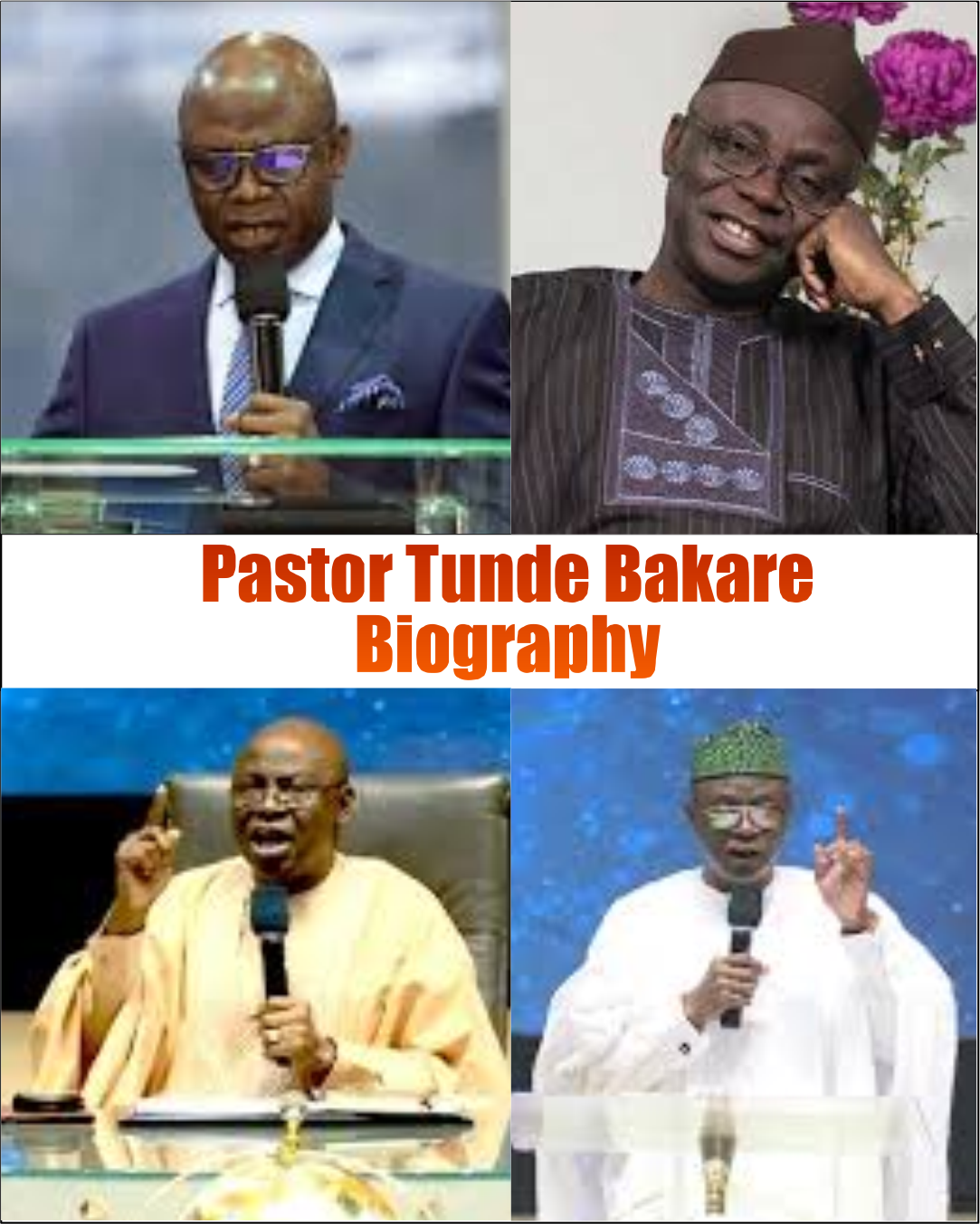
Pastor Tunde Bakare Biography
The Pastor Tunde Bakare Biography: The Muslim Boy Who Became a Christian Prophet
Tunde Bakare was born into a Muslim family, never met his father, crawled on his buttocks for three years of his life, became a lawyer trained under Gani Fawehinmi, walked away from a thriving legal career at the voice of God, built one of Nigeria’s most intellectually driven churches, ran for vice president, turned down a $485,000 Rolls Royce from the presidency, and has been telling Nigerian governments the truth for forty years. At 70 he is still going.
The Muslim Boy Who Became a Christian Prophet — and Told Five Nigerian Governments Exactly What He Thought: The Story of Pastor Tunde Bakare
There is a story about Tunde Bakare that tells you more about him than any sermon ever could.
On his 60th birthday in 2014, a brand-new Rolls Royce with a market value of $485,000 was delivered to him as a birthday gift from the Presidency. While rejecting it, he asked those who brought it if every Nigerian who turns 60 gets a Rolls Royce as a gift from the government.
Then the same government sent him the documents for the allocation of an oil well. He thanked the President and politely declined.
Then, during the Save Nigeria Group work, a bag containing $600,000 in cash was brought to him as appreciation for his contributions to national affairs. He turned it down too.
Three separate attempts to buy a man who had decided, decades earlier, that he could not be bought. The consistency of the refusal is the testimony. Anyone can say no once. Three times — to a Rolls Royce, an oil well, and $600,000 — is a philosophy.
That philosophy was not formed in a comfortable household. It was formed in poverty, in a Muslim compound in Abeokuta, by a boy who never met his father.
Pastor Tunde Bakare Biography
| Information | Details |
|---|---|
| Full Name | Tunde Bakare (Olatunde Tunde Bakare) |
| Date of Birth | November 11, 1954 |
| Age | 71 years (as of 2026) |
| Place of Birth | Abeokuta, Ogun State, Nigeria |
| Nationality | Nigerian |
| Occupation | Pastor, Lawyer, Activist, Politician |
| Church | Founder of Citadel Global Community Church (formerly Latter Rain Assembly) |
| Known For | Strong political activism and prophetic messages on national issues |
| Political Role | Running mate to Muhammadu Buhari in the 2011 presidential election |
Early Spiritual Journey — The Boy Who Never Met His Father
Tunde Bakare was born on November 11, 1954, to a polygamous Muslim family at Iporo Sodeke in Abeokuta. He never met his father, who died when he was only two. He crawled on his buttocks for the first three years of his life, was born into declining wealth, and was raised in abject poverty under the watchful eye of his widowed, hardworking mother whose unwavering discipline and enterprising spirit shaped his character and instilled in him invaluable lessons of courage, perseverance, resilience and integrity.
A fatherless, physically delayed child of a widowed mother in a Muslim household in Abeokuta. That is the raw material from which one of Nigeria’s most formidable public intellectuals and religious voices was built. Not by inheritance. Not by connection. By the specific quality of a mind that asks questions when everyone around it accepts answers.
Born a Muslim and equipped with the rudiments of Islamic education, Bakare had expanded his literacy to the level of being able to read the Quran effortlessly. Young Bakare had started leading prayers and assisting the local mallams in his community during official Islamic engagement. While some of his mates took in everything unreservedly, young Tunde was curious and started asking questions about his faith.
See also: Cardinal Anthony Olubunmi Okogie Biography: The Archbishop Who Volunteered to Die for a Muslim Woman
Calling or Divine Encounter — Light in a Baptist Church
According to official records of his church, God showed Tunde Bakare in 1964 on the night of his circumcision a glimpse of his future, which manifested in a dream from which he woke up in a pool of his own blood. He was ten years old. He told no one. He filed it.
Ten years later, in September 1974, while in a Baptist Church to take the photograph of a friend being baptised, a pillar of light like the one he saw in his vision ten years earlier was replayed inside the church. The encounter was not dramatic in the way Nigerian testimonies often perform drama. It was a recognition — the specific feeling of a man seeing something he had seen before and understanding, finally, what it had always meant.
He was a Muslim from birth who embraced the Christian faith in 1974 at the age of 20. His family’s reaction to the conversion is not recorded in careful detail. The community’s reaction — that a boy who had been reading the Quran and leading prayers had walked into a Baptist church and not walked out the same — can be imagined.
On April 1, 1989, he founded The Latter Rain Assembly, now known as The Citadel Global Community Church.
Teachings and Doctrines — The Lawyer Who Preached Like a Prosecutor
Bakare’s theology cannot be separated from his legal training. He does not preach — he argues. He builds a case, presents evidence, challenges the opposing position, and delivers a verdict. His sermons are structured like briefs filed with the highest court imaginable.
His foundational conviction is that the Gospel is inherently political — that a Church which does not engage with the systems producing poverty, injustice, and corruption has abdicated its prophetic mandate. Not long after he started his ministry, Nigerians started seeing a different man of God: a practical Christian who says it the way it is, not minding whose ox is gored.
He preached accountability before it was fashionable. He preached structural economic reform — resource control, fiscal federalism, institutional restructuring — from the pulpit in an era when most Nigerian pastors were preaching prosperity. “Is it a coincidence that every state of the federation is endowed with mineral resources? Would it not be a better strategy for states to be empowered to manage these resources?” he asked — in a sermon, not a policy paper.
Did you know?
When M.K.O Abiola contested for the presidential election in 1993, Bakare advised against it, prophesying that “he might not come out alive.” Abiola died in detention. In April 1993, Bakare predicted that neither of the two existing political parties would attain political power. Less than two weeks after the June 12 presidential election, General Babangida cancelled the election. A track record of prophecy that his followers cite as evidence and his critics explain away — but cannot fully dismiss.
Controversies and Criticisms — The Man Who Made Everyone Uncomfortable
If Okogie was the Catholic thorn in Nigeria’s political flesh, Bakare is the Pentecostal one — and Pentecostal thorns cut differently.
In a 2006 sermon, he claimed that Muhammadu Buhari would be a bad leader for Nigeria. Yet he accepted the offer to be Buhari’s vice presidential candidate in the 2011 election. The reversal became the most quoted inconsistency in his public record. He explained it as divine instruction overriding personal opinion — the same God who had told him about the Baptist church in 1974 had now told him to run with Buhari. His critics were not satisfied. He ran anyway.
He has been critical of Nigeria’s leadership and has sparked controversy with inflammatory comments regarding Muslims and other spiritual leaders. His statements about Fulani herdsmen — calling them terrorists — were described by Islamic scholars as Islamophobic. His criticism of prominent Pentecostal figures drew fierce responses from their followers. He claimed that many pastors in Nigeria get away with “fake prophecies” because their followers do not hold them accountable — a statement that implicated the entire prophetic Pentecostal industry he operated within.
He was reportedly arrested in March 2002 after preaching sermons critical of Nigeria’s then-president, Olusegun Obasanjo. The arrest proved the point he had been making — that speaking truth to power in Nigeria has a cost, and that he was willing to pay it.
His prophecy about becoming Nigeria’s 16th president — “I will succeed Buhari as President of Nigeria; nothing can change it. I am number 16, and Buhari is number 15. To this end, I was born” — became perhaps his most controversial public statement, drawing both ridicule and intense theological debate about the nature and accountability of prophetic declarations.
Growth of Ministry — From Latter Rain to Citadel
The church he planted in 1989 grew from a gathering of committed believers into one of Nigeria’s most intellectually demanding congregations. His ministry emphasises biblical foundations, societal reform, and political engagement. The congregation at The Citadel Global Community Church in Lagos is not primarily drawn by healings or prosperity promises — it is drawn by the specific quality of preaching that treats the congregation as adults capable of engaging with Scripture, history, politics, and economics simultaneously.
He presides over the Global Apostolic Impact Network — GAIN — a network of churches, ministries, and kingdom businesses committed to advancing the Kingdom of God on earth. He is also President of Latter Rain Ministries Inc., based in Atlanta, Georgia — extending his reach across the Atlantic into the Nigerian and African diaspora communities that constitute some of the most financially significant congregations in the world.
Influence on Followers — The Congregation That Thinks
His followers are not the typical Nigerian church crowd. They are lawyers, doctors, academics, activists, journalists — people who came to The Citadel because it was the only church that made them feel they could bring their full intelligence to their faith rather than leaving it at the door.
The Save Nigeria Group — a coalition of pro-democracy groups and individuals that he convened — demonstrated that his influence extended beyond his congregation into civil society at large. Activists who were not his church members worked alongside him because his name and his platform gave the coalition credibility it would not otherwise have had.
Working with him in the Save Nigeria Group, one observer witnessed him reject questionable donations from people who wanted to identify with the movement for sociopolitical photo opportunities. The integrity he modelled became the culture his followers absorbed. A congregation learns what its leader demonstrates — not what they preach.
Lifestyle and Wealth Discussions
The Rolls Royce story is the central text of any discussion about Bakare and wealth — not because it was the only time but because it was the most dramatic. Three separate refusals — the car, the oil well, the cash — document a man whose relationship with wealth is not performative poverty but principled sufficiency.
When he served as Ogun State and Yoruba Elders delegate to the National Conference in 2014, he refused to collect the N12 million allowance paid to each of the 492 delegates. In his words: “I will not take a penny. It has nothing to do with others; that is by choice. We go with integrity of heart.”
His net worth is estimated at between $1 million and $5 million — modest compared to other prominent Nigerian pastors, but his influence in both religious and political circles sets him apart. The modesty of the figure, relative to the scale of his influence, is itself a statement.
He is married to Olayide Bakare. They have five children and grandchildren. The family life is private by the standards of Nigerian pastoral celebrity culture — deliberately kept away from the performance of pastoral domesticity that other leaders use as congregation management.
Legacy and Global Reach
Among the various awards and honours he has received are a Doctor of Ministry from Indiana Christian University, the 2010 Man of the Year award by Newswatch Magazine, the University of Lagos Golden Jubilee Distinguished Alumni Award in 2012, and an honorary doctorate from Afe Babalola University in 2024.
His reach is transatlantic — through GAIN, through Latter Rain Ministries in Atlanta, through the diaspora congregations that carry his preaching across the world via digital platforms. His sermons are dissected online by Nigerian students in London, Houston, and Toronto. His political declarations are analysed by Nigerian journalists as seriously as statements from party leaders.
Impact on Society and Morality
Nigeria’s religious landscape is crowded with voices claiming prophetic authority. Most of them are saying things their congregations want to hear. Bakare has spent forty years saying things the country needs to hear — and accepting the social cost of the distinction.
He challenged military dictatorship when doing so risked arrest. He challenged democratic governments when doing so risked political isolation. He challenged his fellow pastors when doing so risked professional alienation. He challenged himself — publicly, in his autobiography — when doing so required acknowledging contradictions that most leaders would bury.
Many people have described Pastor Bakare as a noise maker. But deep inside, Nigerians know Bakare is speaking their minds.
A noise maker whose noise is the sound of accountability — the specific, uncomfortable sound of a man who will not be quiet and cannot be bought. Nigeria has produced very few of them. At seventy, Tunde Bakare is still making it.
Frequently Asked Questions
1. Who is Pastor Tunde Bakare?
Pastor Tunde Bakare is a Nigerian cleric, lawyer, and political activist known for his bold sermons, national commentary, and leadership of a major Lagos-based church.
2. What church does Tunde Bakare lead?
He is the founder and overseer of Citadel Global Community Church, a prominent Pentecostal church in Nigeria.
3. Has Tunde Bakare been involved in politics?
Yes — he was the vice-presidential candidate alongside Muhammadu Buhari in the 2011 Nigerian presidential election and has remained active in political discourse.
4. What is Tunde Bakare known for?
He is known for his outspoken views on governance, prophetic declarations, and advocacy for national reform, often addressing political and social issues in Nigeria.
5. What is Pastor Tunde Bakare’s background?
Before entering full-time ministry, he worked in various fields and later became a lawyer, combining legal knowledge with religious leadership and activism.