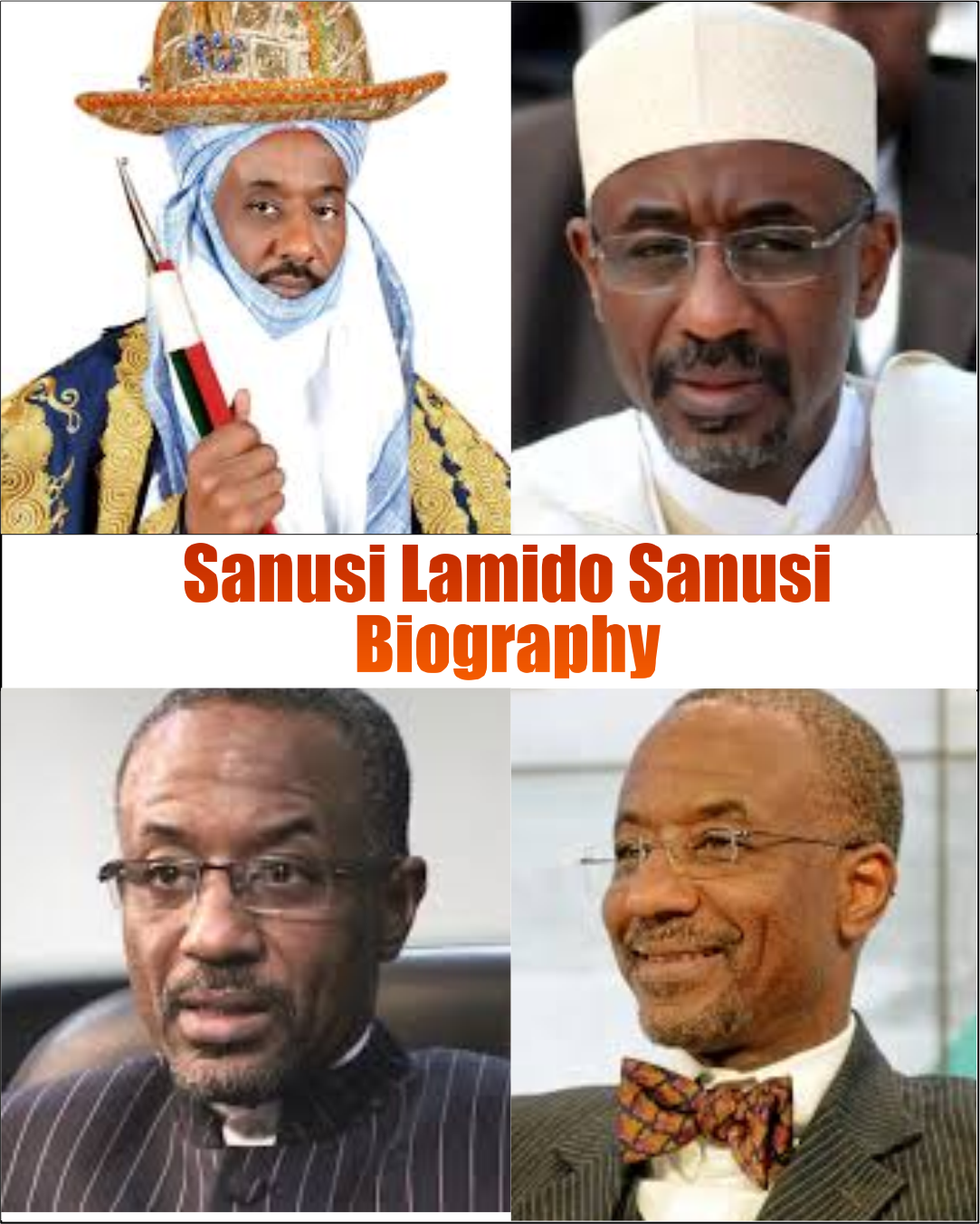
Sanusi Lamido Sanusi Biography
The Sanusi Lamido Sanusi Biography: The Banker Who Accused a Government of theft and Paid With His Throne
Sanusi Lamido Sanusi quit banking to study Arabic in Sudan, returned to become Nigeria’s most feared CBN Governor, fired corrupt bank chiefs in his first six months, accused the government of losing $20 billion in oil revenue, was suspended and had his passport seized, became Emir of Kano, was dethroned by a governor he had embarrassed, and was reinstated in 2024. He is simultaneously Nigeria’s most important Islamic voice and its most inconvenient economic conscience.
The Banker Who Told Nigeria Its Government Stole $20 Billion — and Paid With His Throne: The Story of Sanusi Lamido Sanusi
In 2009, a journalist asked Sanusi Lamido Sanusi — freshly appointed Governor of the Central Bank of Nigeria — whether he had presidential ambitions.
His answer was not what anyone expected.
“No, I don’t. I have ambitions to be the Emir of Kano.”
In a country where every powerful man claims to be uninterested in power, this was a different kind of declaration entirely. He was not performing modesty. He was telling the truth about a destiny he had been preparing for since he abandoned a banking career in the 1990s to study Arabic and Islamic law in Sudan — a choice that baffled his colleagues, made sense to nobody, and turned out to be the most consequential decision of his life.
What happened in the fifteen years between that 2009 interview and his reinstatement as Emir of Kano in May 2024 is the most compressed account of what it costs to be brilliant, honest, and inconvenient in Nigeria simultaneously.
Sanusi Lamido Sanusi Biography
| Information | Details |
|---|---|
| Full Name | Muhammadu Sanusi II (Sanusi Lamido Sanusi) |
| Date of Birth | July 31, 1961 |
| Age | 65 years (as of 2026) |
| Place of Birth | Kano State, Nigeria |
| Nationality | Nigerian |
| Occupation | Islamic Scholar, Economist, Traditional Ruler |
| Religious Role | Former Emir of Kano |
| Known For | Advocacy on governance, economy, and Islamic scholarship |
| Major Position Held | Former Governor of the Central Bank of Nigeria |
Early Spiritual Journey — Royal Palace, Catholic School, and the Question He Could Not Stop Asking
Sanusi was born on 31 July 1961 in Kano to a ruling class Fulani family of the Sullubawa clan. His grandfather was Muhammadu Sanusi I — the 11th Fulani Emir of Kano, deposed in 1963 by the most powerful politician in northern Nigeria, Sir Ahmadu Bello, in a feud that the family never fully forgot. He grew up in the royal palace of his great-uncle Ado Bayero, who reigned for over five decades.
He attended St. Anne’s Catholic Primary School in Kaduna, then King’s College Lagos for his secondary education. A Muslim boy from the Kano royal family, educated at Lagos’s most prestigious secondary school, absorbing both the Islamic intellectual tradition of his household and the Western academic rigour of a colonial-era institution designed to produce Nigeria’s administrative elite.
He studied economics at Ahmadu Bello University Zaria, graduating in 1981. He taught economics there for two years. Then he entered banking — Icon Limited, then UBA, then First Bank — rising through risk management with such speed and precision that by 2009 he was Group Managing Director of First Bank, Nigeria’s largest bank.
But something had happened in between. In the mid-1990s, at the peak of his banking ascent, he quit a banking job to study Arabic and Islamic studies in Sudan. He obtained a degree in Islamic law at the International University of Africa in Khartoum.
See also: Pastor Tunde Bakare Biography: The Muslim Boy Who Became a Christian Prophet
Calling or Divine Encounter — The Sanusi Tsunami
In June 2009, the late President Umaru Musa Yar’Adua appointed Sanusi as the Governor of the Central Bank of Nigeria. He was appointed in the middle of a global financial crisis. The Nigerian banking system was on the edge of collapse — overexposed to a crashing stock market, riddled with insider abuses, governed by executives who had been treating depositor funds as personal property.
What he did next has entered Nigerian financial history as the Sanusi Tsunami.
In the first six months of his tenure, the CBN bailed out nine Nigerian banks at a cost of $4 billion, with Sanusi firing the top executives at eight of the banks. His activity in unearthing financial mismanagement was so swift it was dubbed the “Sanusi Tsunami.”
Eight bank chief executives removed in six months. Not suspended. Not investigated for years through committees. Removed — with the evidence already assembled, the cases already built, the replacements already in position. His actions earned him acclaim from international observers: Sanusi was named the world’s best central banker for 2010 by influential magazine The Banker.
Teachings and Doctrines — Islam as Justice, Not Politics
As a scholar within the Tijaniyyah Sufi tradition, Sanusi’s theological position is precise and consistent: he believes Islam should only bring justice to people and should not be used for selfish political agendas.
This sounds simple. In northern Nigeria, where religion and politics have been deliberately entangled by successive political actors for fifty years, it is profoundly radical. He has argued that the enforcement of Sharia in twelve northern states has produced neither justice nor development — that it has been used as a political instrument by elites who do not themselves live by its demands.
He has argued publicly for girl-child education and against child marriage — positions that within the conservative northern Nigerian Islamic establishment constitute genuine intellectual courage. He has spoken out against polygamy’s link to poverty and terrorism, advocated for family planning, and called for the conversion of underused mosques into schools. Each position was delivered from within the Islamic framework — not as a Western liberal critique of Islam but as an Islamic scholar’s critique of how Islam was being practised by people who should know better.
He was a vehement opponent of Boko Haram — calling its ideology a distortion of Islamic teaching, calling on communities to resist it actively, and paying for that position with his life nearly being threatened. In November 2014, after Sanusi urged his followers to fight Boko Haram, the Great Mosque of Kano was bombed with over 150 casualties. Boko Haram leader Abubakar Shekau accused Sanusi of deviating from Islam and threatened his life.
Controversies and Criticisms — The $20 Billion That Ended His Career
The confrontation that defined him came in December 2013.
In a leaked letter to President Goodluck Jonathan, Sanusi revealed that the Nigeria National Petroleum Corporation failed to remit US$48.9 billion of government oil revenue to the central bank. The figure was later revised downward but remained in the vicinity of $20 billion — a sum so large, across a period of nineteen months, that its disappearance required explanation at the highest levels of government.
The government’s response was not an explanation. It was retaliation.
On 20 February 2014, Sanusi was suspended as Governor of the Central Bank of Nigeria by President Goodluck Jonathan. Nigerian secret police seized his international travel documents and charged him with terrorism financing on 31 March 2014.
Terrorism financing. A man who had just called out corruption at a state oil company was charged with financing terrorism. The charge was so transparently retaliatory that three days later, Sanusi won a court case against the government after he was detained and his passport confiscated by the State Security Service.
He won. But the CBN governorship was gone. The man who had been named the world’s best central banker was out of a job — punished for telling the truth about where Nigeria’s oil money was going.
His other controversies are real and cannot be dismissed. In 2013, allegations of an inappropriate relationship with a CBN employee surfaced — he denied them. In 2015, his marriage to an eighteen-year-old girl drew public backlash, which he defended on legal and religious grounds. In 2020, the Kano State Anti-Corruption Commission invited him over allegations of a N2.2 billion land scam. Critics called him a progressive fraud — a man who sought the benefits of conservatism while evading its responsibilities.
The criticism is not without substance. A man who campaigns against child marriage while marrying an eighteen-year-old occupies an uncomfortable position that his defenders have never fully resolved. He is the most complex figure in Nigeria’s public life — simultaneously its most important reformist voice and its most visible example of the gap between principle and practice.
Growth of Ministry — From CBN to Throne
On 8 June 2014, two days after the death of Emir Ado Bayero, Sanusi was selected to succeed his granduncle as the Emir of Kano — the fifty-seventh monarch of one of Africa’s oldest city-states.
His enthronement was controversial — many expected Bayero’s son to succeed him. The appointment was supported by Governor Kwankwaso. When Kwankwaso’s political rival Ganduje took power in 2015, the conflict became inevitable.
As Emir, Sanusi used the throne the way he had used the CBN — as a platform for uncomfortable truths. He called out the poverty and educational failure of northern Nigeria from within the institution most identified with its traditional establishment. He influenced the construction of a 40,000-book library and oversaw the vernacular modernisation of the 15th-century Emir palace.
In March 2020, Governor Ganduje removed Sanusi from his position as Emir of Kano. Briefly under what amounted to internal exile in a neighbouring state, Sanusi sued in the federal courts for his freedom. He won.
Influence on Followers — The Voice That Travels
As the Khalifa of the Tijaniyyah Sufi order of Nigeria and neighbouring countries, he has politico-spiritual authority over the second largest Sufi order. On 10 May 2021, Sanusi was appointed as leader of the Tijaniyyah Sufi order in Nigeria — an important position held previously by his grandfather, with immense religious authority in West Africa.
His influence extends across West Africa — through the Tijaniyyah network that connects Nigeria, Senegal, Mali, Guinea, and the broader Sahel. His economic and social pronouncements are followed by academics, policymakers, and civil society actors far beyond his emirate. His reinstatement in 2024 was received as a signal of democratic progress by international observers.
At Oxford, at the World Economic Forum, in Senate testimonies and newspaper columns and academic papers — he has written and presented numerous papers at national and international conferences bordering on banking, politics, religion and society, many published in academic and professional journals around the world.
Lifestyle and Wealth Discussions
An online publication estimated his net worth at approximately $80 million — earned through his banking career and his position as Emir. He owned a 1952 Rolls-Royce Silver Wraith, a Rolls-Royce Phantom VI, and a Rolls-Royce Phantom VII when he was Emir.
The contrast with Bakare’s rejected Rolls Royce is instructive. Sanusi owns three. The Islamic scholar who argues against northern Nigeria’s poverty travels in royal conveyances consistent with the Kano emirate’s thousand-year tradition of royal display.
He has four wives and thirteen children — consistent with Islamic permission, controversial by his own publicly stated concern about polygamy’s link to poverty. The gap between his prescriptions and his practice is the most debated dimension of his public persona. He does not deny the gap. He has never pretended it does not exist. He argues that the structural economic arguments stand regardless.
Legacy and Global Reach
Forbes named him Africa Person of the Year in 2011. The Banker named him world’s best central banker for 2010. Time’s 100 Most Influential People list included him in 2011. He received the Global Leadership in Islamic Finance Award as the fifth GIFA Laureate in 2015.
His legacy has two distinct dimensions. The first is economic — the Sanusi Tsunami that recapitalised Nigeria’s banking system during a global financial crisis, fired the corrupt executives nobody else would fire, and exposed the oil revenue scandal that cost him his career. The Nigerian banks that survived 2009 survived partly because of what he did. The $20 billion story he told changed how Nigerians understood the relationship between their oil wealth and their poverty.
The second is Islamic — a Sufi scholar who argued from classical sources that Islam demanded justice rather than performance, that northern Nigeria’s poverty was a religious failure as much as a political one, and that the institutions claiming to govern in Islam’s name had betrayed the faith’s most fundamental commitments.
Impact on Society and Morality
Nigeria’s oil wealth has been disappearing for decades. Most of the people who knew exactly how much was disappearing said nothing. Sanusi wrote a letter. The letter cost him his job, his passport, and eventually his throne. He wrote it anyway.
That choice — to make the truth public regardless of what it costs — is the thread connecting the Islamic scholar studying in Khartoum, the CBN governor firing bank chiefs, the Emir of Kano campaigning against child marriage, and the Oxford visiting scholar writing about monetary policy during the 2008 crisis. They are all the same man, making the same calculation: that the truth matters more than the position it might cost him.
Sanusi is the quintessential rebel — this has shown in nearly every position he has ever held.
In a country that rewards silence and punishes honesty with remarkable consistency, Sanusi Lamido Sanusi has spent thirty years being honest anyway. He has paid for it repeatedly. He has been reinstated repeatedly. He is still writing. He is still talking. The truth he told about the $20 billion has never been fully accounted for.
Frequently Asked Questions
1. Who is Sanusi Lamido Sanusi?
Sanusi Lamido Sanusi is a Nigerian Islamic scholar, economist, and traditional ruler known for his intellectual depth, reformist views, and influence in both religious and national matters.
2. Why is Sanusi Lamido Sanusi famous?
He gained national and international recognition as the former Governor of the Central Bank of Nigeria and later as the Emir of Kano, where he became known for bold reforms and outspoken opinions.
3. Was Sanusi Lamido Sanusi removed as Emir of Kano?
Yes — he was dethroned in 2020 by the Kano State government, a move that sparked widespread debate and controversy across Nigeria.
4. What is Sanusi Lamido Sanusi known for in Islam?
He is respected for his Islamic scholarship, progressive interpretations, and advocacy for education, women’s rights, and social reform within Muslim communities.
5. What impact has Sanusi Lamido Sanusi made?
His impact spans economics, governance, and religion, where he has consistently challenged systems, influenced public policy debates, and inspired critical thinking in Nigeria and beyond.