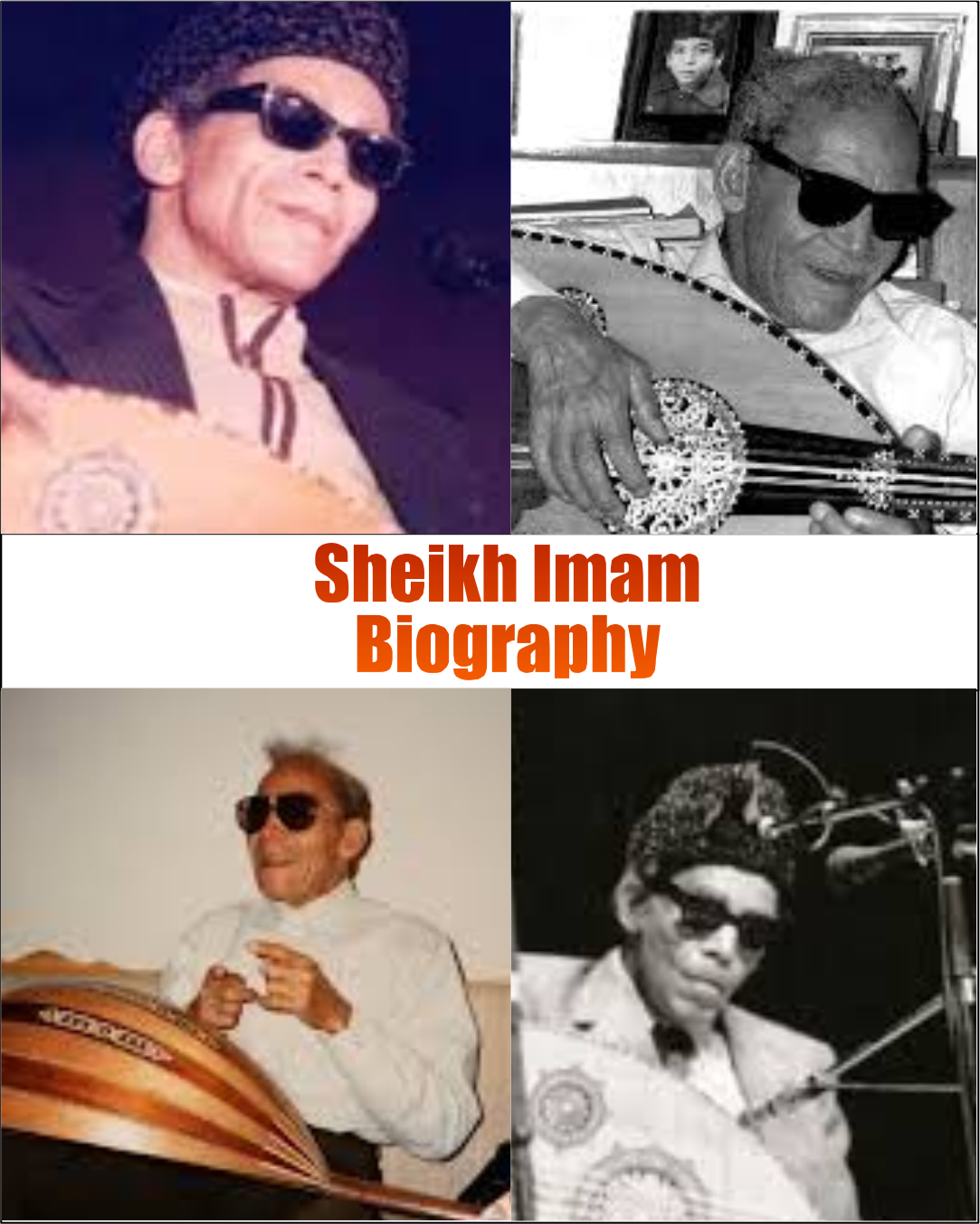
Sheikh Imam Biography
The Sheikh Imam Biography: The Blind Singer Who Mocked Power and Was Heard by Millions.
Explore the life of Sheikh Imam, the Egyptian musician whose politically charged songs, never officially recorded, spread across generations and challenged authority.
The Voice That Power Could Not Record
There are artists whose work is preserved in studios, archived in catalogs, and distributed through official channels.
And then there are those whose voices travel differently—carried not by institutions, but by people.
Sheikh Imam belonged to the latter.
His songs were rarely recorded in any formal sense. They were not promoted by radio stations or protected by record labels. In fact, the state did everything it could to suppress them.
And yet, they spread.
From memory to memory. From voice to voice. Across cafés, streets, and gatherings. His lyrics—sharp, satirical, and unapologetically critical—found their way into the minds of millions.
He did not need distribution.
He had listeners.
Sheikh Imam Biography
| Information | Details |
|---|---|
| Full Name | Imam Muhammad Ahmad Eissa |
| Stage Name | Sheikh Imam |
| Date of Birth | July 2, 1918 |
| Date of Death | June 6, 1995 |
| Age at Death | 76 years |
| Place of Birth | Giza, Egypt |
| Nationality | Egyptian |
| Occupation | Singer, Composer |
| Known For | Political protest songs and collaboration with Ahmed Fouad Negm |
A Childhood Without Sight, But Not Without Vision
Sheikh Imam was born in 1918 in a rural village in Egypt.
He lost his sight at a young age, a condition that would shape his life in profound ways. In a society where opportunities for the blind were limited, his path might have been confined.
But music offered an opening.
He moved to Cairo, where he studied at Al-Azhar and immersed himself in religious and classical Arabic music. He learned to play the oud, developing a style that was both traditional and deeply personal.
His blindness did not limit him.
If anything, it sharpened his connection to sound.
See also: Pastor Tunde Bakare Biography: The Muslim Boy Who Became a Christian Prophet
Meeting the Poet Who Changed Everything
For years, Sheikh Imam performed in modest settings—small gatherings, local events, intimate spaces.
Then he met Ahmed Fouad Negm.
It was a turning point.
Negm was a poet known for his bold, colloquial language and his willingness to challenge authority. Together, they formed a partnership that would redefine political music in Egypt.
Negm wrote the words.
Imam gave them voice.
And what they created was unlike anything around them.
Songs That Refused to Be Safe
Their music did not hide behind metaphor or subtlety.
It was direct.
Sharp.
Often humorous—but with an edge that made its targets clear.
They sang about poverty, corruption, political hypocrisy, and the struggles of ordinary people. They mocked leaders, questioned decisions, and exposed contradictions.
This was not music designed for comfort.
It was music designed to provoke.
A Government That Listened—And Reacted
In a country where political expression was tightly controlled, Imam and Negm’s work did not go unnoticed.
Authorities saw them as a threat.
Their songs were banned. Their performances restricted. Their names monitored.
But suppression did not stop them.
It escalated.
Prison as a Repeated Reality
Sheikh Imam and Ahmed Fouad Negm were arrested multiple times.
Prison became a recurring chapter in their lives.
But even there, the music continued.
They wrote. They composed. They shared their work with fellow prisoners, who carried the songs beyond prison walls once released.
In this way, imprisonment did not silence them.
It extended their reach.
The Power of Memory Over Media
Because their songs were rarely officially recorded, they spread through oral tradition.
Listeners memorized lyrics. Performers recreated melodies. The music lived not in physical formats, but in collective memory.
This gave it a unique resilience.
You could confiscate records.
You could shut down studios.
But you could not erase what people remembered.
A Voice That Represented the Street
Sheikh Imam’s music resonated deeply with ordinary Egyptians.
He did not sing in formal, classical Arabic alone. His delivery carried the rhythms of everyday speech, making his songs accessible and relatable.
People saw themselves in his work.
Their frustrations. Their struggles. Their humor.
He was not speaking for them from a distance.
He was one of them.
Humor as a Weapon
One of the most striking elements of Imam’s work was his use of humor.
His songs often carried a satirical tone—mocking authority in ways that were both entertaining and cutting.
Laughter became a form of resistance.
It allowed people to confront power without direct confrontation, to express dissent in a way that felt both safe and subversive.
Imam understood this balance.
And he used it effectively.
Influence Beyond Borders
While rooted in Egypt, Sheikh Imam’s influence extended across the Arab world.
His songs were shared, adapted, and performed in different contexts, resonating with audiences facing similar political realities.
He became a symbol—not just of Egyptian resistance, but of a broader cultural movement that used art as a tool for critique.
Recognition Without Official Approval
Unlike many artists who receive recognition through formal institutions, Imam’s legacy grew outside official structures.
He was celebrated by the public, by intellectuals, by fellow artists—but rarely acknowledged by the state.
This absence of official endorsement did not diminish his impact.
If anything, it reinforced his authenticity.
Later Years, Lasting Impact
In his later years, Sheikh Imam continued to perform and compose, though the intensity of his earlier confrontations with authority had shifted.
The political landscape evolved, but the relevance of his work remained.
New generations discovered his songs—sometimes through recordings that had finally surfaced, sometimes through performances that kept the tradition alive.
The End of a Voice, Not Its Echo
Sheikh Imam passed away in 1995.
But his voice did not disappear.
It remained—in recordings, in memories, in the continued performance of his songs.
His work had never depended on a single medium.
It lived in people.
A Legacy Carried by Memory
What makes Sheikh Imam’s story unique is not just what he created, but how it survived.
In a world increasingly dependent on documentation, his music thrived without it.
It moved through human connection.
Through shared experience.
Through the simple act of listening and remembering.
The Sound of Defiance
Sheikh Imam did not have the resources of major artists.
He did not have institutional support.
What he had was clarity.
A clear understanding of what he wanted to say—and the courage to say it.
Closing Reflection
Some artists rely on systems to carry their work.
Sheikh Imam relied on people.
He sang truths that could not be officially recorded, but could not be forgotten. He used humor to challenge power, and music to connect with those who felt unheard.
And in doing so, he created something that outlasted suppression.
Not just songs.
But a voice that refused to disappear.
Frequently Asked Questions
1. Who is Sheikh Imam?
Sheikh Imam was an Egyptian singer and composer known for his powerful political songs that spoke against injustice, oppression, and corruption.
2. Why is Sheikh Imam famous?
He became famous for using music as a tool of resistance, especially through his collaborations with poet Ahmed Fouad Negm.
3. What type of music did Sheikh Imam perform?
He performed political and protest music, often accompanied by simple instrumentation like the oud, focusing on strong lyrical messages.
4. Did Sheikh Imam face political persecution?
Yes — due to his outspoken songs, he was imprisoned multiple times by Egyptian authorities during different political regimes.
5. What is Sheikh Imam’s legacy?
He is remembered as a voice of the people, whose music inspired political awareness and resistance movements across the Arab world.