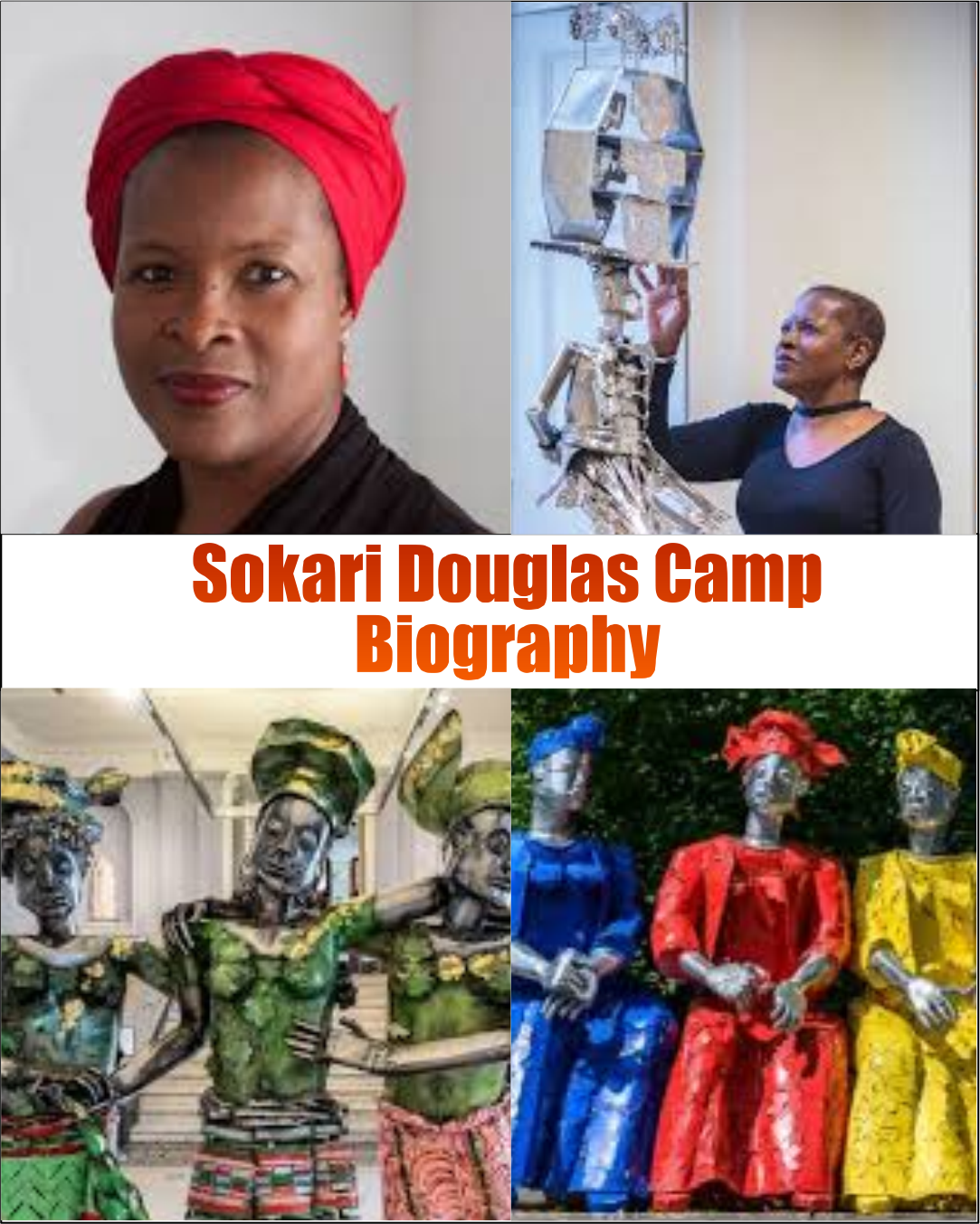
Sokari Douglas Camp Biography
The Sokari Douglas Camp Biography: Sculpting Steel, Identity, and the Niger Delta Story
Discover the life of Sokari Douglas Camp, the Nigerian sculptor who uses steel to explore identity, oil politics, and the cultural memory of the Niger Delta.
The Artist Who Forged Identity Out of Steel
Some artists carve.
Others mold.
Sokari Douglas Camp welds.
She takes cold, industrial steel—rigid, unyielding—and transforms it into figures that carry memory, culture, and resistance.
At first glance, her sculptures feel solid.
Permanent.
But look closer, and there is movement.
Gesture.
Emotion.
Because beneath the metal lies something deeply human.
Sokari Douglas Camp Biography
| Information | Details |
|---|---|
| Full Name | Sokari Douglas Camp |
| Date of Birth | 1958 |
| Age | ~68 years (as of 2026) |
| Place of Birth | Buguma, Rivers State, Nigeria |
| Nationality | Nigerian |
| Occupation | Sculptor, Installation Artist |
| Base | United Kingdom |
| Known For | Steel sculptures exploring Kalabari culture |
| Themes | Identity, heritage, environment, Niger Delta issues |
A Childhood Rooted in Culture
Sokari Douglas Camp was born in 1958 in Buguma, in the Niger Delta region of Nigeria.
Her early life was shaped by the traditions of the Kalabari people—a culture rich in masquerades, ceremonies, and symbolic performance.
These traditions were not distant.
They were lived.
Festivals, costumes, and ritual performances formed part of her visual memory long before she began formal artistic training.
A Journey Beyond Home
Douglas Camp later moved to the United Kingdom to study art, attending institutions such as the Central School of Art and Design and the Royal College of Art in London.
This transition introduced her to new materials and techniques.
It also placed her in a different cultural context—one where African identity was often misunderstood or simplified.
Rather than adapt to expectations, she held onto her roots.
And she found a medium that could carry them.
See also: Mahmoud Ahmed Biography: The Voice Rediscovered That Redefined Ethiopian Music
A Signature Technique Built on Steel
Douglas Camp is best known for her use of steel.
Not as an industrial material alone.
But as a storytelling tool.
She cuts, bends, and welds metal into intricate forms—often life-sized or larger.
Her sculptures frequently depict:
- Human figures
- Costumes inspired by Kalabari traditions
- Masks and ceremonial elements
Despite the hardness of the material, her work conveys fluidity.
Movement appears within structure.
Most Famous Works That Carry Cultural Memory
Some of her most recognized works include:
- All the World is Now Richer
- Battle Bus: Living Memorial
- Church Ede
These pieces vary in form and scale, but they share a common thread.
They engage with history.
With identity.
With collective experience.
Battle Bus, for example, serves as a memorial to conflict in the Niger Delta, combining sculpture with narrative.
Inspiration Rooted in the Niger Delta
Douglas Camp’s work draws heavily from her cultural background.
The Niger Delta—rich in oil, but marked by environmental and political challenges—plays a central role in her themes.
She explores:
- Cultural identity
- Resource exploitation
- Community memory
- Ritual and performance
Her sculptures are not abstract representations.
They are grounded in lived realities.
Hidden Meanings in Form and Structure
At first glance, her work can appear decorative—figures adorned with detailed patterns, elaborate costumes, and striking forms.
But beneath this visual richness lies meaning.
The costumes reference tradition.
The materials reference industry.
The combination creates tension.
Her work often reflects the contrast between cultural heritage and modern disruption.
Between continuity and change.
Struggles of Position and Perception
Douglas Camp’s journey has not been without challenges.
Working between Nigeria and the UK, she navigated spaces where African art was often framed through narrow lenses.
There were expectations.
To represent culture in specific ways.
To fit into predefined categories.
She resisted this.
Her work does not conform.
It exists on its own terms.
Influence on Contemporary Sculpture
Douglas Camp has played a significant role in expanding the possibilities of sculpture.
She demonstrated that:
- Industrial materials can carry cultural meaning
- Traditional themes can exist within contemporary forms
- Sculpture can function as both art and narrative
Her influence can be seen in artists who now explore similar intersections
Controversy and Interpretation
Her work has sparked conversation, particularly around themes of oil politics and environmental impact in the Niger Delta.
Some viewers interpret her pieces as direct political statements.
Others see them as cultural reflections.
This duality creates space for interpretation.
Her work does not dictate meaning.
It invites it.
Recognition Across Borders
Douglas Camp’s work has been exhibited internationally, with pieces shown in major galleries and public spaces.
She has received numerous awards, including an OBE (Order of the British Empire), recognizing her contribution to art.
Her sculptures are held in significant collections, both in Africa and globally.
Recognition came steadily.
And it continues.
The Value of Her Artworks
Douglas Camp’s sculptures are highly valued within the contemporary art market.
Their scale, material, and narrative depth contribute to their significance.
Collectors and institutions recognize not only their aesthetic impact, but their cultural importance.
Her works are not easily replicated.
Each piece carries a distinct presence.
A Legacy Forged in Steel
Douglas Camp’s legacy lies in transformation.
She takes a material associated with industry and reshapes it into something cultural, expressive, and meaningful.
She bridges worlds:
- Tradition and modernity
- Africa and the diaspora
- Art and narrative
Still Creating, Still Evolving
Douglas Camp continues to produce work, exploring new ideas while remaining connected to her roots.
Her sculptures evolve, but their core remains.
Identity.
Memory.
Expression.
The Strength of Her Medium
Steel does not bend easily.
It resists.
And yet, in her hands, it transforms.
This transformation reflects something larger.
The ability to adapt.
To reshape.
To endure.
Closing Reflection
Some artists work with fragile materials.
Sokari Douglas Camp works with steel.
But her art is not about hardness.
It is about what lies beneath it.
Culture.
Memory.
Identity.
She takes something rigid and makes it speak.
And in that process, she creates more than sculpture.
She creates presence.
Solid. Lasting. Unmistakable.
Frequently Asked Questions
1. Who is Sokari Douglas Camp?
Sokari Douglas Camp is a Nigerian-born sculptor known for her large-scale steel installations that explore African identity and cultural heritage.
2. Why is Sokari Douglas Camp famous?
She is recognized for transforming industrial materials like steel into expressive artworks that reflect Kalabari traditions and contemporary issues.
3. What themes does Sokari Douglas Camp explore?
Her work addresses cultural identity, colonial history, environmental concerns, and the Niger Delta experience.
4. What makes her art unique?
Her sculptures combine traditional African motifs with modern industrial materials, creating a distinctive visual language.
5. What is Sokari Douglas Camp’s legacy?
Her legacy lies in preserving African cultural narratives while pushing the boundaries of contemporary sculpture on a global scale.