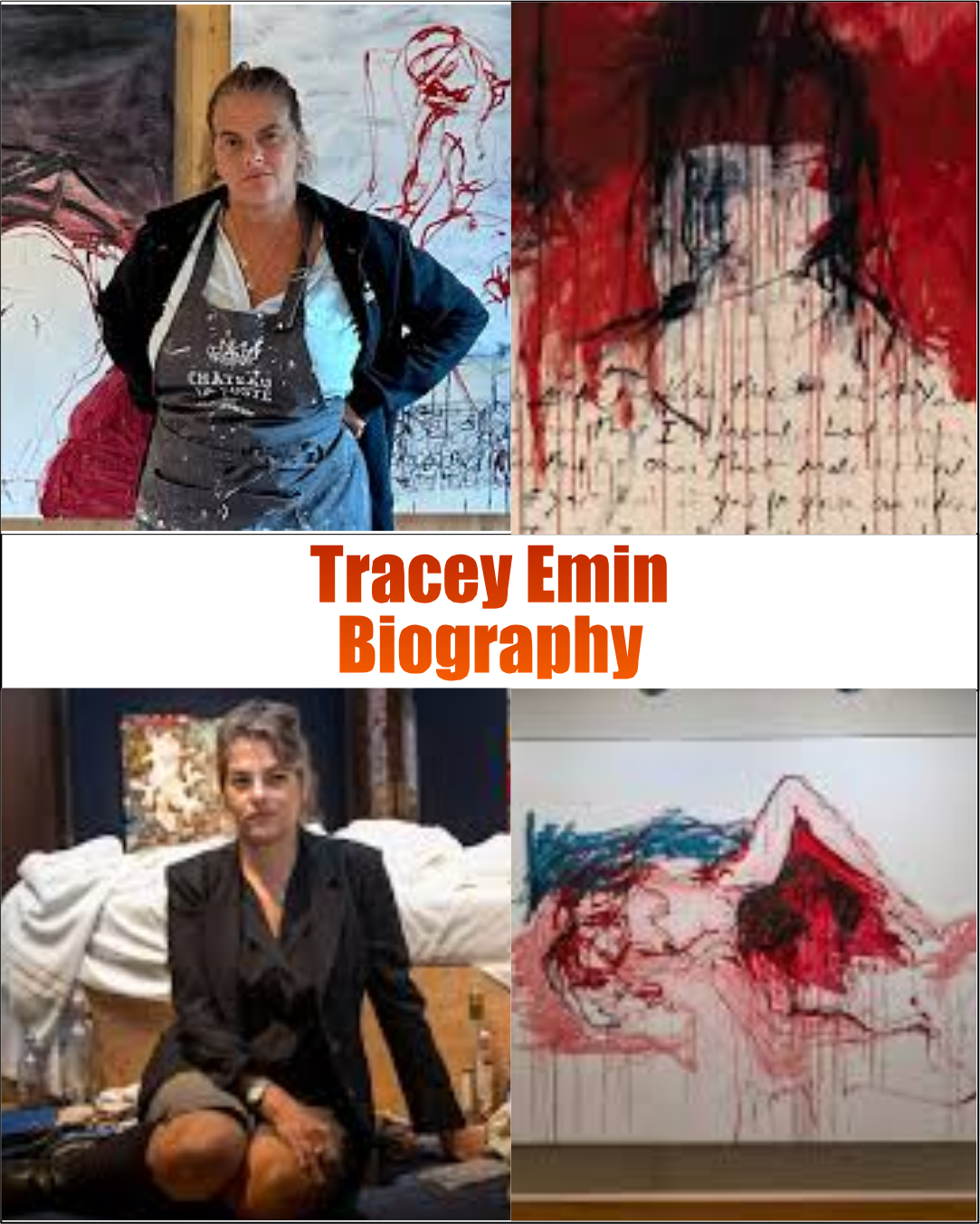
Tracey Emin Biography
The Tracey Emin Biography: Turning Pain, Memory, and Confession Into Art
Discover the life of Tracey Emin, the British artist whose deeply personal works transformed vulnerability, trauma, and identity into powerful contemporary art.
The Artist Who Made Her Life the Artwork
Some artists create distance between themselves and their work.
Tracey Emin removes it completely.
There is no separation.
No disguise.
Her art is her life—unfiltered, exposed, and often uncomfortable.
She does not tell stories from a distance.
She places you inside them.
Tracey Emin Biography
| Information | Details |
|---|---|
| Full Name | Tracey Karima Emin |
| Date of Birth | July 3, 1963 |
| Age | 63 years (as of 2026) |
| Place of Birth | Croydon, London, United Kingdom |
| Nationality | British |
| Occupation | Artist, Writer |
| Art Movement | Young British Artists |
| Known For | Confessional, autobiographical art |
| Famous Work | My Bed |
A Childhood Marked by Instability
Tracey Emin was born in 1963 in London and raised in Margate, England.
Her early life was shaped by instability—financial hardship, family struggles, and experiences that would later become central to her work.
These were not distant memories.
They were formative.
They shaped how she saw herself.
And how she would later choose to express that self.
From Silence to Expression
For a long time, Emin carried her experiences privately.
But when she entered art school, something shifted.
She began to use art not as decoration, but as release.
As confrontation.
As a way of making visible what is often hidden.
A Signature Style Built on Confession
Emin’s work spans multiple mediums:
- Installation
- Drawing
- Neon text
- Sculpture
But what defines it is not material.
It is honesty.
Her pieces often include:
- Personal objects
- Handwritten text
- References to specific moments in her life
Nothing is abstracted.
Everything is direct.
Most Famous Works That Redefined Personal Art
Among Emin’s most recognized works are:
- My Bed
- Everyone I Have Ever Slept With 1963–1995
- You Forgot to Kiss My Soul
My Bed presents her own unmade bed—surrounded by personal items, reflecting a period of emotional difficulty.
It is not staged.
It is presented as it was.
This work became one of the most discussed pieces of contemporary art.
Inspiration Rooted in Personal Experience
Emin does not look outward for inspiration.
She looks inward.
Her work draws from:
- Relationships
- Trauma
- Memory
- Identity
She transforms lived experience into artistic form.
Nothing is invented.
Everything is felt.
See also: Ben Enwonwu Biography: The Nigerian Master Behind Tutu and the Rise of Modern African Art
Hidden Meanings in Raw Presentation
At first glance, Emin’s work can appear simple—even confrontational.
An unmade bed.
A handwritten phrase.
But within this simplicity lies depth.
The objects are not random.
They are evidence.
Markers of specific moments.
Her work invites viewers to confront not just her experiences, but their own reactions to them.
Struggles of Exposure and Judgment
Emin’s openness has not been without consequence.
Her work has been widely criticized—sometimes dismissed as too personal, too raw, or not “art” in the traditional sense.
She has faced:
- Public scrutiny
- Media attention
- Misinterpretation
But she has remained consistent.
She does not soften her work for acceptance.
Influence on Contemporary Art
Emin played a key role in shifting contemporary art toward personal narrative.
She demonstrated that:
- Vulnerability can be a form of strength
- Personal experience can hold universal meaning
- Art does not need to be detached to be significant
Her influence is visible in artists who now explore identity and emotion more openly.
Controversy and Debate
Emin’s work has sparked ongoing debate.
Some view it as deeply powerful.
Others question its artistic value, arguing that it relies too heavily on personal exposure.
There are also broader discussions about gender—how confessional work by female artists is received compared to male counterparts.
These conversations remain central to her legacy.
Recognition and Institutional Acceptance
Despite early criticism, Emin has received significant recognition.
Her work has been exhibited in major institutions, including:
- The Tate Britain
- The Royal Academy
She has received numerous honors and continues to be a prominent figure in contemporary art.
What was once controversial is now widely studied and collected.
The Value of Her Artworks
Emin’s works have achieved substantial value in the art market.
Pieces like My Bed have sold for significant sums, reflecting both cultural impact and demand.
Collectors recognize the importance of her contribution to contemporary art.
A Legacy of Honesty
Emin’s legacy is rooted in honesty.
She changed how personal experience is viewed within art.
She removed the expectation of distance.
And replaced it with presence.
Still Creating, Still Revealing
Emin continues to produce work, exploring new forms while maintaining her core approach.
Her recent works often reflect on time, memory, and mortality.
Her voice remains consistent.
Direct.
Unfiltered.
The Power of Vulnerability
What makes Emin’s work powerful is its willingness to reveal.
To show what is often hidden.
To speak what is often unspoken.
This vulnerability creates connection.
Closing Reflection
Some artists hide behind their work.
Tracey Emin steps through it.
She invites viewers into moments that are deeply personal—sometimes uncomfortable, always real.
And in doing so, she changes something fundamental.
She shows that art does not need to be distant to be meaningful.
Sometimes, the closer it gets—
the more powerful it becomes.
Frequently Asked Questions
1. Who is Tracey Emin?
Tracey Emin is a British contemporary artist known for her deeply personal and autobiographical artworks.
2. Why is Tracey Emin famous?
She became famous as part of the Young British Artists and for her bold, confessional style.
3. What is My Bed?
My Bed is one of her most famous works, featuring her own unmade bed surrounded by personal items, symbolizing emotional vulnerability and real-life experiences.
4. What themes does Tracey Emin explore?
Her work explores love, trauma, sexuality, identity, and personal struggle.
5. What is Tracey Emin’s legacy?
Her legacy lies in redefining contemporary art through honesty, vulnerability, and the use of personal life as artistic material.