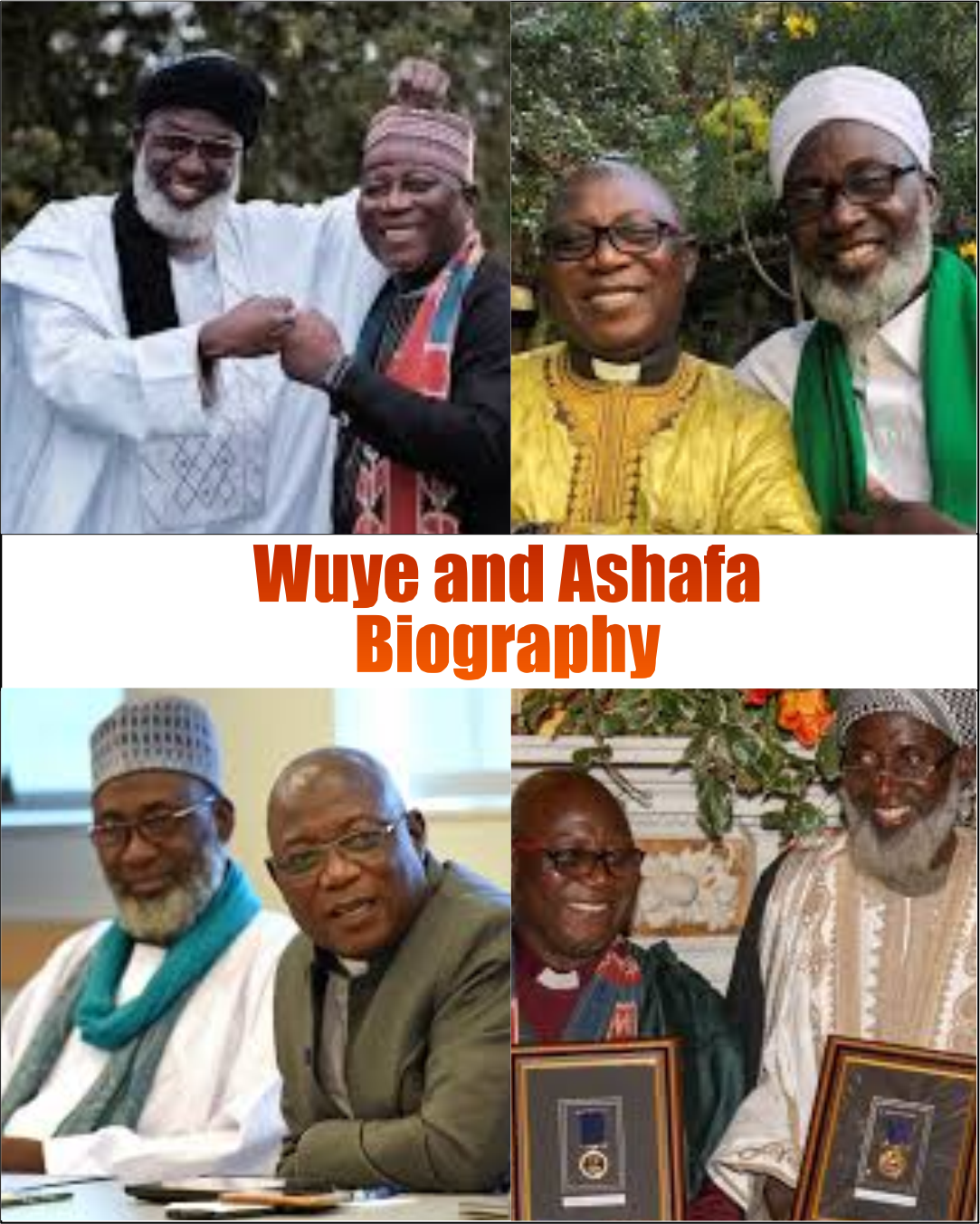
Wuye and Ashafa Biography
The Wuye and Ashafa Biography: The Remarkable Story of Enemies to Peacemakers.
Discover the powerful true story of James Wuye and Muhammad Ashafa—once enemies in violent conflict, now global icons of peace and interfaith unity.
In a world often divided by religion, tribe, and ideology, few stories challenge the narrative of conflict like that of James Wuye and Muhammad Ashafa. Their journey is not just inspiring—it is deeply human, raw, and transformative.
Once sworn enemies on opposite sides of violent religious clashes in Kaduna, Nigeria, they have become global symbols of reconciliation, proving that peace is not just possible—it is powerful.
This is not a simple story of friendship. It is a story of pain, loss, confrontation, and ultimately, healing.
Wuye and Ashafa Biography
| Information | Details |
|---|---|
| Full Names | James Movel Wuye & Muhammad Nurayn Ashafa |
| Popular Name | Wuye–Ashafa Interfaith Duo |
| Date of Birth | Wuye (1959), Ashafa (1956) |
| Place of Birth | Kaduna State, Nigeria |
| Nationality | Nigerian |
| Religious Background | Wuye (Christian Pastor), Ashafa (Muslim Imam) |
| Occupation | Peacebuilders, Religious Leaders |
| Known For | Interfaith dialogue and conflict resolution |
| Organization Founded | Interfaith Mediation Centre |
Early Spiritual Journey
Both men were deeply shaped by faith from an early age—but in very different ways.
James Wuye grew up in a Christian household and developed a strong commitment to his beliefs. His spiritual path led him into ministry, where he became actively involved in defending his faith—sometimes aggressively.
Muhammad Ashafa, on the other hand, was raised in a devout Muslim family. His upbringing instilled discipline, religious devotion, and a strong sense of identity tied to Islam.
Their early journeys shared one similarity: deep conviction.
But conviction, when mixed with tension and misinformation, can easily turn into division.
And that is exactly what happened.
See also: Fela Kuti Biography: The Rebel Who Turned Music into a Weapon Against Power
The Turning Point: Conflict and “Calling” Through Pain
The Kaduna religious crises of the 1990s became the battlefield where both men stood on opposing sides.
Wuye led a Christian youth militia.
Ashafa led a Muslim youth group.
What began as defense of faith escalated into violent confrontation.
During this period:
- Wuye lost his right arm in the violence
- Ashafa lost close family members and friends
These were not abstract losses. They were deeply personal scars.
For years, both men carried anger, grief, and a desire for revenge.
But then came a turning point—one that neither expected.
Through separate but parallel experiences, both men began to feel a spiritual conviction that their path needed to change. This wasn’t a dramatic “light from heaven” moment, but a gradual realization:
Violence was not protecting their faith—it was destroying it.
That realization became their true calling.
Teachings and Doctrines
After reconciling (a process that itself took time and mediation), Wuye and Ashafa began to develop a shared message rooted in both Christianity and Islam.
Their teachings emphasize:
- Peace as a divine mandate
- Understanding over ignorance
- Dialogue over violence
- Shared humanity above religious differences
They do not dilute their individual beliefs. Instead, they highlight common ethical foundations:
- Love
- Compassion
- Justice
- Forgiveness
Their doctrine is not about merging religions—it is about coexistence with respect.
Controversies and Criticisms
Their work, while widely praised, has not been without criticism.
Some critics—especially from hardline religious factions—have accused them of:
- Being too “soft” on opposing faiths
- Compromising religious purity
- Engaging with individuals seen as adversaries
Others question the practicality of dialogue in the face of extreme violence.
There are also concerns from skeptics who believe:
- Dialogue alone cannot solve deep-rooted political and economic conflicts
- Their model may not be easily scalable in all conflict zones
Despite these criticisms, Wuye and Ashafa have remained consistent in their approach.
Their response is simple:
Peace is not weakness—it is strategy.
Growth of Their Ministry and Work
What began as a personal reconciliation evolved into a structured movement.
They co-founded the Interfaith Mediation Centre (IMC) in Kaduna, Nigeria.
Through this platform, they have:
- Mediated conflicts between communities
- Trained religious leaders in peacebuilding
- Organized interfaith dialogues
- Worked with governments and NGOs
Their work has expanded beyond Nigeria into:
- Other African countries
- Europe
- The United States
They have also collaborated with international organizations focused on conflict resolution and religious tolerance.
Influence on Followers
Their influence operates on multiple levels:
Grassroots Impact
At the community level, they have:
- Reduced tensions in conflict-prone areas
- Helped prevent retaliatory violence
- Encouraged cooperation between religious groups
Religious Leadership Influence
They have trained pastors and imams to:
- Preach peace
- Avoid inflammatory rhetoric
- Promote unity within diversity
Global Inspiration
Their story has been used in:
- Academic research
- Peacebuilding case studies
- International conferences
For many, they are living proof that transformation is possible—even after deep conflict.
Lifestyle and Wealth Discussions
Unlike many high-profile religious figures, Wuye and Ashafa maintain relatively modest public lifestyles.
Their work is primarily supported through:
- NGO funding
- Partnerships
- International grants
There is no widely verified evidence of extravagant wealth or luxury associated with them.
Their credibility largely stems from:
- Consistency in message
- Personal sacrifice
- Focus on mission over materialism
This simplicity reinforces their authenticity.
Legacy and Global Reach
Wuye and Ashafa are no longer just local figures—they are global symbols.
Their legacy includes:
- A model for interfaith reconciliation
- A framework for community-level peacebuilding
- A powerful narrative of forgiveness and transformation
They have received international recognition, including peace awards and invitations to speak on global platforms.
Their story has also been documented in films and case studies used worldwide.
Impact on Society and Morality
Perhaps their greatest contribution lies in shifting how people think about conflict.
They challenge deeply rooted assumptions:
- That enemies cannot become allies
- That religion must divide
- That violence is inevitable
Instead, they promote a moral framework based on:
- Responsibility
- Empathy
- Dialogue
- Courage
- Their work has helped communities move from:
- fear to understanding
- hatred to cooperation
- violence to peace
Conclusion
The story of Wuye and Ashafa is not just about religion. It is about humanity.
It is about what happens when individuals choose:
- Healing over hatred
- Dialogue over destruction
- Unity over division
Their journey reminds us that peace is not passive—it is active, intentional, and often difficult.
But as their lives show, it is always worth it.
Frequently Asked Questions
1. Who are Wuye and Ashafa?
James Wuye and Muhammad Ashafa are Nigerian religious leaders — a Christian pastor and a Muslim imam — who transformed from former enemies into global symbols of peace and interfaith cooperation.
2. Why are Wuye–Ashafa famous?
They are famous for their remarkable reconciliation story after participating in religious violence, and for promoting peace through interfaith dialogue.
3. What is the Interfaith Mediation Centre?
The Interfaith Mediation Centre is an organization they co-founded to promote peace, conflict resolution, and religious tolerance in Nigeria and beyond.
4. Did Wuye and Ashafa ever have conflict?
Yes — they were once on opposite sides of violent religious clashes in Kaduna, making their eventual friendship and collaboration even more powerful.
5. What impact have Wuye–Ashafa made?
Their work has influenced peacebuilding efforts globally, earning them international recognition and serving as a model for resolving religious conflicts.