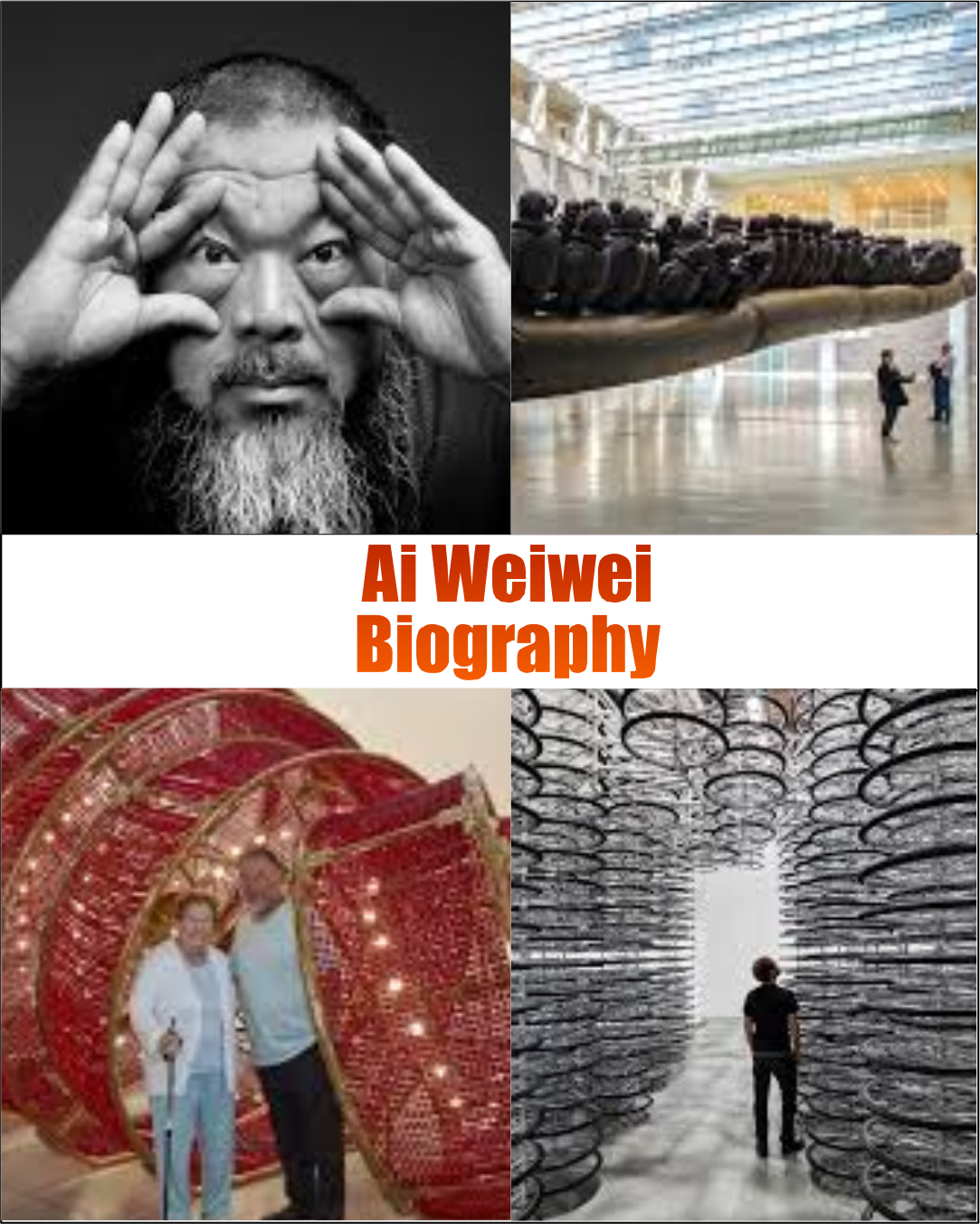
Ai Weiwei Biography
The Ai Weiwei Biography: The Artist Who Turned Dissent Into Global Art
Discover the life of Ai Weiwei, the Chinese artist and activist whose bold works challenge authority, censorship, and human rights.
The Artist Who Refused to Stay Silent
Some artists avoid politics.
Others confront it carefully.
Ai Weiwei walks directly into it.
Not as commentary from a distance.
But as confrontation.
His work does not separate art from reality. It collapses the space between them—turning exhibitions into statements, objects into questions, and silence into something impossible.
Because for him, art is not neutral.
It is a position.
Ai Weiwei Biography
| Information | Details |
|---|---|
| Full Name | Ai Weiwei |
| Date of Birth | August 28, 1957 |
| Age | 69 years (as of 2026) |
| Place of Birth | Beijing, China |
| Nationality | Chinese |
| Occupation | Artist, Activist, Filmmaker |
| Known For | Politically charged art and human rights activism |
| Art Style | Conceptual art, installation, documentary film |
| Notable Experience | Detained by Chinese authorities in 2011 |
A Childhood Marked by Exile
Ai Weiwei was born in 1957 in Beijing, China, into a family already marked by political tension.
His father, Ai Qing, was a poet who fell out of favor with the government and was exiled during the Anti-Rightist Campaign.
As a child, Ai Weiwei lived in remote regions under harsh conditions—far from the cultural centers of the country.
This early experience shaped his understanding of authority, control, and displacement.
It also introduced him to the consequences of speaking out.
Finding His Voice Beyond Borders
In the 1980s, Ai Weiwei moved to the United States, spending time in New York.
There, he was exposed to Western contemporary art, including conceptual and performance-based practices.
He absorbed influences from artists who challenged norms—who used art not just to create, but to question.
When he eventually returned to China, he carried these ideas with him.
But he applied them within a very different context.
See also: Fela Kuti Biography: The Rebel Who Turned Music into a Weapon Against Power
A Signature Style Built on Concept and Provocation
Ai Weiwei’s work does not belong to a single medium.
He works across:
- Sculpture
- Installation
- Photography
- Film
What connects these forms is intention.
He often uses everyday objects—recontextualizing them to reveal deeper meanings.
A chair becomes history.
A seed becomes mass production.
A structure becomes memory.
His work is not about aesthetics alone.
It is about what lies beneath.
Most Famous Works That Challenged Systems
Among Ai Weiwei’s most recognized works are:
- Sunflower Seeds
- Dropping a Han Dynasty Urn
- Remembering
Sunflower Seeds consists of millions of hand-painted porcelain seeds, filling large exhibition spaces.
At first glance, it appears simple.
But it speaks to mass production, individuality, and collective identity.
Dropping a Han Dynasty Urn documents the artist intentionally destroying a historical object—raising questions about value, preservation, and cultural authority.
Inspiration Rooted in Justice and Memory
Ai Weiwei’s work is driven by a clear set of concerns:
- Human rights
- Freedom of expression
- Government accountability
One of his most powerful projects, Remembering, was created in response to the 2008 Sichuan earthquake.
Using thousands of backpacks, he formed a sentence commemorating children who died due to poorly constructed schools.
This was not just art.
It was testimony.
Hidden Meanings in Everyday Objects
Ai Weiwei often uses familiar materials.
But within them, he embeds meaning.
The repetition of objects suggests systems.
The scale suggests impact.
The context transforms interpretation.
His work invites viewers to reconsider what they see—not just as objects, but as symbols of larger structures.
Struggles Under Surveillance and Control
Ai Weiwei’s outspokenness came with consequences.
He faced:
- Government surveillance
- Detention
- Restrictions on movement
In 2011, he was detained by Chinese authorities for 81 days.
The reasons were not fully transparent.
But the message was clear.
His work had crossed a line.
Creating Under Constraint
Despite these challenges, Ai Weiwei continued to create.
Even under surveillance, he found ways to document, to express, to communicate.
His work became more than artistic.
It became an act of persistence.
A refusal to be silenced.
Influence on Global Contemporary Art
Ai Weiwei’s impact extends beyond his own work.
He has influenced how artists engage with politics and activism.
He demonstrated that:
- Art can challenge authority
- Creativity can exist under restriction
- Visibility can be a form of resistance
His approach reshaped expectations of what contemporary art can do.
Controversy and Debate
Ai Weiwei’s work is often controversial.
Some view his actions—such as destroying historical objects—as provocative or disrespectful.
Others see them as necessary disruptions.
There are also debates about the balance between art and activism—whether his work is more political than artistic.
These discussions are part of his presence in the art world.
Recognition Across the World
Ai Weiwei has received international recognition, with exhibitions in major institutions worldwide.
His work has been shown in:
- The Tate Modern
- The Royal Academy of Arts
- The Venice Biennale
He has received numerous awards and honors, reflecting both artistic achievement and cultural impact.
The Value of His Artworks
Ai Weiwei’s works are highly valued in the global market.
Large installations, limited editions, and conceptual pieces command significant prices.
But their value is not just financial.
They carry political and cultural weight.
They represent moments of resistance.
A Legacy Built on Defiance
Ai Weiwei’s legacy is defined by defiance.
He does not separate his identity from his work.
He does not adjust his message for acceptance.
He remains consistent.
Still Speaking, Still Creating
Ai Weiwei continues to produce work, often addressing global issues such as migration and displacement.
His focus has expanded.
But his approach remains the same.
Direct.
Uncompromising.
Visible.
The Power of Visibility
What makes Ai Weiwei’s work powerful is not just what it says.
It is that it exists.
In spaces where silence is expected, his work appears.
And in appearing, it disrupts.
Closing Reflection
Some artists create to be seen.
Ai Weiwei creates so that others cannot look away.
He uses art as a form of presence—a way to document, to question, to resist.
And in doing so, he transforms the role of the artist.
From observer.
To participant.
To witness.
Frequently Asked Questions
1. Who is Ai Weiwei?
Ai Weiwei is a Chinese contemporary artist and activist known for using art as a tool to challenge authority and advocate for human rights.
2. Why is Ai Weiwei famous?
He is famous for his bold political activism and artworks that critique government policies, censorship, and social injustice.
3. What kind of art does Ai Weiwei create?
He works across multiple mediums, including sculpture, installation, photography, and film, often with strong political messages.
4. Was Ai Weiwei ever arrested?
Yes — he was detained by Chinese authorities in 2011, which drew global attention and criticism from human rights organizations.
5. What is Ai Weiwei’s legacy?
His legacy lies in merging art and activism, inspiring artists worldwide to use their platforms for social and political change.