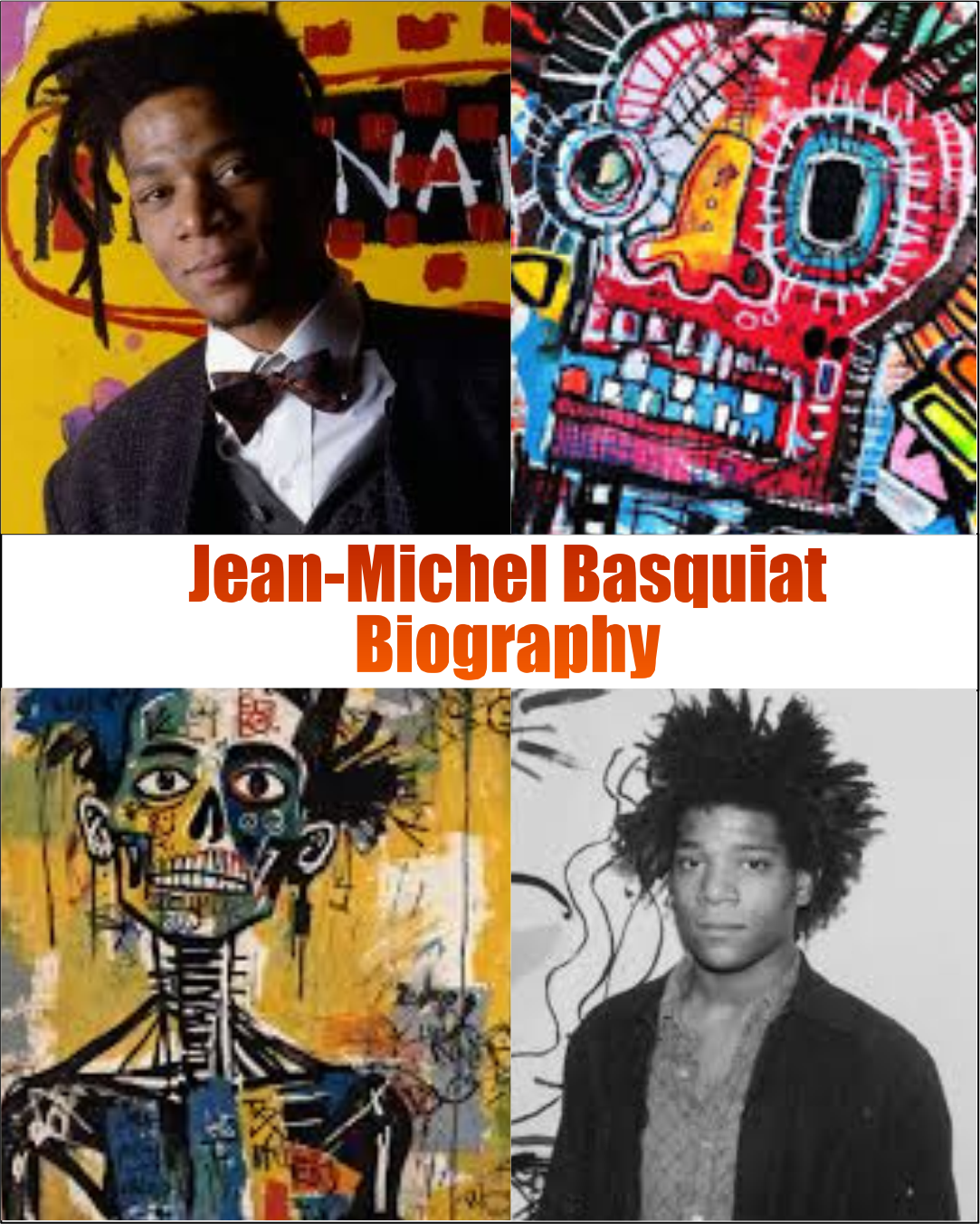
Jean-Michel Basquiat Biography
The Jean-Michel Basquiat Biography: From Street Graffiti to Global Art Icon
Explore the life of Jean-Michel Basquiat, the artist who rose from New York streets to redefine contemporary art with raw, political, and expressive paintings.
The Artist Who Turned the Streets Into a Canvas
Before the galleries, before the auctions, before the headlines – there was a young man writing cryptic messages on the walls of New York City.
Jean-Michel Basquiat did not wait for permission to be seen.
He made himself visible.
Through graffiti.
Through symbols.
Through words that felt fragmented but carried weight.
And from that raw beginning, he would rise—fast, intensely, and without compromise—into one of the most influential artists of his generation.
Jean-Michel Basquiat Biography
| Information | Details |
|---|---|
| Full Name | Jean-Michel Basquiat |
| Date of Birth | December 22, 1960 |
| Date of Death | August 12, 1988 |
| Age at Death | 27 years |
| Place of Birth | Brooklyn, New York, USA |
| Nationality | American |
| Occupation | Painter, Graffiti Artist |
| Known For | Neo-expressionist paintings and SAMO graffiti |
| Art Movement | Neo-expressionism |
A Childhood of Contrasts
Basquiat was born in 1960 in Brooklyn, New York, into a culturally rich but complex environment.
His father was Haitian.
His mother was Puerto Rican.
This dual heritage exposed him to multiple languages, histories, and artistic influences from an early age.
His mother encouraged his creativity, taking him to museums and supporting his interest in art.
But stability was fragile.
Family struggles and personal challenges shaped his early life, creating a tension that would later surface in his work.
See also: Amália Rodrigues Biography: The Voice That Turned Fado into Portugal’s Soul
SAMO: A Voice on the Streets
As a teenager, Basquiat began creating graffiti under the name SAMO (short for “Same Old Shit”).
But this was not typical graffiti.
Instead of tags or images, SAMO consisted of phrases—cryptic, poetic, sometimes confrontational.
Messages like:
- “SAMO as an end to mindwash religion”
- “Plush safe… he think”
These writings appeared across downtown Manhattan, catching attention.
They felt different.
Intentional.
From Street to Studio
Basquiat’s transition from street artist to gallery artist happened quickly.
His work began attracting interest from collectors and curators who recognized something unique in his approach.
He moved into painting on canvas, but he did not abandon his roots.
The energy of the street remained.
The urgency remained.
A Signature Style That Refused Order
Basquiat’s paintings are instantly recognizable.
They are:
- Raw
- Layered
- Fragmented
He combined:
- Text
- Symbols
- Anatomical drawings
- Abstract forms
Words are crossed out, repeated, emphasized.
Figures appear distorted, almost skeletal.
There is no attempt at neatness.
Everything feels immediate.
Most Famous Works That Defined a Generation
Among Basquiat’s most celebrated works are:
- Untitled (1982) featuring a skull-like head
- Hollywood Africans
- Irony of Negro Policeman
These works engage with themes of race, power, identity, and history.
They are not subtle.
But they are not simple either.
Each piece carries layers of meaning.
Inspiration Rooted in Experience and Observation
Basquiat drew inspiration from a wide range of sources:
- African and Caribbean history
- Jazz music
- Anatomy textbooks
- Street culture
He absorbed information constantly, translating it into visual form.
His work reflects a mind that was always processing—always connecting ideas.
Hidden Meanings in Words and Symbols
At first glance, Basquiat’s work can appear chaotic.
But within that chaos is intention.
Words are used not just for meaning, but for emphasis.
Crossed-out text does not erase—it highlights.
Symbols repeat, creating patterns of thought.
References to history, particularly Black history, are embedded throughout his work.
His paintings require reading as much as viewing.
Struggles Behind the Success
Basquiat’s rise was rapid.
But it came with pressure.
The art world embraced him quickly—but not always on equal terms.
He was often seen through the lens of race, labeled, categorized, and sometimes misunderstood.
Fame brought attention.
It also brought expectation.
And with that came strain.
Influence on Art Movements
Basquiat became a central figure in the Neo-Expressionist movement, which emphasized raw emotion and a return to figurative painting.
But his influence goes beyond any single movement.
He bridged:
- Street art and fine art
- Text and image
- Personal narrative and cultural critique
His work opened doors for artists who followed.
Controversy and Criticism
Basquiat’s career was surrounded by debate.
Some critics questioned whether his rapid success was driven by genuine appreciation or market hype.
Others focused on his collaborations, particularly with Andy Warhol, debating influence and authorship.
There were also broader issues of exploitation—how young Black artists were treated within predominantly white art institutions.
These conversations remain part of his legacy.
Recognition During and After His Life
During his lifetime, Basquiat achieved significant recognition.
He exhibited internationally, collaborated with major artists, and became a prominent figure in the art world.
But his life was short.
He passed away in 1988 at the age of 27.
After his death, his recognition only grew.
The Value of His Artworks
Basquiat’s works are among the most valuable in contemporary art.
In 2017, one of his paintings sold for over $100 million, setting a record for an American artist at the time.
Collectors view his work not just as art, but as cultural artifacts—representing a moment, a voice, a shift in the art world.
A Legacy That Continues to Expand
Basquiat’s influence is visible across multiple fields:
- Visual art
- Fashion
- Music
His imagery and style continue to inspire new generations.
His work remains relevant, not as history, but as ongoing conversation.
The Power of Unfiltered Expression
What makes Basquiat’s work enduring is its honesty.
It does not attempt to refine or simplify.
It presents thought as it occurs—fragmented, layered, intense.
This rawness is its strength.
Closing Reflection
Some artists wait for recognition.
Jean-Michel Basquiat created as if recognition did not matter.
He painted quickly.
Urgently.
As if time was limited.
And in that urgency, he captured something rare.
A voice that could not be contained.
A vision that refused structure.
A presence that continues to resonate.
Long after the walls he first painted on have disappeared.
Frequently Asked Questions
1. Who is Jean-Michel Basquiat?
Jean-Michel Basquiat was an American artist who rose from the streets of New York as a graffiti artist to become one of the most influential figures in contemporary art.
2. Why is Jean-Michel Basquiat famous?
He became famous for his raw, expressive paintings that combined text, symbols, and imagery to address race, identity, and power.
3. What is SAMO?
SAMO (Same Old Sh*t) was the graffiti tag Basquiat used in his early career, which gained attention across New York City.
4. What themes did Basquiat explore?
His work explored race, inequality, history, identity, and the Black experience in America.
5. What is Jean-Michel Basquiat’s legacy?
His legacy lies in transforming street art into high art and influencing generations of artists, making him a lasting icon in global contemporary art.